

A schedule contract, formally known as a Multiple Award Schedule (MAS) contract, is a governmentwide agreement issued by the General Services Administration (GSA) that lets qualified commercial vendors sell products and services to federal, state, and local buyers at pre-negotiated prices. Award does not guarantee sales. It opens a door, but you still have to walk through it and knock on agency doors yourself.
Federal agencies purchase more than $39 billion annually through MAS contracts, which tells you the money is real. But the businesses that actually benefit are the ones with a repeatable product or service, at least two years of financial stability, and the staff bandwidth to chase opportunities once the ink dries. If you’re a one-person shop hoping the contract sells itself, hold off.
Here’s a fast gut check before you commit weeks to an application:
- You have a minimum multi-year history of financial statements or a Startup Springboard workaround
- Your pricing is already competitive with what you’d offer your best commercial customer
- Someone on your team can commit real hours to marketing after award, not just during the application
- You have several past-performance references you can document
- You’re prepared to spend several months on the process, not just weeks
If most of those check out, keep reading. If they don’t, fix the gaps first.
Key Takeaways
A Schedule contract opens access to over $39 billion in annual federal purchasing, but award only creates the opportunity to sell, not the sales themselves.
| Point | Details |
|---|---|
| Confirm eligibility first | Verify two years of financials, past performance, and SAM.gov registration, or check Startup Springboard if you’re newer. |
| Complete mandatory training | Pathways to Success and the Readiness Assessment are required gates before eOffer submission. |
| Prepare pricing carefully | Align your commercial price list with your MFC documentation to avoid negotiation delays. |
| Expect 3 to 12 months | Timeline depends on offer completeness and negotiation complexity, not just GSA’s queue. |
| Plan to sell after award | Transactional Data Reporting and active marketing through GSA Advantage! and eBuy start the moment your contract goes live. |
Table of Contents
- Schedule Contract Eligibility and Readiness Requirements
- How Do You Apply for a Schedule Contract?
- What Documents and Templates Do You Need?
- How Long Does It Take to Get a Schedule Contract?
- What Happens After You Win a Schedule Contract?
- Common Mistakes That Delay or Kill a Schedule Offer
- Should You Handle This Yourself or Hire Help?
- What the Process Actually Rewards
- Sources
- FAQ
Schedule Contract Eligibility and Readiness Requirements
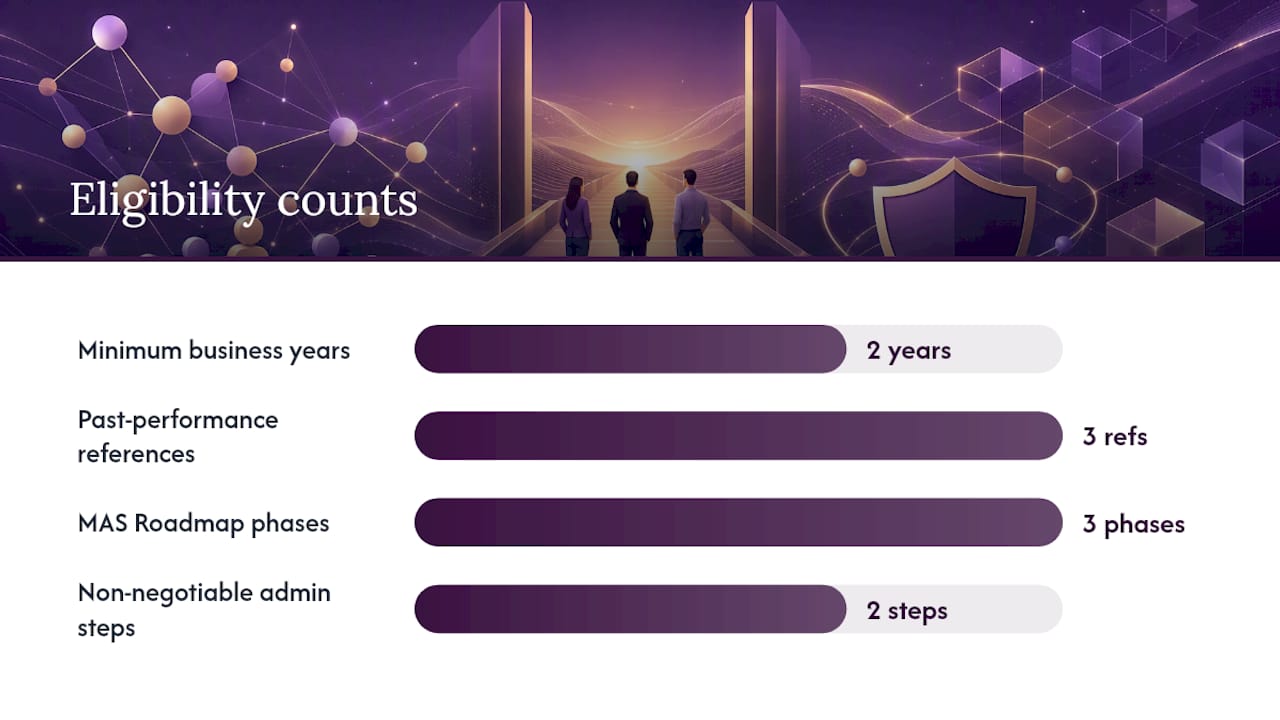
GSA doesn’t hand out Schedule contracts to anyone who fills out a form. The baseline requirement is two years of business operations with financial statements to prove it, plus documented past performance showing you can deliver. You’ll also need an active SAM.gov registration with a current Unique Entity Identifier (UEI) and CAGE code before you submit anything.
Newer companies aren’t automatically shut out. GSA’s Startup Springboard pathway lets businesses under two years old substitute financial backing, like a parent company’s balance sheet or a personal guarantee, for the standard two-year track record. It’s a narrow door, but it exists for founders who have capital and capability without the tenure.
Two administrative steps are non-negotiable, and GSA won’t let you skip either one:
- Complete Pathways to Success training. This GSA-run course walks you through the entire MAS process and requires a formal acknowledgment before you can move forward.
- Pass the Readiness Assessment. Your designated Authorized Negotiator, the person who will speak for your company during negotiations, has to complete this assessment, and it acts as a gate. You cannot submit an offer without it.
Both requirements come straight from the MAS Roadmap, which lays out the process in three phases: Get Ready, Assemble Offer, and Finalize Offer.
Before you touch eOffer, run through this checklist:
- Confirmed legal entity structure (LLC, corporation, etc.)
- Active UEI and CAGE code through SAM.gov
- Two years of financial statements, or your Startup Springboard documentation
- At least three past-performance references, ideally with contact information ready
- Evidence supporting your Most Favored Customer (MFC) pricing, meaning proof of the best price you’ve given a comparable commercial customer
Pro Tip: Pull your past-performance references before you start the application, not after. Contracting officers move faster when they can verify your track record without chasing down a client who’s slow to respond.
If you’re unsure whether your business clears the baseline, a quick eligibility review can save you from sinking months into an offer that gets bounced on a technicality.
How Do You Apply for a Schedule Contract?
The MAS application unfolds in a specific sequence, and skipping steps or rushing them can trigger clarification requests that stall your timeline. Here’s the order GSA expects you to follow.
Step one: Pathways to Success training. You already know this is mandatory. What’s easy to miss is that it’s not a formality. The training covers SIN selection, pricing strategy, and the documentation you’ll need later, so treat it as prep work rather than a box to check.
Step two: Readiness Assessment. Your Authorized Negotiator completes this before submission. It confirms your company understands the compliance obligations you’re about to sign up for, including Transactional Data Reporting, which we’ll get to in the post-award section.
Step three: Choose your Special Item Numbers (SINs). This is where a lot of applicants stumble. Use GSA eLibrary to map your products or services to the correct SIN categories. Pick the wrong SIN and you’ll either misrepresent your offering or get flagged during technical review. If your company offers multiple distinct service lines, you may need more than one SIN, which multiplies your documentation load.
Step four: Assemble your offer. This is the bulk of the work, and it breaks into three parts:
- Administrative section. Your company information, SAM.gov registration data, and signed representations and certifications.
- Technical section. Narrative responses describing your qualifications, technical approach, and past performance. GSA enforces a 10,000-character limit on several of these narrative factors, and you’re expected to type them directly into eOffer rather than attach them as separate documents. Paste in a Word document and hope for the best, and portions of your response may simply get ignored during review.
- Pricing section. Your price proposal, including your commercial price list and MFC documentation, showing the government is getting your best deal.
Step five: Submit through eOffer. GSA’s eOffer portal is the system of record for submission. Everything you assembled gets uploaded here, and the portal has its own quirks, like file size limits and required templates, that trip up first-time applicants regularly.
Step six: Negotiation. Once a contracting officer picks up your offer, expect back-and-forth on pricing, terms, and sometimes technical clarifications. This isn’t a rubber-stamp process. Contracting officers are trained to push for pricing at or below what you offer your best commercial customer, so come in with your MFC documentation airtight.

The Vendor Support Center confirms this entire cycle, from Get Ready through Finalize Offer, can take up to 12 months depending on how complete your submission is and how much negotiation is required. Complete, well-documented offers with competitive pricing move faster because contracting officers spend less time chasing missing pieces or countering inflated prices.
A step-by-step breakdown of the acquisition timeline can help you plan internal deadlines around each phase instead of treating the whole thing as one undifferentiated slog.
One thing that catches almost everyone off guard: submission clarifications. Contracting officers routinely send back requests for missing signatures, inconsistent pricing between your commercial price list and your GSA proposal, or narrative sections that exceed the character limit and got truncated. None of these are fatal, but each round of clarification adds weeks to your timeline. The businesses that move through review fastest are the ones who proofread their pricing math three times before hitting submit.
What Documents and Templates Do You Need?
Every Schedule offer runs on paperwork, and GSA is specific about the format it wants. Two pricing templates dominate: the FCP Product template for companies selling goods, and FCP Services Plus for service providers. Both require you to disclose your Most Favored Customer pricing, meaning the best price you’ve extended to a comparable commercial customer for comparable volume and terms.
Here’s what your document package needs to include:
- Completed FCP Product or FCP Services Plus pricing template, matched to your SIN
- Two years of financial statements (or Startup Springboard documentation if you qualify)
- At least three past-performance references, plus completed Past Performance Questionnaires if requested
- Supplier authorization letters, if you’re reselling manufactured products
- A subcontracting plan, if your business doesn’t qualify as small under your SIN’s size standard
- Signed representations and certifications through SAM.gov
Financial statements deserve special attention because this is where offers most often get held up. GSA wants documentation showing your business is financially stable enough to perform on federal orders, not just profitable on paper. If you’re leaning on Startup Springboard because you don’t have two years of history, your substitute documentation, whether that’s a parent company guarantee or personal financial backing, needs to be just as thorough as standard statements would be.
Past performance references carry more weight than most applicants expect. Contracting officers use them to gauge whether you can actually deliver at the volume and quality your proposal promises. Vague references (“did good work, no issues”) get less traction than specific ones with dollar values, project scope, and a contact who will actually pick up the phone.
Pro Tip: Save every document as a PDF before uploading to eOffer. The portal handles PDFs more reliably than Word files, and a formatting glitch in a Word document is a common, avoidable reason offers bounce back for revision.
If your SIN requires it, you may also need SIN-specific templates covering things like labor category descriptions or product literature. Check the solicitation attachments for your specific SIN before assuming the general templates cover everything.
How Long Does It Take to Get a Schedule Contract?
Plan for three to 12 months from the day you start assembling your offer to the day you sign an award. That range isn’t arbitrary. The Vendor Support Center sets that window based on offer complexity and how much back-and-forth negotiation requires, and both variables are largely within your control.
A few factors stretch or compress that timeline:
- Completeness of your initial submission. Offers with clean pricing documentation and no missing signatures move through review faster than ones that trigger clarification requests.
- Negotiation complexity. If your pricing needs significant adjustment to satisfy MFC requirements, expect several rounds of back-and-forth.
- Prior contract history. A previously canceled Schedule contract adds scrutiny and documentation requirements, which we’ll cover in the pitfalls section.
- Contracting officer workload. This one’s outside your control, but submission timing can matter. Volume tends to spike around fiscal year-end deadlines.
While you’re waiting on review, don’t sit idle. Use the time to build relationships with contracting officers at agencies you’ll target once you’re awarded, and look for subcontracting opportunities that let you accumulate federal past performance before your Schedule even goes live. That groundwork pays off the moment your contract number becomes active.
What Happens After You Win a Schedule Contract?
Winning the award is the beginning of the compliance relationship, not the end of it. GSA expects ongoing contract administration, and the biggest shift for most new contractors is Transactional Data Reporting.
Here’s what you’re on the hook for after award:
- Accept and track contract modifications. Your price list, terms, and even your SINs can change over the life of the contract, and each change requires a formal modification through GSA.
- Report sales and pay the Industrial Funding Fee (IFF). This small fee, calculated as a percentage of your Schedule sales, funds the MAS program itself and gets reported alongside your sales data.
- Comply with Transactional Data Reporting. The current solicitation confirms TDR is mandatory for Schedule contractors, meaning you report transaction-level data, including price paid and quantity, for every order. This is a real back-office lift. If your accounting system isn’t set up to capture this data automatically, budget time to build that workflow before your first sale.
- Manage option periods. Schedule contracts typically run in multi-year option periods, and missing an option exercise deadline can lapse your contract entirely.
None of this generates a single dollar of revenue on its own. That’s the part too many new contractors misunderstand: a Schedule contract is a hunting license, not a paycheck. GSA’s own guidance on accessing contract opportunities makes clear that award holders are expected to actively market themselves, not wait for orders to appear.
Your selling channels break down into a few main paths. List your catalog on GSA Advantage!, the government’s online storefront, so agencies can find and order from you directly. Monitor eBuy for RFQs that match your SINs. Build direct relationships with contracting officers and program managers at agencies that buy what you sell. And don’t overlook subcontracting or teaming arrangements with larger primes who already have agency relationships you don’t.
Pro Tip: Treat your first six months post-award like a product launch, not paperwork cleanup. The contractors who see early Schedule sales are the ones who had a marketing plan ready before their contract number was even active.
A more detailed walkthrough of post-award marketing strategy covers specific outreach tactics if you want to go deeper on the selling side. If your team needs help generating leads once you’re in market, contractor-focused digital marketing tactics built for lead generation translate reasonably well into agency outreach campaigns, too.
Common Mistakes That Delay or Kill a Schedule Offer
Most rejected or delayed offers fail for reasons that are entirely preventable. The top culprit is pricing inconsistency: your commercial price list says one thing, your GSA pricing proposal says another, and a contracting officer catches the gap immediately. Fix your internal pricing documentation before you ever open eOffer.
Incomplete past-performance references cause almost as much friction. A reference that can’t be reached, or one that doesn’t match the dollar value and scope you claimed, sends your offer back for clarification and adds weeks.
Watch for these specific red flags in your own application before you submit:
- Technical narratives that exceed the 10,000-character limit and get truncated in eOffer
- Missing signatures on representations and certifications
- Financial statements that don’t clearly demonstrate two years of stable operation
- Past-performance dollar values that don’t reconcile with your invoices or contracts
- SIN selections that don’t match your actual product or service offering
Post-award, the mistakes shift from paperwork to performance. Contractors get suspended or have contracts canceled for failing to report TDR data on time, missing option exercise deadlines, or falling short of minimum sales thresholds. If your Schedule was previously canceled, know that a new offer isn’t automatically dead on arrival, but it does require documented remediation. GSA’s solicitation instructions note that contracting officers may ask for proof of federal sales activity in the prior 12 months or a specific plan showing how you’ll avoid repeating the same compliance failure.
Pro Tip: If a past cancellation is part of your history, address it head-on in your offer narrative instead of hoping it goes unnoticed. Contracting officers see your company’s contract history in the system regardless, and a proactive explanation reads far better than a discovered gap.
Should You Handle This Yourself or Hire Help?
Some businesses genuinely can run the entire MAS process solo, especially if they have a dedicated staffer with time to spare and patience for the eOffer learning curve. But most business owners underestimate the hours involved, particularly around pricing documentation and technical narrative writing, until they’re three months in and behind schedule.
Gsascheduleservices works specifically with small and medium-sized businesses navigating this process, offering readiness assessments, full documentation preparation, MFC pricing analysis, and negotiation support through award. The value isn’t just speed, though a well-prepared offer does move faster through review. It’s risk reduction: catching pricing inconsistencies, incomplete references, and SIN mismatches before a contracting officer does.
Services typically cover:
- Readiness assessments to confirm eligibility before you invest time in a full application
- Complete documentation preparation, including pricing templates and technical narratives
- Negotiation support once a contracting officer picks up your offer
- Post-award compliance assistance, including TDR setup and modification management
Pro Tip: Ask any consultant, including us, exactly what happens if your offer gets clarification requests. A firm that only helps with the initial submission and disappears during negotiation isn’t giving you the full support most applicants actually need.
If you want a candid read on where your business stands before committing to either path, start with a discovery conversation to see what a realistic timeline and scope look like for your specific situation.
What the Process Actually Rewards
The conventional advice treats Schedule applications like a paperwork exercise: fill out the templates, submit, wait. That framing undersells what actually determines success. Contracting officers aren’t grading you on form completion. They’re grading you on internal consistency, whether your pricing story, your past-performance claims, and your financial documentation all tell the same coherent story about your business.
What gets underestimated most is the post-award workload. Business owners pour months into the application and treat award day as the finish line, when it’s closer to a starting gun. Transactional Data Reporting, option period management, and active agency outreach are ongoing jobs, not one-time tasks.
If I had to name the single highest-leverage move for a first-time applicant, it’s building your Most Favored Customer pricing case before you touch eOffer. Everything else, the technical narratives, the past-performance write-ups, matters less than whether your pricing survives negotiation intact.
Sources
FAQ
What Is a Schedule Contract?
A schedule contract, also called a Multiple Award Schedule (MAS) contract, is a governmentwide agreement issued by GSA that lets approved vendors sell products and services to federal, state, and local buyers at pre-negotiated prices.
How Do I Get a GSA Schedule Contract?
You complete GSA’s Pathways to Success training, pass a Readiness Assessment, assemble your pricing and technical documentation, and submit your offer through eOffer for review and negotiation with a contracting officer.
What Are the Four Types of Contracts?
Federal procurement generally recognizes fixed-price, cost-reimbursement, time-and-materials, and indefinite-delivery contracts as the main categories; a Schedule contract is a type of indefinite-delivery vehicle used to streamline repeat purchasing.
What Is a Schedule Agreement?
In federal contracting, a schedule agreement typically refers to the same Multiple Award Schedule contract vehicle, an agreement establishing pre-negotiated prices and terms that ordering activities can use to place orders without a new solicitation each time.
How Long Does It Take to Get Approved?
Most applicants should expect three to 12 months from initial submission to award, depending on how complete the offer is and how much price negotiation the contracting officer requires.
Recommended
- The Basics of GSA Contract Schedule
- GSA Schedule Contracts: Your Guide to Success
- How to Access GSA Contract Opportunities: Quick Guide (2023)
- How to Get a GSA Schedule: A Step by Step Guide