

The Federal Travel Regulation (FTR) is the official body of travel and relocation rules governing reimbursable official travel for federal civilian employees and others authorized to travel at government expense. It is codified at 41 CFR Subtitle F and administered by the General Services Administration. Contractors are generally governed by FAR cost principles, not the FTR, unless a contract explicitly incorporates FTR provisions.
Before you go further, here are your immediate next steps:
- Step 1: Identify which FTR parts apply to your situation (TDY travel, relocation, or local travel) using the GSA FTR landing page.
- Step 2: Check your agency’s supplemental travel policy or local travel directive, which often fills gaps the FTR leaves open.
- Step 3: Confirm your authorizing official (for employees) or contracting officer (for contractors) before incurring any travel costs.
- Step 4: Start a written travel authorization before travel begins, or, if you are a contractor, confirm travel cost allowability language in your contract.
- Step 5: Note that the FTR was reorganized effective December 8, 2025; verify you are reading the current version on eCFR, not a cached pre-2025 document.
Key Takeaways
The FTR governs federal civilian employee travel and relocation under 41 CFR Subtitle F, while contractors follow FAR 31.205-46 cost principles unless the contract explicitly incorporates FTR provisions.
| Point | Details |
|---|---|
| Primary authority | The FTR is codified at 41 CFR Subtitle F; use eCFR for citations and GSA’s page for per diem rates and bulletins. |
| 2025 reorganization | The December 8, 2025 final rule shifted the FTR to narrative format and trimmed Chapter 300 to a glossary; update any internal policies that cite old section numbers. |
| 50-mile rule | The relocation distance test requires the new station to be at least 50 miles further from the employee’s residence than the old station, calculated via the shortest commonly traveled route. |
| Contractor travel | Contractors are governed by FAR 31.205-46, not the FTR; confirm travel cost allowability language in your contract before incurring costs. |
| Agency supplement | Every agency should publish a supplemental travel policy defining official-station radius, local travel rules, and approval thresholds to reduce disputes and audit risk. |
Table of Contents
- What does the federal travel regulation actually cover?
- Where can you read the authoritative FTR text and look up rates?
- What entitlements and allowances can you claim under the FTR?
- How does your official duty station affect relocation and travel-time pay?
- When does travel time count as hours of work?
- How to request, authorize, and claim travel reimbursement
- What agencies are required to do under the FTR
- What changed in the 2025 FTR reorganization?
- What contractors need to know about travel costs
- Why clear agency supplemental policy is the most underrated compliance tool
- Sources
- FAQ
What does the federal travel regulation actually cover?
The FTR governs a wide range of official travel and relocation situations. At its core, it controls how federal civilian employees are reimbursed when they travel on official business or move to a new official duty station. Here is a quick map of the major topics and the eCFR parts where you will find them.
Covered topics and their primary FTR locations:
- Temporary duty (TDY) travel and per diem (41 CFR Part 301-11): daily lodging and meal and incidental expense (M&IE) allowances for employees away from their official station on official business.
- Transportation (41 CFR Part 301-10): rules for common carrier travel, privately owned vehicle (POV) mileage reimbursement, rental cars, and government-furnished transportation.
- Travel authorizations and reimbursements (41 CFR Part 301-2): the requirement for advance written authorization, voucher filing, and timelines.
- Relocation allowances (41 CFR Parts 302-1 through 302-17): moving expense allowances (MEA), relocation income tax allowances (RITA), shipment of household goods, temporary quarters, and service agreements.
- Definitions (41 CFR § 300-3.1): official station, temporary duty station, and other key terms that determine entitlement.
- Reporting requirements: agency-level reporting on premium-class travel and other mandated disclosures.
Who is covered?
The FTR applies to federal civilian employees and any other individuals specifically authorized to travel at government expense. That includes certain non-federal travelers when an agency authorizes their travel under specific statutory authority.
Government contractors sit in a different lane. The FTR does not govern contractor travel unless the contract explicitly incorporates or references FTR provisions. FAR 31.205-46 controls the allowability of travel costs for contractors under cost-reimbursement arrangements. A contractor cannot simply assume FTR per diem rates apply to their invoice; the contract terms and FAR cost principles are what matter.
Three quick examples:
GS employee on TDY: A GS-12 analyst travels from Washington, D.C., to Denver for a five-day conference. The FTR governs her lodging reimbursement (up to the GSA-published per diem rate for Denver), her M&IE, her airfare (subject to the Fly America Act and city-pair contract requirements), and her voucher filing deadline.
Employee relocating to a new official station: A federal engineer accepts a position in a different city more than 50 miles from his current official station. The FTR’s relocation chapters (41 CFR Part 302-2 and related parts) govern his eligibility, the distance test, service agreement requirement, household goods shipment, and RITA calculation.
Contractor on a cost-reimbursement contract: A contractor traveling to a client site bills travel costs against a cost-reimbursable line item. Her allowable costs are determined by FAR 31.205-46 and the specific contract clauses, not by FTR per diem tables, unless the contract says otherwise.
Where can you read the authoritative FTR text and look up rates?
Three primary sources cover the FTR, and each serves a different purpose. Knowing which one to use saves time and prevents citation errors.
The three primary sources:
GSA FTR landing page hosts FTR bulletins, per diem tables, mileage rate announcements, and links to related policy files. Use it for current per diem and mileage rates and to download the latest bulletins. It is not the place to cite for regulatory text.
eCFR (41 CFR Subtitle F) is the continuously updated electronic version of the Code of Federal Regulations. Use it for quick citation of specific regulatory sections and to confirm current rule text. The eCFR reflects amendments faster than the print CFR.
Federal Register is the official daily journal of the U.S. government. Use it for rule history, preamble analysis, and the official text of final rules. The 2025 reorganization rule is published there and provides the authoritative record of what changed and why.
How to look up per diem rates using the GSA Per Diem Lookup:
- Go to the GSA FTR landing page and locate the Per Diem Lookup link.
- Select the fiscal year for your travel dates (GSA per diem rates run October 1 through September 30).
- Enter the destination city or ZIP code. If the city is not listed, the standard CONUS rate applies.
- Note the lodging ceiling and the M&IE rate separately. The M&IE rate has a first/last day rule (typically 75% of the full daily rate).
- Confirm the locality name matches your actual work location, not just where you are staying. Per diem locality is determined by where the work activity occurs.
How to subscribe to FTR updates:
- Visit the Federal Register website and search for “Federal Travel Regulation.”
- Click “Subscribe” or use the email-alert feature to receive notifications when GSA publishes new FTR rules or proposed rules.
- Bookmark the GSA FTR bulletins page directly and set a calendar reminder to check it at the start of each fiscal year (October 1) and again in January, when mileage rates are often updated.
- For eCFR changes, use the eCFR “Recent Changes” feature or subscribe to the eCFR email digest for Title 41.
Pro Tip: Prefer eCFR for regulatory citations in official documents and Federal Register notices for rule history and preamble analysis. GSA’s own pages are the right place for per diem tables and bulletins, but they are not the authoritative regulatory text.
What entitlements and allowances can you claim under the FTR?
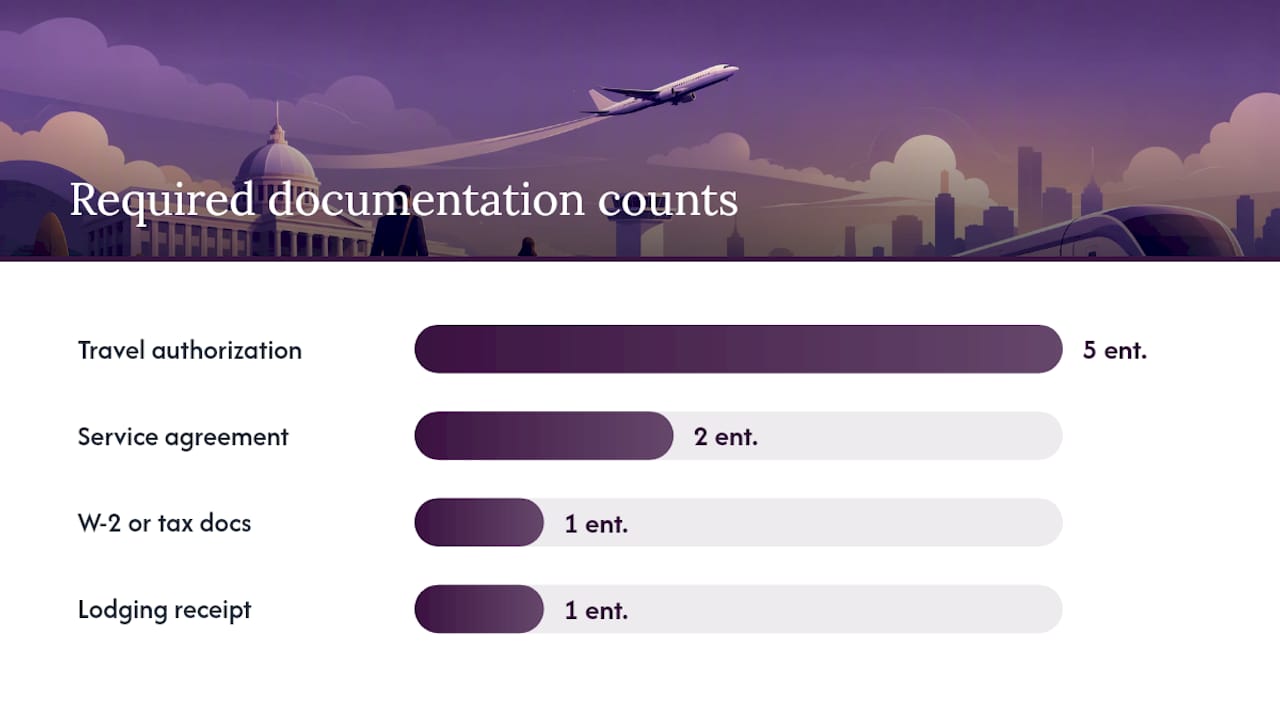
The FTR authorizes a specific set of reimbursable expenses, each tied to a particular travel or relocation scenario. The table below maps the main entitlements to when they apply and what documentation you typically need to support a claim.
| Entitlement | When authorized | Typical documentation required |
|---|---|---|
| CONUS lodging per diem | TDY travel away from official station | Travel authorization, lodging receipt (required for lodging costs) |
| M&IE per diem | TDY travel away from official station | Travel authorization; no receipts required for M&IE |
| POV mileage reimbursement | Authorized use of privately owned vehicle for official travel | Travel authorization, odometer or mapping documentation |
| Rental car | TDY when rental is advantageous to the government | Travel authorization, rental agreement, fuel receipts if applicable |
| Airfare (city-pair or lowest available) | TDY requiring air travel | Travel authorization, ticket receipt, justification if not using city-pair contract |
| Moving expense allowance (MEA) | Permanent change of station (PCS) relocation | Service agreement, distance test documentation, agency approval |
| Relocation income tax allowance (RITA) | PCS relocation where taxable allowances were paid | W-2 or tax documentation, agency RITA calculation worksheet |
| Household goods shipment | PCS relocation | Service agreement, weight tickets, carrier documentation |
| Temporary quarters subsistence expense (TQSE) | PCS relocation during transition period | Travel authorization, lodging and meal receipts |
| Storage of household goods | PCS relocation under specific conditions | Agency authorization, storage contract |
A few points worth knowing before you file:
Lodging receipts are required for lodging reimbursement; there is no receipt-free lodging claim above the government rate. M&IE, by contrast, does not require receipts, but the first and last days of travel are reimbursed at 75% of the applicable daily rate.
Per diem locality is determined by the location of the work activity, not where you sleep. When work spans multiple jurisdictions within a single installation or facility, the higher applicable per diem rate often controls for the entire stay. Confirm this with your agency travel office before filing.
Relocation allowances under 41 CFR Part 302-2 come with a distance test and time limits. Part 302-2 specifies the eligibility requirements, including how the distance between old and new official stations is measured and the deadlines for completing relocation.
Airfare rules require use of city-pair contract fares when available. If you book outside the city-pair program, you need a written justification. Premium-class travel requires separate agency authorization and is subject to reporting requirements that survived the 2025 reorganization.
How does your official duty station affect relocation and travel-time pay?
The term “official station” carries more legal weight than most travelers realize. Under FTR § 300-3.1, an official station is the location of an employee’s permanent duty station, which the agency defines. That definition directly controls whether a relocation is reimbursable, whether travel is local or TDY, and whether overtime or compensatory time applies to travel time.
The 50-mile threshold explained
Agencies may define an official-duty-station radius of up to 50 miles for purposes of determining whether travel is local or requires TDY treatment. This is not a universal entitlement rule. An agency that has not published a supplemental policy defining its official-station radius cannot simply apply a blanket 50-mile assumption. The FLRA’s decision in National Treasury Employees Union v. U.S. Department of Homeland Security illustrates exactly this tension: the Authority analyzed whether an agency’s official-station definition was consistent with FTR § 300-3.1 and examined the legal dispute over whether road miles or straight-line miles should govern the boundary.
For relocation eligibility, 41 CFR Part 302-2 requires that the new official station be at least 50 miles further from the employee’s current residence than the old official station. The calculation uses the shortest commonly traveled routes, not straight-line distance.
The practical rule: An employee whose new official station is 52 miles further from home than the old one clears the relocation distance test. An employee whose new station is 48 miles further does not, regardless of how far the actual commute feels. Always calculate using the shortest commonly traveled route, and document that calculation in the relocation file. Agencies that rely on straight-line mileage without a published policy authorizing it risk disputes and appeals.
Two worked examples
Example A — Relocation distance test:
An employee’s current official station is in Arlington, Virginia. Her residence is 12 miles from that station. She accepts a position in Richmond, Virginia. The new official station is 95 miles from her residence via the shortest commonly traveled route. The distance test: 95 miles (new station to residence) minus 12 miles (old station to residence) = 83 miles. That exceeds 50 miles, so she is eligible for relocation allowances under Part 302-2, subject to a service agreement and agency approval.

Example B — Overtime and travel-time pay:
An employee’s official station is defined by his agency as a 25-mile radius from the main office. He is directed to travel to a site 40 miles away. Because the destination falls outside the defined official-station radius, the travel is TDY, and travel-time rules under Title 5 apply. If the same agency had never published a supplemental policy defining the radius, the employee and the agency would need to resolve the classification before the voucher could be processed correctly.
Action steps: Confirm your agency’s official-station definition in writing before a relocation or extended TDY assignment. If the definition is unclear, contact your HR office or agency travel office. Agencies that have not published a supplemental policy defining the official-station boundary should do so before disputes arise.
When does travel time count as hours of work?
Travel time is compensable only under specific conditions, and the rules differ depending on whether an employee is covered by the Fair Labor Standards Act (FLSA) or is FLSA-exempt under Title 5. Getting this wrong costs agencies money and creates grievance risk.
Qualifying conditions for travel-as-work under Title 5:
- Travel is ordered or approved by the agency.
- Travel occurs during the employee’s regular working hours on any day of the week.
- The employee performs actual work while traveling (e.g., reviewing documents, attending a call).
- Travel involves an overnight stay and the travel portion falls within the employee’s regular working hours on the day of travel.
- Travel is performed as a passenger on an overnight trip and the travel time falls within regular working hours on a non-workday.
OPM’s guidance on hours of work for travel explains these conditions in detail and distinguishes the rules for FLSA-exempt versus FLSA-covered employees.
Decision flow:
- Determine the employee’s FLSA status (exempt or covered).
- Confirm the travel is ordered or approved by the agency.
- Ask: does the travel occur during the employee’s scheduled work hours, or does the employee perform work while traveling?
- If yes to either condition in step 3, the travel time is generally compensable.
- If no, apply the overnight-travel rule: compensable only if the travel falls within regular working hours on the day of travel, even on a non-workday.
- Document the determination and attach it to the time and attendance record.
Comparison of the two regulatory tracks:
| Factor | Title 5 (FLSA-exempt employees) | OPM/FLSA (FLSA-covered employees) |
|---|---|---|
| Who it covers | Most federal white-collar employees above GS-7 equivalent | Non-exempt employees, typically lower-grade or wage-grade |
| When travel is compensable | During scheduled work hours; overnight travel within regular hours; work performed while traveling | Same core conditions, plus FLSA’s “suffered or permitted” standard may apply |
| Overtime rate | Title 5 overtime rate (premium pay rules) | FLSA overtime rate (regular rate overtime for hours over 40 in a workweek) |
| Key citations | 5 U.S.C. statutes; 5 CFR regulations | 29 U.S.C. statutes; 5 CFR regulations |
| Agency obligation | Document compensable travel time; include in pay period | Same, plus FLSA recordkeeping requirements |
Practical note: An employee who is a passenger on a flight during non-work hours and does not perform any work is generally not in a compensable travel status under either track. The moment the agency requires the employee to attend a call or review materials during that flight, the calculus changes. Document the expectation before the trip, not after.
How to request, authorize, and claim travel reimbursement
The authorization-to-reimbursement cycle has several checkpoints where claims commonly fail. Here is what employees and approving officials each need to do.
Employee checklist
- Obtain written travel authorization before incurring any travel costs. Retroactive authorizations are possible but require additional justification and supervisor approval.
- Verify the per diem locality for your destination using the GSA Per Diem Lookup before booking lodging. Do not assume the city you are visiting has a published rate; check by ZIP code.
- Capture all required receipts during travel. Lodging receipts are mandatory. Receipts for other expenses are generally required when the expense exceeds the agency’s threshold (commonly $75, though agency policy may differ).
- Complete your travel voucher within five business days of returning from TDY, or within the timeframe your agency requires. Late vouchers are a common denial trigger.
- Separate allowable from non-allowable expenses before filing. Personal meals when government-furnished meals are provided, first-class upgrades without authorization, and expenses outside the authorized travel dates are not reimbursable.
- For relocation claims, attach the signed service agreement, distance test documentation, and any agency-specific forms required under the agency’s supplemental policy.
Approving official checklist
- Verify mission necessity before approving. A travel authorization without a documented mission purpose is an audit flag.
- Confirm the employee’s official station and the correct per diem locality for the destination.
- Check that receipts meet the threshold requirements and that lodging receipts are present.
- Document any exceptions (medical dietary needs, religious meal accommodations, emergency travel) in the authorization file.
- For premium-class travel, confirm the written authorization meets the FTR’s specific justification requirements and that the approval is at the required level.
- Retain all travel records per your agency’s records management schedule. The FTR does not set a universal retention period; agency policy and the National Archives General Records Schedule govern.
Common denial reasons and quick remedies
Missing receipts are the single most common denial trigger. If a lodging receipt is lost, a supplemental affidavit explaining the loss and confirming the expense can sometimes substitute, subject to agency policy. No written authorization is harder to fix after the fact; a retroactive authorization memo signed by the authorizing official and explaining why advance authorization was not obtained is the standard remedy. Duplicate claims, where the same expense appears on two vouchers, require a corrected voucher and a brief explanation memo.
A note on ETS and ETSNext: The federal government has been transitioning its electronic travel system. If your agency has moved to a new platform, confirm with your travel office which system governs your current voucher workflow and where to find the agency’s implementation guidance. System transitions sometimes create temporary gaps in workflow documentation that can delay reimbursement.
What agencies are required to do under the FTR
Agency obligations under the FTR go well beyond approving individual vouchers. Travel offices that treat the FTR as a claims-processing function rather than a policy-management function tend to accumulate audit findings.
Mandatory agency tasks:
- Establish and publish an internal travel policy that supplements the FTR with agency-specific rules (official-station radius, local travel definitions, approval thresholds, and any agency-unique allowances).
- Designate authorizing officials in writing and maintain a current list of who can approve travel and at what dollar thresholds.
- Require signed service agreements for employees receiving relocation allowances, as specified in 41 CFR Part 302-2.
- Implement reporting for premium-class travel authorizations as required by the FTR and OMB guidance.
- Maintain travel records in accordance with the agency’s records management schedule and the applicable General Records Schedule.
Practical operational items:
A well-constructed agency supplemental travel policy covers at minimum: the official-station radius definition, local travel rules (what counts as local travel and what reimbursement is available), approval authority levels, receipt thresholds, and the process for handling exceptions. Agencies that publish this document on their intranet and update it when the FTR changes reduce the volume of employee inquiries and disputed vouchers significantly.
Internal audit checkpoints worth building into the travel program include: a quarterly sample review of travel vouchers for receipt compliance, an annual review of premium-class travel authorizations against the FTR’s justification requirements, and a post-relocation audit to confirm service agreements are on file and RITA calculations are documented.
GSA’s local travel policy guidance is a useful reference for agencies drafting or updating their local travel definitions. Agency-specific directives frequently fill gaps the general FTR leaves open, particularly around local travel definitions and internal mileage radii.
Pro Tip: Build a one-page decision matrix that maps the most common travel scenarios (local travel, TDY under 50 miles, TDY over 50 miles, relocation, contractor travel) to the required approvals, applicable FTR parts, and documentation checklist. Post it in your travel office and link it from your agency’s intranet travel page. It cuts adjudication time and reduces the “I didn’t know I needed that” voucher denials.
What changed in the 2025 FTR reorganization?
The 2025 final rule reorganized and streamlined the FTR with an effective date of December 8, 2025. The changes are primarily structural, not substantive, but they affect how you navigate the regulation and where you find specific provisions.
Key changes from the 2025 reorganization:
- Chapter 300 was trimmed to a glossary and definitions chapter; substantive TDY and relocation material moved into Chapters 301 through 304.
- The format shifted from a question-and-answer structure back to a narrative regulatory format, which is the standard CFR style.
- Redundant provisions were eliminated, reducing the overall length of the regulation.
- Some reporting requirements were removed as part of the deregulatory intent, but controls on premium-class travel authorization remain in place.
- Agencies should expect to update internal policy documents that cross-reference specific FTR section numbers, since chapter and section numbering changed.
Practical impacts for administrators:
- Internal travel policies that cite specific FTR Q&A numbers will need to be updated to reference the new narrative section numbers.
- Agency supplemental policies may need to be more detailed now, since the 2025 streamlining effort anticipates more reliance on agency-level supplements for local travel detail.
- Training materials and intranet travel guides that reference the old Q&A format should be revised before employees encounter the discrepancy.
- The deregulatory intent of the rule signals that GSA expects agencies to exercise more discretion at the local level, which makes a well-drafted supplemental policy more important than ever.
How to stay current after the 2025 reorganization:
- Subscribe to Federal Register email alerts for “Federal Travel Regulation” to catch any proposed or final rules.
- Check the GSA FTR bulletins page at the start of each fiscal year (October 1) and again in January for mileage rate updates.
- Set a calendar reminder for the midyear period (April) to check for any interim per diem adjustments GSA may publish.
- Review the eCFR “Recent Changes” log for Title 41 quarterly to catch any technical corrections or minor amendments.
What contractors need to know about travel costs
The FTR does not govern contractor travel. That single point resolves most of the confusion contractors bring to their contracting officers, and it is worth stating plainly before anything else.
Under FAR 31.205-46, travel costs for contractors are allowable only to the extent they are reasonable, allocable, and not otherwise unallowable under the FAR cost principles. The FTR per diem rates serve as a ceiling for reasonableness in most cases, meaning a contractor cannot claim lodging costs that exceed the applicable FTR per diem rate for the destination and expect them to be fully allowable, but the contractor is not entitled to the FTR rate as a floor either.
Understanding the types of government contracts you are working under matters here. Cost-reimbursement contracts allow travel costs as a direct charge when the contract includes a cost-reimbursable line item for travel. Fixed-price contracts generally absorb travel costs into the price, and the contractor bears the risk of cost overruns. Time-and-materials contracts typically allow direct billing of travel costs at actual cost, subject to the FAR 31.205-46 reasonableness standard.
Contractor negotiation and documentation checklist:
- Confirm whether your contract includes explicit travel cost allowability language. If it does not, request a contract modification or clarification from the contracting officer before incurring travel costs.
- Ask the contracting officer for a letter of authorization if you need access to government-negotiated hotel or car rental rates. Commercial vendors are not required to extend government rates to contractors, but a contracting officer letter can persuade many vendors to do so.
- Include cost-reimbursable line items for travel in your contract proposal if travel is a foreseeable cost. Vague “travel as needed” language creates disputes at invoice time.
- Document vendor discounts or the absence of them. If a vendor refuses to extend government rates, document that refusal and book at the lowest commercially available rate instead.
- Align your travel cost documentation with FAR 31.205-46: receipts, purpose of travel, connection to contract performance, and reasonableness justification for any costs that approach or exceed FTR per diem levels.
For a broader look at federal contractor requirements and how regulatory obligations intersect with travel cost allowability, the compliance considerations go well beyond travel alone. Contractors who understand the full scope of their regulatory obligations tend to have fewer invoice disputes and faster payment cycles.
If your business is pursuing or maintaining a GSA Schedule contract and needs help navigating the compliance side, Gsascheduleservices works with small and medium businesses to handle the documentation, negotiation, and ongoing contract management that keeps GSA contracts in good standing.
Why clear agency supplemental policy is the most underrated compliance tool
Most travel disputes I see in federal agencies do not come from employees trying to game the system. They come from genuine ambiguity, usually because the agency never published a clear supplemental travel policy. The FTR sets the floor and the ceiling, but it deliberately leaves room for agencies to define their own official-station boundaries, local travel rules, and approval thresholds. When an agency does not fill that space, employees and approving officials fill it themselves, inconsistently.
The 2025 reorganization makes this more pressing, not less. By trimming the FTR to a leaner narrative format and signaling that agencies should exercise more local discretion, GSA has effectively raised the stakes for agencies that have been coasting on the old Q&A structure. If your agency’s supplemental policy still references FTR section numbers from the pre-2025 format, it is already out of date.
Three things belong at the top of every travel manager’s priority list right now. First, define the official-station radius in writing and publish it. The FLRA precedent on road miles versus straight-line miles shows exactly what happens when this is left vague. Second, publish a clear local travel policy that tells employees what counts as local travel, what is reimbursable, and who approves it. Third, build an audit trail from authorization through voucher through payment. The agencies that do this well rarely end up in disputes, and when they do, they resolve them quickly because the documentation is there.
For businesses navigating the contractor side of this equation, the compliance picture is different but equally important. Understanding where the FTR ends and FAR 31.205-46 begins is the starting point. Getting the contract language right before travel begins is what keeps invoices from being disputed six months later.
Sources
- eCFR :: 41 CFR Subtitle F – Federal Travel Regulation System (FMR Subtitle F)
- Federal travel regulation and related files | GSA
- Federal Travel Regulation; Reorganizing and Streamlining the Federal Travel Regulation To Improve Operational Efficiency
- Hours of work for travel — OPM
- FAR 31.205-46 — Travel costs
- National Treasury Employees Union v. U.S. Department of Homeland Security (FLRA decision)
FAQ
What does the federal travel regulation govern?
The FTR governs reimbursable official travel and relocation for federal civilian employees and others authorized to travel at government expense, covering per diem, transportation, relocation allowances, and travel authorizations under 41 CFR Subtitle F.
What are the current travel restrictions for federal employees?
The FTR requires advance written authorization for all official travel, mandates use of city-pair contract airfares when available, and restricts premium-class travel to specific authorized circumstances; agencies may impose additional restrictions through supplemental policies.
How does the OPM guidance relate to the FTR on travel time?
OPM’s hours-of-work guidance addresses when travel time is compensable under Title 5 and FLSA rules, which is a pay and leave question separate from the FTR’s reimbursement rules; both sets of rules apply to a single trip but govern different aspects of it.
What is the 50-mile rule for federal travel?
For relocation, the new official station must be at least 50 miles further from the employee’s residence than the old official station, measured via the shortest commonly traveled route under 41 CFR Part 302-2. For overtime and local travel purposes, agencies may define an official-duty-station radius of up to 50 miles, but only if the agency has published that definition in a supplemental policy.
Are government contractors covered by the FTR?
No. Contractors are governed by FAR 31.205-46 for travel cost allowability, not the FTR, unless the contract explicitly incorporates FTR provisions. Contractors should confirm travel cost language with their contracting officer before incurring any travel expenses.
Recommended
- Federal Acquisition Regulations for Dummies: Plain-English Guide
- Understanding Federal Contractor Requirements: A Guide
- Federal Procurement Training Essentials Guide
- Federal Contracts Onboarding Workflow: A 2026 Guide