
Your firm qualifies as small under SBA rules if your business, combined with any affiliates, falls at or below the size threshold assigned to your specific NAICS code. That threshold is expressed as either a maximum number of employees or a maximum level of average annual receipts, depending on your industry. The fastest way to confirm your status is the SBA Size Standards Tool, which lets you enter a NAICS code and your figures to get an immediate answer.
Before you run the tool, have these ready:
- Your primary NAICS code (and any secondary codes relevant to active solicitations)
- Payroll records or headcount data covering the last 24 months
- Tax returns or financial statements for the last 3–5 complete fiscal years
- A list of all affiliated entities, including partial owners, parent companies, and controlled subsidiaries
Key Takeaways
SBA size standards are NAICS-specific thresholds that determine whether your firm, including all affiliates, qualifies as small for federal contracting purposes.
| Point | Details |
|---|---|
| Size is NAICS-specific | Every NAICS code carries its own employee or receipts threshold; confirm the code assigned to each solicitation. |
| Two calculation windows | Employees: 24-month average per pay period. Receipts: 5-year average of total income plus cost of goods sold. |
| Affiliates always count | Include all entities you control or that control you; omitting affiliate figures is the most common misclassification error. |
| SAM does not auto-update | After any SBA size standard revision, manually update your SAM.gov profile to reflect the current threshold. |
| Gsascheduleservices | Offers size calculation workbooks, NAICS mapping, and full GSA schedule application support for qualifying small businesses. |
Table of Contents
- What SBA size standards actually measure
- How to calculate your employee count and annual receipts
- Where to look up your NAICS code and official size standard
- Affiliation rules: which entities count toward your size
- Why your size determination matters for contracting
- How SBA sets and updates size standards
- When to consult a specialist
- Gsascheduleservices can help you prepare your size review and GSA schedule application
- Sources
- FAQ
What SBA size standards actually measure
An SBA size standard is the maximum size a firm and its affiliates may be to qualify as a small business for federal contracting programs. Every NAICS code carries its own threshold, so a company that is “small” in one industry may not be small in another. The official regulations live in 13 CFR Part 121, which is the statutory authority for how SBA establishes and revises these thresholds.
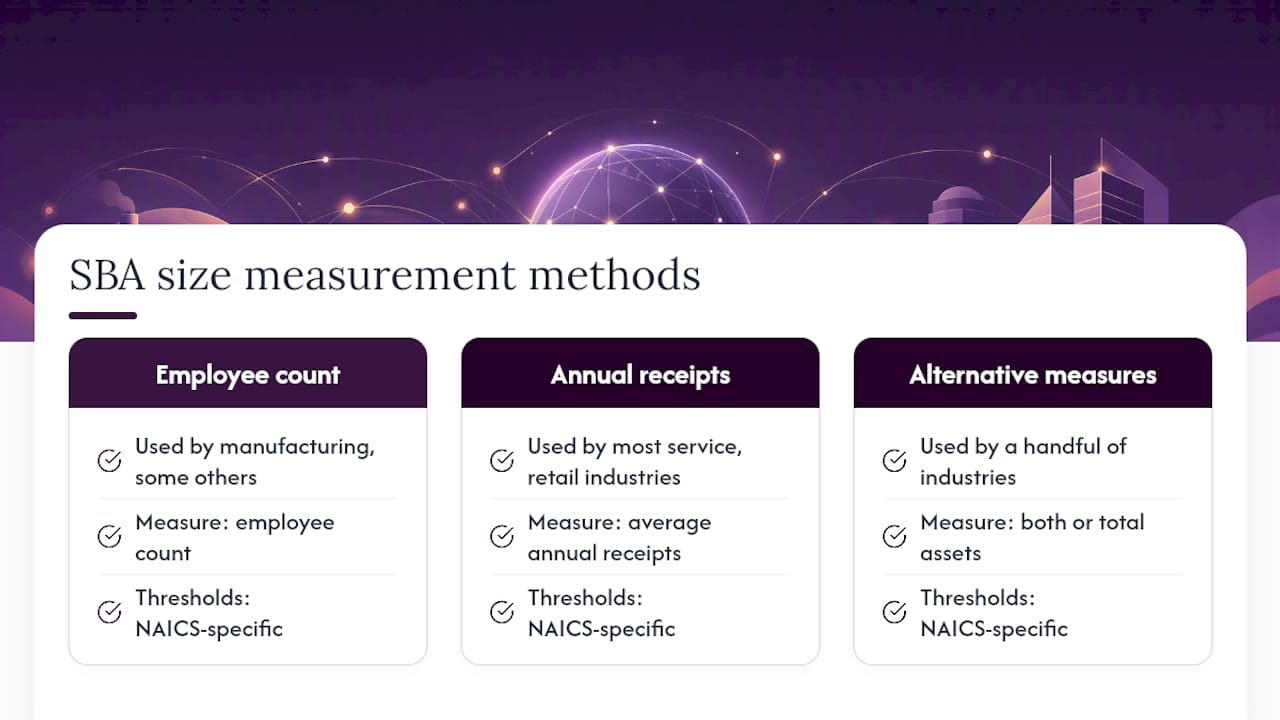
Size is measured one of two ways, and understanding industry-specific SEO benefits for small service businesses can help clarify why SBA varies standards by industry. Manufacturing and some other industries use an employee count. Most service and retail industries use average annual receipts. A handful of industries use both, or use an alternative measure such as total assets.
Beyond the size threshold itself, SBA requires four baseline conditions for small-business status: the firm must be for-profit, independently owned and operated, not dominant in its field nationally, and physically located and operating in the United States. Dominance is a real disqualifier, not a formality. SBA evaluates competition, start-up costs, and growth trends when setting thresholds precisely to keep dominant players out of the small-business pool.
The authoritative reference for specific NAICS thresholds is the Table of Small Business Size Standards, effective March 17, 2023.
How to calculate your employee count and annual receipts
The formulas are defined in the CFR, and getting them wrong is one of the most common reasons firms misclassify themselves.
Employee calculation (13 CFR § 121.106)
Count the average number of employees per pay period over the most recent 24 calendar months. Include full-time, part-time, and temporary workers. Seasonal employees count during the periods they work. Do not exclude workers just because they are on a short-term contract or placed by a staffing agency if your firm controls their day-to-day work.
Receipts calculation (13 CFR § 121.104)
Average total receipts over the most recent five complete fiscal years. “Receipts” means total income plus cost of goods sold, as reported on federal tax returns. For most SBA programs, the five-year window applies. Some loan programs use a three-year average instead, so confirm which window applies to your specific program before you calculate.
For firms younger than five years, multiply average weekly revenue by 52 to arrive at an annualized figure. This prevents a short operating history from artificially deflating the receipts number.
Worked example A — services firm (receipts-based): A management consulting firm reports gross revenues of $4.2M, $4.8M, $5.1M, $5.4M, and $5.5M over five fiscal years. Total: $25M. Divided by five: $5M average annual receipts. If the applicable NAICS threshold is $19M, this firm qualifies as small. If the threshold is $4.5M, it does not.
Worked example B — manufacturer (employee-based): A precision parts manufacturer averages 480 employees per pay period over 24 months. If the NAICS threshold is 500 employees, the firm qualifies. At 510 employees, it does not, regardless of revenue.
Pro Tip: Seasonal spikes and temp-agency workers trip up more firms than any other single factor. If you use a staffing agency during peak periods, confirm whether those workers meet SBA’s “economic realities” test for inclusion before you finalize your employee count.
Where to look up your NAICS code and official size standard
Three official resources cover this, and each serves a different purpose.
- SBA Size Standards Tool (Sba): Enter your NAICS code and your receipts or employee count. The tool returns a pass/fail determination instantly. Use this for a quick self-check before submitting a proposal.
- Table of Small Business Size Standards (PDF, effective March 17, 2023): The authoritative printed reference. Use this when you need to document the exact threshold for a specific NAICS code or when preparing a size certification for a contracting officer.
- 13 CFR Part 121 via eCFR (Law): The legal text. Use this when you need to cite the regulatory basis for a size determination, file an appeal, or interpret an edge case.
- data.sba.gov (machine-readable dataset): A downloadable dataset of all size standards. Useful if you manage multiple SAM profiles or need to run bulk checks across a portfolio of NAICS codes.
One point that catches contractors off guard: the NAICS code that matters for a specific solicitation is the one the contracting officer assigns to that solicitation, not necessarily your primary NAICS. You may have a primary NAICS of 541611, but a specific contract could be coded 541512. Know your primary NAICS, but verify the assigned code on every solicitation before you self-certify.
For NAICS mapping strategy, particularly if you are pursuing GSA schedule work, expert NAICS code consulting can prevent costly mismatches between your capabilities and the codes you hold.
Affiliation rules: which entities count toward your size
Affiliation is where most size-standard errors originate. SBA counts the employees and receipts of all affiliated entities together with yours when determining whether you are small. The key question is control, not ownership percentage alone.
SBA finds affiliation when one entity has the power to control another, whether or not that control is actively exercised. Common indicators include:
- Ownership of 50% or more of voting stock
- Minority ownership combined with a contractual right to block major decisions
- Common management: the same individual serves as CEO or controls the board of both entities
- Shared facilities, equipment, or employees between two nominally separate firms
- A creditor or investor with the contractual right to control operations
- A subcontractor relationship where the prime controls the sub’s day-to-day work
SBA will likely find affiliation. Another common trap is a parent company that holds a minority stake but supplies the majority of your revenue through a long-term exclusive contract. That economic dependence can trigger affiliation even without formal ownership control.
The red flags that typically prompt an SBA affiliation review are: a recent ownership restructuring before a set-aside bid, a subcontractor that performs the majority of contract work, and shared back-office functions like payroll or accounting between two entities that claim to be independent. Avoiding common bidding mistakes starts with getting affiliation right before you certify.
Why your size determination matters for contracting
Confirming your size status is not a one-time administrative task. It directly controls which solicitations you can compete on and which certifications you can hold.
Set-asides and sole-source awards for small businesses, 8(a) firms, HUBZone companies, and service-disabled veteran-owned small businesses all require you to meet the size standard for the NAICS code assigned to that specific contract. Certifications like SBA 8(a) carry their own size requirements on top of the general small-business threshold. Exceeding the size standard for a set-aside contract after award can trigger a size protest, a formal SBA determination, and potential debarment.
After you confirm your size, take these steps:
- Update SAM.gov immediately. SAM registrations do not auto-update when SBA revises size standards. If the threshold for your NAICS changed and your profile still reflects the old standard, you could be misrepresenting your status on active solicitations.
- Prepare supporting documentation. Keep your payroll records, tax returns, and affiliate analysis in a single file. Contracting officers and SBA size specialists can request these at any time.
- Flag your NAICS on every proposal. Confirm the solicitation’s assigned NAICS and verify your size against that specific code before you self-certify in the proposal.
- Contact SBA Size Specialists if you are near the threshold or have complex affiliation. The SBA Office of Size Standards handles formal size determinations and can be reached through sba.gov.
Understanding how your SBA designation interacts with GSA schedule eligibility is a separate but related question. SBA designation and GSA contract eligibility are connected but not identical, and knowing the difference protects you from assuming one automatically confers the other.
How SBA sets and updates size standards
SBA does not pick thresholds arbitrarily. The 2023 Size Standards Methodology White Paper describes a structured approach that examines five primary industry factors: average firm size, the degree of competition within the industry, start-up costs and entry barriers, the distribution of firms by size, and the small-business share of federal contracting in that industry. The result is a percentile-based threshold calibrated to each industry’s actual structure.
Under 13 CFR § 121.102, SBA must review monetary-based size standards at least once every five years and publish a proposed rule if inflation has eroded those thresholds. This is why receipts-based standards tend to rise over time while employee-based standards are more stable.
Key things to monitor:
- Proposed rules in the Federal Register: SBA publishes proposed size standard changes for public comment before they take effect. Subscribing to Federal Register alerts for “SBA size standards” is the fastest way to catch upcoming changes.
- Effective dates: The current table is effective March 17, 2023. Future revisions will carry their own effective dates, and the old threshold applies to solicitations issued before the new date.
- SAM update timing: When a new rule takes effect, update your SAM profile promptly. A profile showing the wrong size status under a revised standard creates compliance exposure on any solicitation you pursue after the change.
When to consult a specialist
Most firms can run the Size Standards Tool and confirm their status in under an hour. A few situations genuinely warrant professional help before you certify.
Get expert guidance when:
- You have any ownership overlap, shared management, or contractual relationships with other entities and are unsure whether affiliation applies
- You are bidding on a contract where the NAICS code differs from your primary code and you have not calculated size for that code before
- You are pursuing multiple certifications (8(a), HUBZone, SDVOSB) simultaneously and need to confirm size under each program’s specific rules
- You received a size protest or a formal SBA size determination request
- Your SAM profile is flagged or your small-business status is disputed by a contracting officer
- You are applying for a GSA schedule and need NAICS-to-SIN mapping that aligns with your size status
A credible consultant should deliver a documented NAICS mapping, a size calculation workbook showing the 24-month employee average and 5-year receipts average with source data, an affiliate due-diligence memo, and, if needed, a formal appeal filing. Before paying for consulting, call the SBA Office of Size Standards directly. They offer guidance at no cost and can clarify whether your situation requires a formal determination or just a careful self-calculation.
The cost of getting it wrong is asymmetric
Most contractors who misclassify their size do so by undercounting affiliates or miscalculating the receipts window. The upside of correct classification is access to every set-aside and certification your firm legitimately qualifies for. The downside of incorrect classification ranges from a lost contract to a formal finding of misrepresentation. Getting the calculation right, and documenting it, is the single most protective thing you can do before you certify.
Accuracy also matters on the upside. Firms that discover they have been overly conservative, treating themselves as large when they actually qualify as small, have been leaving set-aside opportunities on the table. A careful size review sometimes opens doors rather than closing them.
Gsascheduleservices can help you prepare your size review and GSA schedule application
Disclosure: Gsascheduleservices is the publisher of this article and offers paid consulting services described below.
Getting your size determination right is the first gate on the path to a GSA schedule contract. Gsascheduleservices works with small and medium-sized businesses on exactly this sequence: confirming size and NAICS eligibility, preparing the documentation contracting officers expect, and moving through the GSA schedule application without the back-and-forth that stalls most first-time applicants.
Services include NAICS and SIN code mapping, size calculation workbooks, SAM.gov profile updates, affiliate due-diligence review, and full GSA schedule application preparation. For businesses already on schedule, ongoing compliance support keeps your contract current as standards evolve.
Schedule a discovery call to walk through your NAICS, your size figures, and your GSA readiness in one focused conversation.
Sources
- 13 CFR § 121.102 – How does SBA establish size standards? | Electronic Code of Federal Regulations (e-CFR) | US Law | LII / Legal Information Institute
- Table of Small Business Size Standards Matched to North American Industry Classification System Codes
- Size Standards Tool | U.S. Small Business Administration
- Data
FAQ
What size qualifies as a small business under SBA rules?
It depends on your NAICS code. Most manufacturing firms qualify at 500 employees or fewer, while most service industries use a receipts threshold that typically ranges from $8M to $47M, though specific limits vary by industry. Check the SBA Size Standards Tool for the exact figure tied to your NAICS code.
What is the SBA Table of Size Standards?
The Table of Small Business Size Standards is the official SBA document that lists every NAICS code alongside its applicable size threshold, expressed as either maximum employees or maximum average annual receipts. The current version is effective March 17, 2023.
Is 500 employees considered a small business?
For many manufacturing and mining NAICS codes, yes. For most service, retail, and professional industries, the threshold is receipts-based rather than headcount-based, so employee count alone does not determine your status. Always verify against the specific NAICS code assigned to your solicitation.
How do I calculate my average annual receipts for SBA purposes?
Add total income plus cost of goods sold for each of your five most recent complete fiscal years, then divide by five. Use figures from your federal tax returns. For firms in business fewer than five years, multiply average weekly revenue by 52 to arrive at an annualized figure.
What happens if my size status changes after I win a contract?
Generally, size is determined at the time of offer or self-certification, not at award or during performance. However, you must maintain accurate SAM.gov registration, and a size protest can trigger a formal SBA review of your status at the time you certified. Keep your calculation documentation on file for every proposal you submit.
Recommended
- Will my SBA Designation help get a GSA Contract?
- SBA Certifications and the GSA Program
- What Every Contractor Should Know About The SBA’s New Rules
- GSA Contract Eligibility Criteria – Quick Guide