

In federal contracting, a “contract schedule” means one specific thing: a GSA Multiple Award Schedule (MAS), the government contract vehicle that lets pre-approved vendors sell commercial products and services to federal agencies at negotiated prices. If you’re an SMB owner weighing whether to pursue one, three items gate your eligibility right now.
Executive checklist — confirm these before anything else:
- Your business has been operating for at least two years (or you qualify for the Startup Springboard exception)
- You have financial statements covering a suitable historical period (income statement, balance sheet)
- You have measurable and documented past performance
Your immediate next steps: Complete the Pathways to Success training (3–4 hours), finish the Readiness Assessment with an Authorized Negotiator, and register on SAM.gov to get your Unique Entity Identifier (UEI) and FAS ID.
Key Takeaways
Getting a GSA Schedule requires completing mandatory training, assembling specific documents, and maintaining active compliance after award — a Schedule that isn’t marketed won’t generate sales on its own.
| Point | Details |
|---|---|
| Complete training first | Pathways to Success training and the Readiness Assessment must be completed before eOffer accepts your submission. |
| Eligibility is non-negotiable | Two years in business, two years of financials, and measurable past performance are required; Startup Springboard may help newer firms. |
| Timeline: 2–6 months | Prepared offerors reach award in roughly 2–6 months; incomplete submissions extend that significantly. |
| Award does not equal sales | Active marketing on GSA Advantage!, eBuy, and direct outreach is required to convert a Schedule into revenue. |
| Gsascheduleservices | Offers full-service application support, pricing development, and post-award maintenance for SMBs pursuing a Schedule. |
Table of Contents
- Is a GSA Schedule the right move for your business right now?
- Eligibility checklist and documents to assemble before you apply
- Step-by-step roadmap to prepare and submit a MAS offer
- How to choose SINs, NAICS codes, and price your offer competitively
- Practical eOffer submission tips and the most common rejection reasons
- How to maintain your Schedule after award
- How to find and win federal orders through your Schedule
- Realistic timeline and cost expectations
- Why the upfront work on a Schedule is worth it for most SMBs
- Gsascheduleservices handles the process so you can focus on selling
- Sources
- FAQ
Is a GSA Schedule the right move for your business right now?
The MAS works best for businesses that sell commercial products or services with repeat-buyer potential across multiple federal agencies. If you have an established catalog, documented past performance, and the capacity to respond to RFQs consistently, the Schedule gives you access to a procurement channel that operates year-round with no solicitation windows.
Delay the application if you lack two years of financials, have thin or undocumented past performance, or if a targeted set-aside contract or teaming arrangement would get you to revenue faster. A Schedule is a long-term investment, not a shortcut.
Pro Tip: Before applying, estimate your realistic federal pipeline. If you can identify fewer than three agencies that regularly buy what you sell, the ROI of a full MAS application may not justify the effort versus pursuing a partner contract holder arrangement first. Check the decision factors here before committing.
Eligibility checklist and documents to assemble before you apply
GSA’s eligibility requirements are firm: two years in business, two years of financial statements, and measurable past performance. The Startup Springboard program can waive some of these for qualifying newer businesses, but the bar for that exception is specific.
Gather these documents before opening eOffer:
- Financial statements: Two years of income statements and balance sheets (audited preferred, but not always required)
- Past performance write-ups: Three to five references with contract values, scope, and agency or client contact information
- Commercial pricelist: Your current catalog or rate card, formatted per GSA requirements
- SF-1449 fields: The standard solicitation form fields you’ll complete inside eOffer
- Representations and certifications: Completed and current in SAM.gov
- NAICS and SIN mapping: A list of the Special Item Numbers you intend to offer, matched to your NAICS codes and size standards
Use Pathways to Success as your template checklist — it lists every required document and attachment by category. Download the Large Category Attachments for your specific offering area before you start building the offer. A detailed eligibility walkthrough can help you confirm which documents apply to your situation.
Step-by-step roadmap to prepare and submit a MAS offer
The sequence is fixed. Skipping a step doesn’t save time — it creates rejections.
1. Complete Pathways to Success training. The MAS Roadmap requires 3–4 hours of training. Your Authorized Negotiator must complete it within the past year before eOffer will accept the acknowledgement.
2. Complete the Readiness Assessment. An Authorized Negotiator (who must be an employee, not a contractor) completes this assessment. eOffer requires confirmation it was done within the past year.
3. Read the MAS solicitation and category attachments. Solicitation 47QSMD20R0001 and its category-specific attachments contain the actual offer requirements. SCP-FSS-001 is the master clause document. Read it before building anything.
4. Register in SAM.gov and get your FAS ID. SAM.gov registration with an active UEI is mandatory. FAS ID requires multi-factor authentication (MFA) per the solicitation requirements.
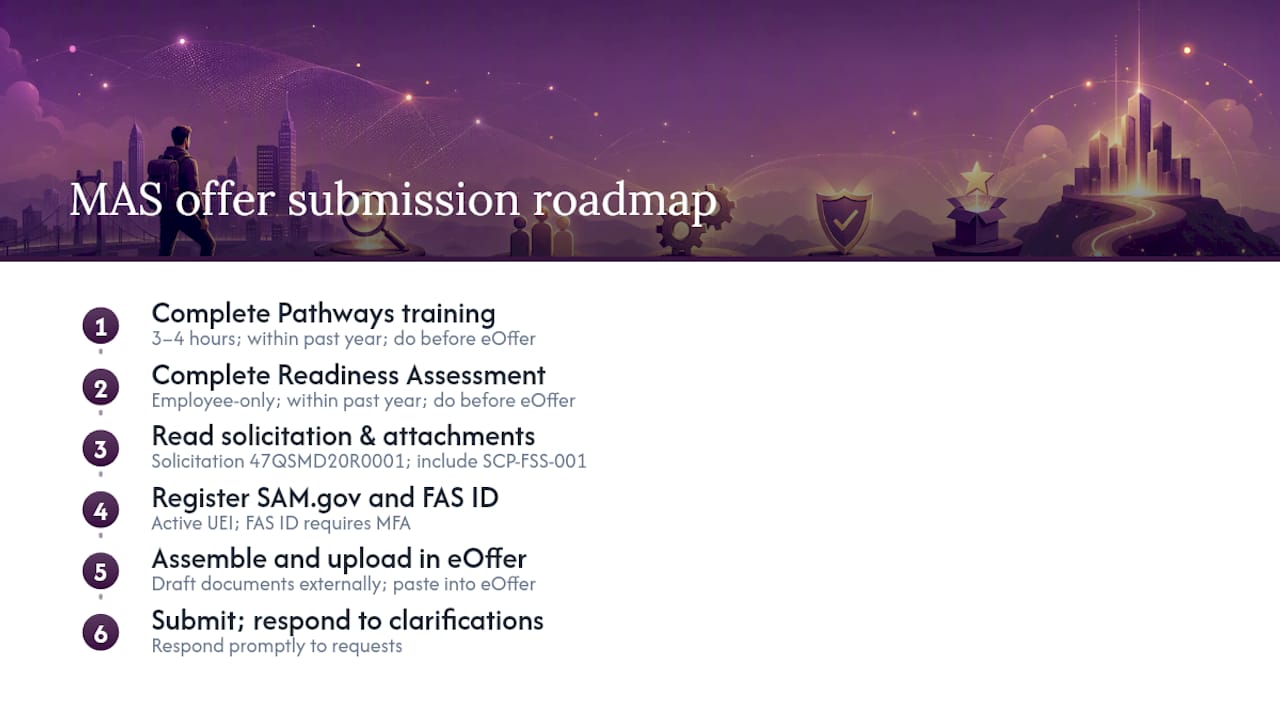
5. Assemble and upload your offer in eOffer. eOffer automates much of the proposal structure, but you must prepare text, pricing, and templates outside the system first. Character limits inside eOffer are strict — draft narratives in a word processor, then paste.
6. Submit and respond to clarifications. After submission, a contracting officer reviews the offer and may request clarifications. Response time matters; delays extend your contract timeline significantly.
The single most common timeline killer: Offerors who start eOffer before completing training and the Readiness Assessment hit the acknowledgement wall and must restart. Do both first, every time.
How to choose SINs, NAICS codes, and price your offer competitively
Start with GSA eLibrary to look up Special Item Numbers that match your commercial practice. Each SIN maps to a large category and carries its own set of required attachments and pricing documentation.
Your NAICS code determines your small business size standard under SBA rules. Map it carefully — the wrong NAICS can affect your set-aside eligibility on orders.
Pricing essentials:
| Pricing element | What GSA requires |
|---|---|
| Commercial pricelist | Your current published or catalog price for each item/service |
| Price reasonableness | Documentation showing your GSA price is fair relative to commercial sales |
| Most Favored Customer (MFC) | Identify the customer class receiving your best commercial discount |
| IFF (Industrial Funding Fee) | Currently 0.75% of Schedule sales, remitted quarterly |
| TDR opt-in | Transactional Data Reporting replaces the Price Reductions Clause for opted-in SINs |
Pro Tip: TDR participation removes the Price Reductions Clause obligation for covered SINs, which simplifies ongoing compliance. Review the MAS solicitation TDR provisions carefully before deciding — once you opt in, the reporting obligation is quarterly and non-negotiable.
The Multiple Award Schedule page links directly to SIN-specific templates and category resources. Use it as your reference point when building the pricing section.
Practical eOffer submission tips and the most common rejection reasons
The critical prerequisite before filing is completing the Pathways to Success training and the Readiness Assessment; eOffer does not accept submission without acknowledgement of these.
Before you open eOffer:
- Draft all narrative responses (past performance, technical approach) in Word; eOffer’s text fields have character limits and no autosave
- Confirm your Authorized Negotiator is an employee with a valid FAS ID and MFA enabled
- Have at least two Authorized Negotiators listed — one as primary, one as backup
- Download and complete all required templates for your SINs before uploading
- Verify SAM.gov registration is active (renewals lapse annually)
Most common rejection causes and how to avoid them:
- Missing or incomplete templates: Every SIN has required attachments; a missing one triggers rejection. Cross-reference the 25 most common rejection reasons before submitting.
- Pricing gaps: Items listed without supporting commercial price documentation fail price reasonableness review.
- Thin past performance: Fewer than three references, or references without verifiable contact information, consistently draw clarification requests that extend the contract timeline by weeks.
Pro Tip: Treat the eOffer submission like a legal filing. Every field has a purpose. A government proposal writing guide can help you structure narratives that answer the contracting officer’s actual evaluation criteria, not just fill the space.
How to maintain your Schedule after award
Award is the beginning of the compliance workload, not the end. The MAS solicitation and GSA’s ongoing requirements create a recurring calendar of obligations.
Core maintenance tasks:
- IFF remittance: 0.75% of Schedule sales reported and paid quarterly via the 72A Reporting System
- Sales reporting: Required quarterly; TDR participants report transaction-level data instead of aggregate sales
- Price updates: Any commercial price change must be reflected via contract modification before the new price takes effect on Schedule
- Contract modifications: Scope changes, new SINs, personnel changes, and address updates all require formal mods through eMod
- Compliance reviews: GSA conducts periodic reviews; recordkeeping for five years post-contract is standard
Warning: Failure to report sales or remit IFF on time can result in contract termination. Missing a required modification — particularly one that changes contract scope — creates compliance exposure that can void orders already placed.
Use the maintenance checklist to build a recurring compliance calendar from day one of award.
How to find and win federal orders through your Schedule
A Schedule gives you access to channels. It does not bring buyers to you. GSA’s guidance is explicit: active marketing and response capability are required to convert a Schedule into revenue.
Channels and tactics:
- GSA Advantage!: Keep your pricelist current, add product images and descriptions, and monitor your listing’s search ranking. Stale listings lose visibility.
- eBuy: Federal buyers post RFQs here. Under FAR subpart 8.4, ordering activities may solicit at least three Schedule holders or post to eBuy. Monitor daily and respond fast — many RFQs have 5–10 day windows.
- Direct outreach: Identify contracting officers and program managers at target agencies. Capability statements, GSA Advantage! profile links, and past performance summaries are your tools.
- Teaming: Partner with larger prime contractors who need your SINs to complete a larger order.
Past performance updates, pricing agility, and a capture strategy for your top three target agencies are the difference between a Schedule that generates revenue and one that sits dormant.
Realistic timeline and cost expectations
| Phase | Typical duration |
|---|---|
| Training and Readiness Assessment | 1–2 weeks |
| Document assembly and pricing prep | 2–6 weeks |
| eOffer build and submission | 1–2 weeks |
| GSA review and negotiation | 2–4 months |
| Total: decision to award | 2–6 months |
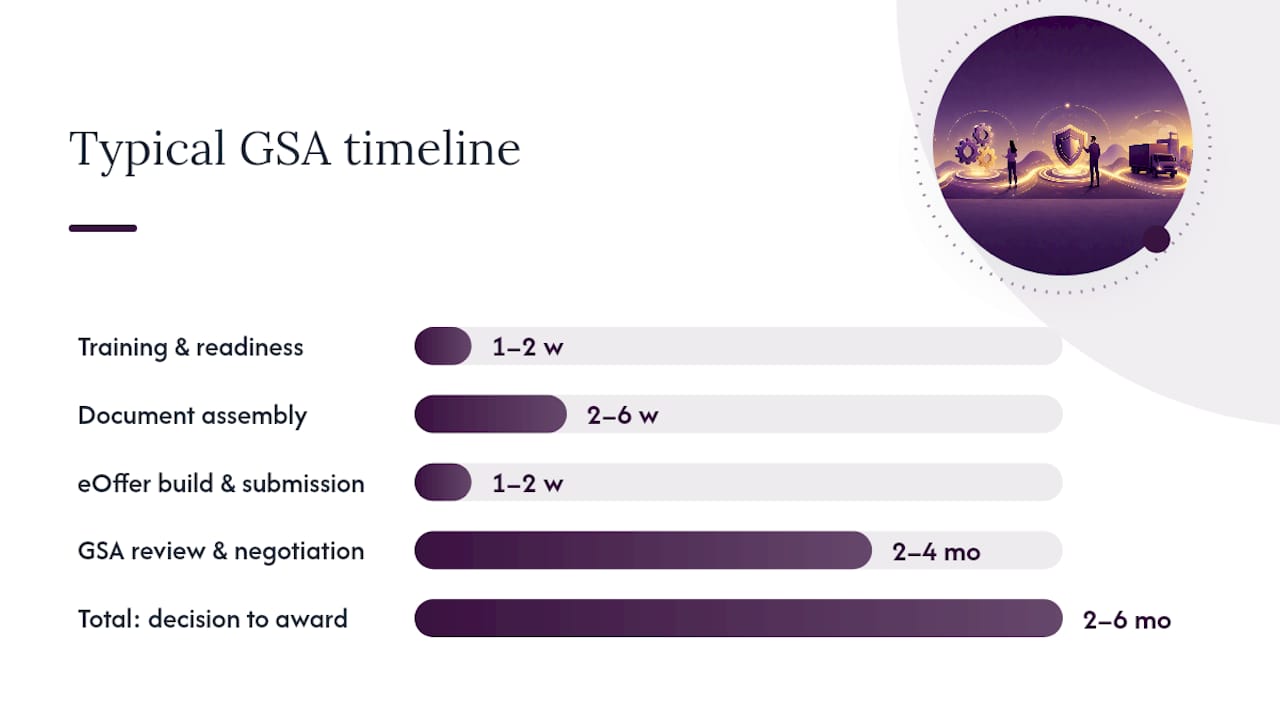
Prepared offerors with clean financials, strong past performance, and complete documentation land closer to the two-month end. Complex offers, clarification rounds, or incomplete submissions push toward six months or beyond.
Cost buckets to plan for: significant internal labor time for a first-time applicant, possible consulting fees for offer preparation and negotiation support, the ongoing IFF, and the opportunity cost of business development time post-award.
Streamlined offer criteria in the solicitation can shorten review time for qualifying offerors. Check the solicitation document to see if your offer qualifies.
Why the upfront work on a Schedule is worth it for most SMBs
The conventional wisdom treats the MAS application as a bureaucratic obstacle. That framing misses the point. The process is designed to pre-qualify you as a trusted vendor for the entire federal government — not just one agency, not one contract. Once you’re on Schedule, any ordering activity can buy from you directly without a full competition.
What SMB leaders consistently underestimate is the post-award marketing requirement. The Schedule is a license, not a lead. Businesses that treat award as the finish line typically see minimal sales in year one. The ones that build a target agency list, respond to every relevant eBuy RFQ, and update their GSA Advantage! listing quarterly are the ones generating steady pipeline by year two.
The lead time is real. Plan for 2–6 months to award, then another 6–12 months before federal sales become a reliable revenue line. That timeline is worth it for businesses with a long-term federal strategy. For businesses chasing a single contract, a different vehicle is probably the right answer.
Gsascheduleservices handles the process so you can focus on selling
Getting on a GSA Schedule is a full documentation and compliance project before it’s a sales channel. Gsascheduleservices works with SMB owners who want the Schedule without spending 200 internal hours learning the solicitation from scratch. The service covers eligibility assessment, full offer preparation, pricing development, eOffer submission, negotiation support, and post-award maintenance — everything from SAM.gov registration through your first sales report.
For businesses that want help with a specific phase (offer-only, pricing, or ongoing compliance retainer), tiered options are available. The starting point is a discovery call and readiness assessment that tells you exactly where you stand and what it will take to get to award.
Sources
Bookmark these before starting your offer:
Save PDFs of the solicitation and category attachments locally. GSA updates refreshes periodically, and working from a cached version of the wrong refresh is a common source of errors.
FAQ
What does “contract schedule” mean in federal contracting?
A contract schedule refers to a GSA Multiple Award Schedule (MAS), a long-term government contract vehicle that lets pre-approved vendors sell commercial products and services to federal agencies at negotiated prices.
How long does it take to get a GSA Schedule?
Prepared offerors typically reach award in 2–6 months; incomplete submissions or clarification rounds can push that timeline considerably longer.
What are the basic eligibility requirements for a MAS contract?
GSA generally requires two years in business, two years of financial statements, and measurable past performance; the Startup Springboard program may waive some requirements for qualifying newer businesses.
Does a GSA Schedule guarantee federal sales?
No. A Schedule provides access to GSA Advantage!, eBuy, and direct RFQ channels, but active marketing and consistent RFQ responses are required to generate orders.
Can Gsascheduleservices help with the full application process?
Yes. Gsascheduleservices offers eligibility assessment, offer preparation, pricing development, eOffer submission support, and post-award maintenance — start with a discovery call to assess your readiness.
Recommended
- GSA Schedule Contracts: Your Guide to Success
- Done-for-You GSA Schedule Consulting | GSA Focus
- Done-for-You GSA Schedule Consulting | GSA Focus
- How to Grow a Small Business Through a GSA Schedule