

Whether the Most Favored Customer (MFC) / Basis of Award (BOA) pricing requirement applies to your GSA Schedule contract comes down to one question: does your contract still carry clause 552.238-81, or have you accepted a Transactional Data Reporting (TDR) modification? If 552.238-81 is in your contract, you are legally bound to maintain the BOA price relationship and report any price reductions to your Contracting Officer (CO). If you have accepted TDR, those legacy obligations no longer apply to covered SINs. Three things to do right now:
- Check your contract file for clause 552.238-81 (the Price Reductions Clause). If it is there and no TDR modification has been executed, MFC/BOA rules are in force.
- Log into the GSA Vendor Support Center (VSC) and confirm whether a TDR modification is on record for your contract and which SINs it covers.
- Pull your Commercial Sales Practices (CSP) disclosure and current BOA data from your FAS Catalog Platform file, or prepare your transactional data submissions if TDR is already active.
Key Takeaways
Whether MFC/BOA applies to your GSA Schedule contract depends entirely on whether clause 552.238-81 is still active or a TDR modification has replaced it for your covered SINs.
| Point | Details |
|---|---|
| Check your clause version first | Search your contract for 552.238-81; if present without a TDR mod, legacy BOA obligations are fully in force. |
| TDR eliminates BOA tracking | TDR participants do not maintain a BOA relationship or file CSP disclosures for covered SINs. |
| Price reduction triggers are broad | Any change that disturbs the BOA price relationship, including rebates, terms, or concessions, must be reported and offered to the government. |
| TDR shifts burden to data quality | GSA leadership projects up to $50 million in savings from TDR, but clean transactional records are now the compliance baseline. |
| Gsascheduleservices supports the transition | Gsascheduleservices offers readiness assessments, modification management, and audit response support to keep your contract compliant. |
Table of Contents
- What the GSA most favored customer clause actually means for your contract
- Which contracts are covered and how to check your status
- What to report, where, and when under PRC vs. TDR
- What triggers a price reduction and a worked example
- Consequences of a violation and how to respond step by step
- Practical compliance checklist for day-to-day operations
- The shift to TDR changes more than just your paperwork
- GSA Schedule pricing compliance support for contractors
- Sources
- FAQ
What the GSA most favored customer clause actually means for your contract
The terms “Most Favored Customer” and “Basis of Award” are used interchangeably in GSA practice, and both refer to the same contractual mechanism. When you negotiate a GSA Schedule contract, the CO and your company agree on a specific commercial customer or category of customers whose pricing and discount terms the government will track. That customer or category is your BOA customer. The government’s Schedule price must maintain the same relationship to your BOA customer’s price throughout the life of the contract.
The operative clause is GSAR 552.238-81, the Price Reductions Clause. Its core obligation is straightforward: if you give your BOA customer a better deal than the one the government is getting, you have triggered a price reduction and must report it and offer the government a matching reduction.
The clause covers more than just the unit price. Discounts, concessions, special terms, and any other element that affects the net price to the BOA customer can trigger the reporting obligation if they disturb the established relationship.
The TDR alternative replaces this static BOA comparison with transactional data submissions. Under TDR, contractors do not maintain a BOA relationship for covered SINs and are not subject to the legacy PRC tracking obligations. The enforcement model shifts from “did you give your BOA customer a better deal?” to “what are you actually selling, to whom, and at what price?”
Which contracts are covered and how to check your status
Not every GSA Schedule contractor is in the same position right now. Some contracts still carry the full legacy PRC/BOA framework. Others have accepted TDR modifications. A few are split: partially TDR-covered by SIN and partially under legacy PRC until subsequent refreshes or modifications are accepted.
Here is how to determine where you stand:
- Open your contract file and search for the text “552.238-81.” If that clause appears without a TDR alternate, legacy PRC obligations are active.
- Check your CO correspondence for any bilateral modification referencing TDR or Refresh 27. The modification must be fully executed (signed by both parties) to be effective.
- Log into the Vendor Support Center and navigate to your contract node. The VSC lists clause versions and modification history.
- Review your FAS Catalog Platform entry. If you are a TDR participant, the MFC/BOA fields will either be absent or flagged as not required for your covered SINs.
The modification mechanics matter here. Refresh 27 made TDR mandatory for eligible SINs, but the obligation does not kick in until the contractor accepts the modification. Until that bilateral mod is signed and in effect, every legacy PRC obligation remains fully enforceable, regardless of what Refresh 27 says at the policy level.
Pro Tip: Confirm the effective date of any TDR modification and map it to each SIN in your contract. Some contractors discover mid-audit that one SIN was excluded from the modification scope, leaving them unexpectedly subject to legacy BOA rules for that SIN alone.
What to report, where, and when under PRC vs. TDR
The reporting paths under legacy PRC and TDR are fundamentally different. Getting them confused is one of the most common compliance errors on GSA Schedule contracts.
Under legacy PRC (clause 552.238-81):
Contractors must maintain a CSP disclosure that identifies the BOA customer or category, the price/discount relationship established at award, and any changes to that relationship. When a price reduction occurs, the contractor must notify the CO in writing, describe the reduction, and offer the government a matching reduction. The FAS Catalog Platform file must reflect current pricing and the BOA data.
Under TDR:
GSA guidance explicitly states that TDR participants are not required to provide MFC/BOA entries in the FAS Catalog Platform or follow legacy PRC tracking for covered SINs. Instead, contractors submit transactional data (invoice-level records including order number, SIN, product/service description, unit price, quantity, and total price) on a monthly basis through the FAS Sales Reporting Portal (SRP).
| Dimension | Legacy PRC (552.238-81) | TDR Participants |
|---|---|---|
| Who it applies to | All MAS contractors without TDR mod | Contractors who accepted TDR modification for eligible SINs |
| Reporting required | CSP disclosure, BOA data in FAS Catalog Platform, written CO notification of reductions | Monthly transactional data via FAS SRP; no CSP/BOA entries required |
| Trigger events | Any change that disturbs the BOA price/discount relationship | No BOA trigger; oversight based on transaction-level analytics |
| Remedies | Notify CO, offer matching price reduction, possible retroactive adjustment | Data quality corrections; no BOA-based reduction offers |
| Operational impact | Ongoing BOA monitoring, catalog versioning, CO communications | Frequent, accurate invoice-level data submissions; clean ERP/billing data required |
Documentation checklist for audit readiness:
- Signed contract with all executed modifications (including any TDR mod)
- Current and historical CSP disclosures (legacy PRC contractors)
- Dated snapshots of FAS Catalog Platform submissions
- Commercial price lists and discount schedules, versioned by effective date
- Invoices and order records supporting transactional submissions (TDR contractors)
- Written CO notifications for any reported price reductions (legacy PRC)
For GSA pricing governance generally, maintaining versioned archives of every catalog submission is the single most effective way to limit dispute exposure during an audit.
What triggers a price reduction and a worked example
Under clause 552.238-81, a price reduction is triggered any time you change your pricing or discount terms in a way that disturbs the relationship between what the government pays and what your BOA customer pays. The triggers are broader than most contractors expect.
Common triggers:
- Direct discount increase to the BOA customer. You lower the unit price to your BOA customer below the level established at award.
- Special one-off concession. You offer the BOA customer a volume rebate, extended payment terms, or a bundled discount that effectively reduces their net price without changing the catalog price.
- New pricing tier. You create a new commercial pricing tier that the BOA customer qualifies for, and that tier is more favorable than the government’s current rate.
- Changes to ancillary terms. Free shipping, extended warranties, or service add-ons offered to the BOA customer that were not part of the original pricing relationship.
Worked example:
Assume your GSA Schedule contract was awarded with the following relationship:
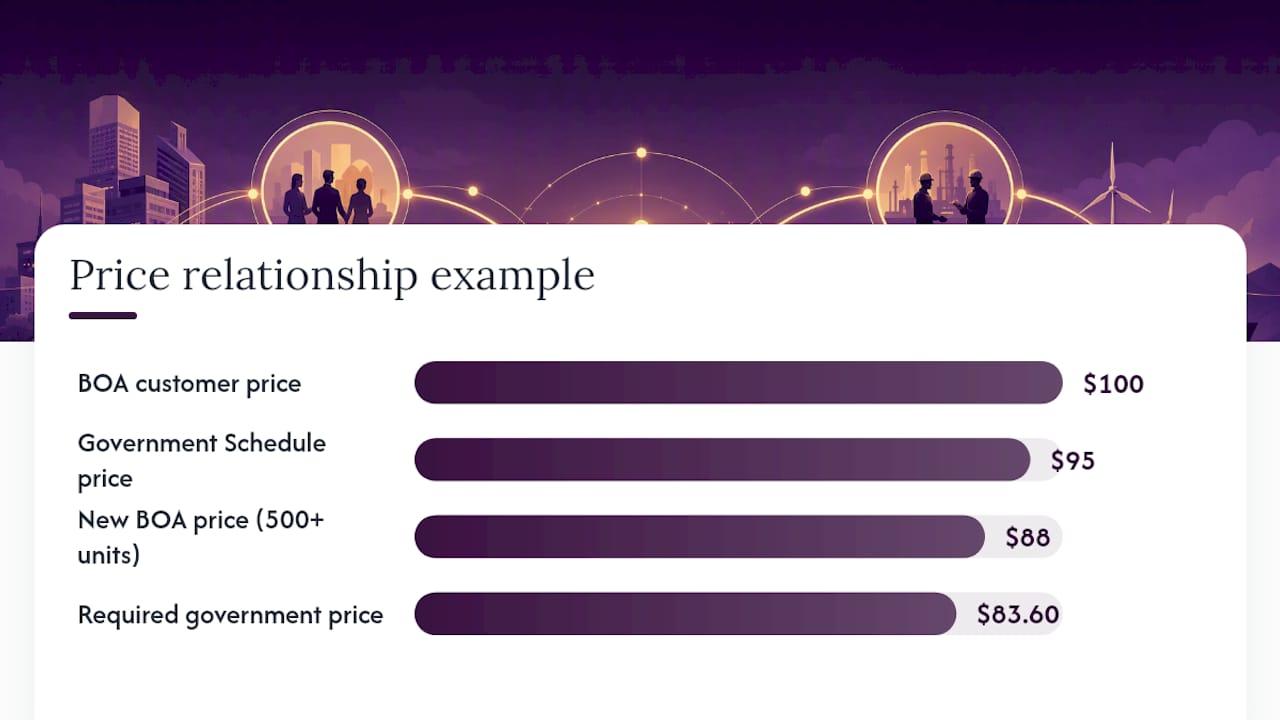
- BOA customer price: $100 per unit
- Government Schedule price: $95 per unit (a 5% discount to the BOA customer)
Six months into performance, your sales team offers the BOA customer a volume deal at $88 per unit for orders over 500 units. The new BOA customer price is $88. The government’s price must maintain at least the same 5% discount relationship.
Required government price: $88 × 0.95 = $83.60 per unit
Your current Schedule price of $95 now exceeds the required $83.60. You have a reportable price reduction. You must notify the CO, offer the government $83.60 per unit, and update your catalog accordingly.
Under TDR, this BOA comparison does not apply. GSA’s oversight instead uses transaction data to identify pricing patterns across the contractor base, a fundamentally different analytical model.
For a deeper look at how PRC and TDR compare operationally, the mechanics diverge significantly at the enforcement layer.
Consequences of a violation and how to respond step by step
Failing to report a price reduction under clause 552.238-81 is not a paperwork technicality. The government can seek a retroactive price adjustment covering every order placed during the period the unreported reduction was in effect. In cases involving knowing concealment or false certifications, exposure under the False Claims Act is a real possibility, carrying treble damages and civil penalties.
Immediate response sequence:
- Stop and document. Before notifying anyone externally, gather all relevant records: the commercial invoice or agreement that triggered the reduction, the current BOA data in your contract file, and the Schedule price in effect at the time.
- Notify your contracts and legal team. Do not let sales or pricing staff communicate with the CO before contracts counsel has reviewed the facts. Premature statements can escalate risk.
- Prepare a written notification to the CO. Describe the price reduction clearly, state the effective date, calculate the required government price using the BOA relationship, and offer the matching reduction.
- Consider a voluntary governmentwide price reduction. If the reduction is commercially significant, offering it across all Schedule orders rather than just to the CO can demonstrate good faith and limit audit exposure.
- Update the FAS Catalog Platform. Once the CO acknowledges the notification, update your catalog pricing to reflect the corrected rate.
- Retain all communications. Every email, modification, and acknowledgment from the CO becomes part of your compliance record.
Pro Tip: During initial fact-finding, avoid characterizing the situation as a “violation” in internal communications. Describe it as a “pricing review” until legal counsel has assessed the facts. This is not about concealment; it is about preserving the ability to present a complete, accurate picture to the CO.
Practical compliance checklist for day-to-day operations
Compliance with MFC/BOA and PRC obligations does not happen by accident. It requires a defined internal process, clear ownership, and a monitoring cadence that catches problems before they become reportable events.
Operational checklist:
- Assign a named owner (contracts or pricing manager) for every GSA Schedule pricing change.
- Require written approval before any commercial discount or concession is offered to the BOA customer or category.
- Version-control all FAS Catalog Platform submissions with effective dates.
- Conduct a quarterly reconciliation of commercial price lists against the current Schedule price.
- Maintain a cross-functional review (sales + pricing + contracts) for any pricing action that touches the BOA customer.
Monitoring cadence:
| Check | Frequency | Responsible Role |
|---|---|---|
| Commercial price list vs. Schedule price comparison | Monthly | Pricing Manager |
| BOA customer discount review (legacy PRC) | Quarterly | Contracts Manager |
| FAS Catalog Platform file accuracy | Quarterly | Contracts/Admin |
| TDR transactional data submission | Monthly | Finance/Billing |
| CO correspondence review | Ongoing | Contracts Manager |
| Audit readiness documentation check | Annually | Contracts + Legal |
Tooling and recordkeeping minimums:
Retain transaction-level invoices and order records for at least three years, or longer if your specific contract clauses require it. Your ERP or billing system should tag each transaction with the SIN, order number, and unit price so TDR submissions can be generated without manual reconstruction. For legacy PRC contractors, the CSP support file should live in a shared, access-controlled location alongside the contract file, not in a single employee’s inbox.
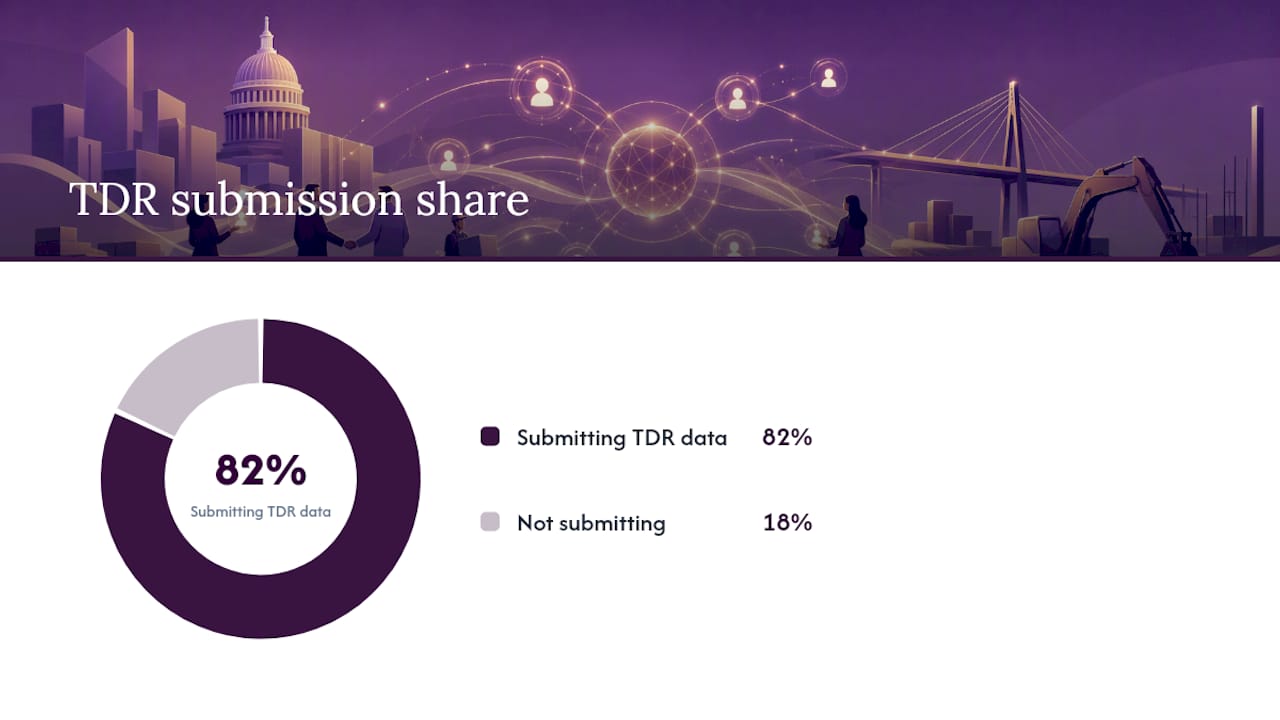
GSA leadership has stated that TDR implementation could save agencies and industry as much as $50 million in administrative costs, with one FAS office reporting that 82% of its contracts were already submitting TDR data. That trajectory means clean transactional data is increasingly becoming the baseline expectation.
The GSA Inspector General flagged data quality issues during TDR expansion, which means contractors who submit inaccurate or incomplete transactional data face heightened scrutiny as GSA tightens its oversight model.
Pro Tip: Maintain a versioned archive of every FAS Catalog Platform submission with a timestamp. When a CO or auditor asks when a price changed, a dated snapshot answers the question in minutes instead of days.
When the compliance picture gets complicated, whether that means a split SIN situation, a potential retroactive reduction, or a TDR data quality problem, bring in outside pricing counsel or a GSA contract specialist before engaging the CO. Scoping that engagement early is far cheaper than managing it after a formal inquiry.
For a broader GSA Schedule maintenance checklist, the same version-control and ownership principles apply across all contract obligations, not just pricing.
The shift to TDR changes more than just your paperwork
The move from legacy PRC to TDR is the most significant structural change to GSA Schedule pricing compliance in a generation. Most contractors focus on what they no longer have to do: maintain a BOA relationship, track MFC discounts, file CSP disclosures for covered SINs. That is the right instinct, but it misses the harder part.
TDR does not reduce compliance burden. It redirects it. The old model punished contractors for giving one customer a better deal than the government. The new model will flag contractors whose transaction data looks inconsistent, incomplete, or statistically anomalous compared to peers. That is a different kind of exposure, and it rewards contractors who treat their billing and ERP systems as compliance infrastructure, not just accounting tools.
The contractors who will struggle under full TDR implementation are not the ones who were gaming the BOA system. They are the ones who never built clean, auditable transaction records because the old model did not require them. Refresh 27’s mandatory TDR flow changes the enforcement model from comparing to a static BOA to relying on transaction data and analytics. That means data hygiene is now a pricing compliance issue.
Priority actions:
- Confirm your contract’s TDR modification status and which SINs are covered.
- Fix any recordkeeping gaps in your billing system before the next TDR submission cycle.
- Establish pricing governance: a named owner, a change-control process, and a quarterly review cadence.
Congressional activity in 2025 and 2026 also signals continued legislative interest in Schedule pricing reform, with H.R. 1118 among the measures addressing acquisition policy. The policy direction is clearly toward more data, more transparency, and less tolerance for contractors who cannot produce clean records on demand.
GSA Schedule pricing compliance support for contractors
Navigating the PRC-to-TDR transition while keeping your catalog current and your CO relationship intact is genuinely difficult work, especially for small and medium businesses without a dedicated contracts team. Gsascheduleservices provides hands-on support at every stage: readiness assessments that identify whether your contract is still under legacy BOA obligations or TDR-covered, CSP and price-list preparation, contract modification management for the TDR transition, and audit response preparation when a CO inquiry arrives.
The practical difference for most clients is speed and accuracy. Gsascheduleservices handles the documentation, the FAS Catalog Platform updates, and the CO communications so your pricing and sales teams can focus on winning orders rather than managing compliance files. For contractors in professional and technical services, where industry reporting shows tight margins and high audit sensitivity, that support pays for itself quickly.
This article is general information, not legal advice. For contract-specific interpretation, consult your Contracting Officer or qualified legal counsel.
Start with a compliance diagnostic to identify your current obligations and the fastest path to a clean, audit-ready contract file.
Sources
- Most Favored Customer / Basis of Award | Vendor Support Center
- Acquisition
- Transactional Data Reporting requirements | GSA
FAQ
What is the Most Favored Customer clause in a GSA contract?
The Most Favored Customer (MFC) clause, formalized as clause 552.238-81 (the Price Reductions Clause), requires contractors to maintain the price and discount relationship between the government and the commercial customer identified as the Basis of Award. Any change that gives the BOA customer a better deal triggers a reporting obligation and a required price offer to the government.
Does MFC/BOA apply if you are a TDR participant?
No. Contractors who have accepted a TDR modification for eligible SINs are not required to maintain a BOA relationship or file CSP disclosures for those SINs. The VSC and GSA’s TDR guidance both confirm this exemption explicitly.
What is an example of a Most Favored Customer clause trigger?
If your GSA Schedule price is $95 per unit based on a BOA customer price of $100, and you later offer that BOA customer a volume deal at $88, the government’s price must drop to $83.60 (maintaining the same 5% discount relationship). Failing to report and offer that reduction is a clause violation.
What happens if you miss a required price reduction report?
The government can seek a retroactive price adjustment covering all orders placed during the unreported period. In cases involving knowing concealment or false certifications, False Claims Act exposure is possible, carrying treble damages and civil penalties.
How do you check whether your GSA contract is under TDR or legacy PRC?
Search your contract file for clause 552.238-81 and check for any executed bilateral modification referencing TDR or Refresh 27. The GSA Vendor Support Center also lists clause versions and modification history for your contract node.
Recommended
- GSA Contract Eligibility Criteria – Quick Guide
- GSA Contract Eligibility Criteria – Quick Guide
- Fourth Step – GSA Registration (GSA Advantage, E-buy, … )
- Winning Business with a GSA Contract