

Reconciling your GSA Schedule terms and conditions means comparing every clause, price, product, and supplier agreement in your contract against what your business is actually doing — then correcting the gaps before an auditor finds them. The three immediate steps: assign one person as the reconciliation owner, pull your original award document plus every modification, and block 30–60 minutes this week to run through the checklist below. GSAM clause 552.212-71 governs the commercial terms in your contract; the GSA eMod/eOffer portal is where you fix anything that’s out of alignment; and Gsascheduleservices can handle the entire process for you if you’d rather not do it alone.
Start here:
- Assign a named reconciliation owner with calendar authority to schedule the review.
- Pull your original award, all approved modifications, and your current GSA-approved price list.
- Schedule a 30–60 minute reconciliation session within the next five business days.
Callout: Designate at least two authorized negotiators on your contract. GSA sends mass-mod notices to those contacts only. If one person leaves and the other misses the email, you can blow a 90-day acceptance window without realizing it.
Table of Contents
- What does “contract reconciliation” actually mean for MAS holders?
- How to reconcile your GSA T&Cs: the step-by-step checklist
- What to collect: building your living contract file
- How do you reconcile pricing, SIN lists, and TAA compliance?
- How do you submit modifications through eMod and eOffer?
- What internal controls keep reconciliation repeatable?
- What are the most common reconciliation problems and how do you fix them?
- When should you contact your CO or IOA, and what should you say?
- Sample reconciliation checklist and template you can use today
- Key Takeaways
- Why proactive reconciliation protects more than just compliance
- Gsascheduleservices makes reconciliation manageable for SMB contractors
- Useful sources and quick downloads
- FAQ
What does “contract reconciliation” actually mean for MAS holders?
Contract reconciliation, in the GSA Schedule context, is the process of comparing what your contract says against what your business is doing. That covers pricing, product and SIN listings, supplier agreements, clause compliance, and administrative data. It is not a one-time task at award; it is a recurring check that keeps your contract current and defensible.
The most common use-cases are: running a pre-audit self-check before a Contract Assessment Visit (CAV), reviewing the contract after any modification, updating the record when you add or drop products, and onboarding new sales staff or subcontractors who need to know the contract’s boundaries.
Understanding GSA T&Cs also means knowing the order of precedence. Federal law and the FAR govern first. The GSAR and GSAM follow. Your Commercial Supplier Agreements (CSAs) come last. Under GSAR 552.212-4, many CSA clauses — indemnification, forum selection, automatic renewals — are unenforceable against the government. That means a clause your supplier put in a commercial agreement may simply not apply to your GSA orders, and you need to know which ones before a dispute arises.
GSAM clause 552.212-71 is the specific provision that incorporates commercial supplier agreement terms into the MAS contract framework. It is the clause to check first when you are trying to interpret GSA terms that touch your supplier relationships.
How to reconcile your GSA T&Cs: the step-by-step checklist
This is the operational core. Work through these steps in order. The timeline column tells you when each stage should be complete.
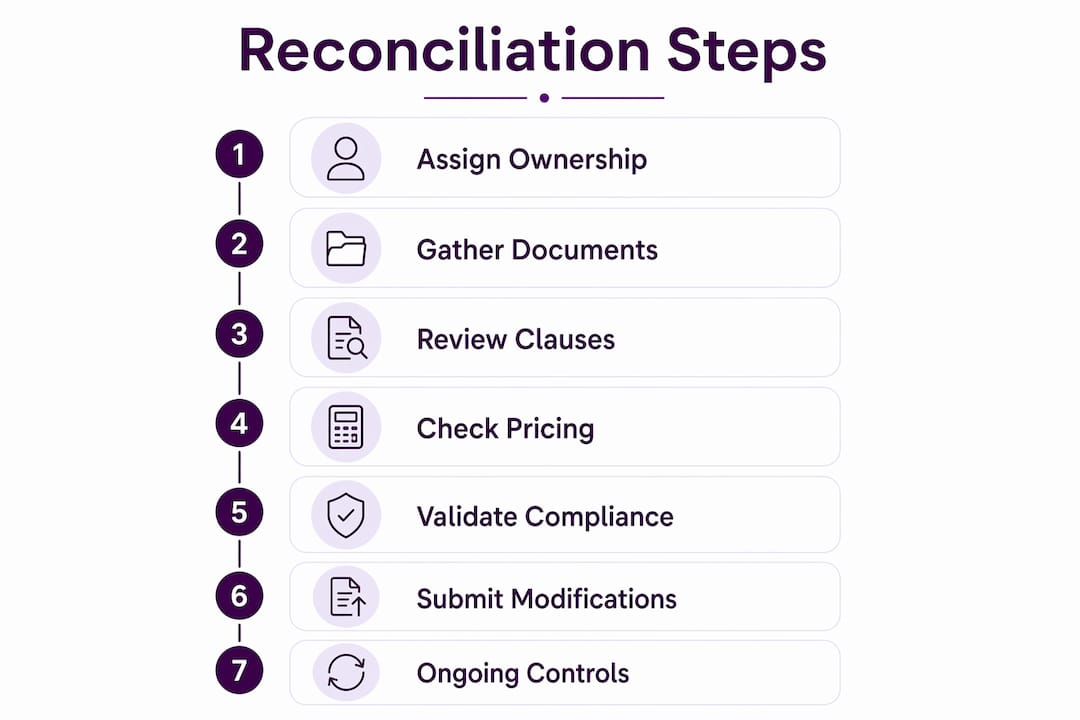
Assign ownership (Immediate). Name one person as the reconciliation lead. Give them access to the contract file, eMod/eOffer, and the CO’s contact information. Confirm two authorized negotiators are listed on the contract.
Gather all contract documents (Within 48 hours). Collect the original award, every approved modification (mass and individual), the current GSA-approved price list, all SIN/Schedule mappings, CSA texts, and all correspondence with your CO and Industrial Operations Analyst (IOA).
Inventory all clauses (Within 5 business days). List every GSAR/FAR/GSAM clause in the contract. Flag any clause that has a periodic action requirement (reporting, registration renewal, price list updates). Pay particular attention to 552.212-71, 552.238-80, and 552.238-82.
Reconcile pricing and product/SIN lists (Within 30 days). Compare every product and service on your current GSA Advantage price list against what you are actually selling. Identify any item sold outside the contract scope and stop those sales immediately.
Review all CSAs for unenforceable terms (Within 30 days). Check each supplier agreement against the Federal Register GSAR update from February 2018. Flag indemnification clauses, automatic renewal provisions, and forum-selection language — these do not apply to government orders.
Verify TAA compliance for every product (Within 30 days). Confirm country-of-origin for each item. Obtain updated supplier attestations. Document everything in the contract file.
Submit required modifications via eMod/eOffer (Within 60 days for identified gaps). Any pricing change, product addition or deletion, or material CSA change requires a formal modification. Do not make changes unilaterally.
Set a recurring review cadence (Ongoing). The GSA compliance checklist recommends monthly sales and TAA reviews, quarterly pricing audits, and annual checks for SAM.gov registration and security requirements.
Pro Tip: Before making any change that could affect government rights, pricing, or scope, contact your assigned MAS Contracting Officer first. A documented email exchange with the CO costs you 15 minutes and can prevent a compliance finding that costs you months.

What to collect: building your living contract file
An organized contract file is not just good practice. IOAs expect immediate access to your records during a CAV, and disorganized or incomplete files directly affect your contractor report card score.
Core documents to gather:
- Original contract award and all approved modifications (mass and individual), indexed by mod number and date
- Current GSA-approved price list (the version published on GSA Advantage)
- SIN and Schedule mappings showing which products/services fall under which Special Item Numbers
- All CSA texts from your commercial suppliers
- Correspondence with your CO and IOA, including emails, letters, and any written guidance received
- SAM.gov registration confirmation and renewal dates
- Sales reports submitted through the FAS Sales Reporting Portal
Clause inventory items to flag:
- 552.212-71 (commercial supplier agreement terms)
- 552.238-80 (Industrial Funding Fee and sales reporting)
- 552.238-82 (modifications and GSA Advantage catalog updates)
- 52.204-7 (SAM.gov registration — annual renewal required)
- Any custom contract-level language negotiated at award
Living file structure: Keep a master folder with subfolders for Award Documents, Modifications, Price Lists, CSAs, CO Correspondence, and Sales Reports. Every file should be named with the document type, date, and mod number where applicable.
| Document Type | Date | Mod Number | Notes |
|---|---|---|---|
| Original Award | MM/DD/YYYY | N/A | Base contract; all subsequent mods reference this |
| Mass Modification | MM/DD/YYYY | Mod #XXX | Accepted within 90-day window; signed copy on file |
| Individual Mod | MM/DD/YYYY | Mod #XXX | Price update / product addition; CO-approved |
| GSA Price List | MM/DD/YYYY | N/A | Current published version; matches GSA Advantage |
| CSA Text | MM/DD/YYYY | N/A | Supplier name; flagged unenforceable clauses noted |
| CO Correspondence | MM/DD/YYYY | N/A | Subject line; action taken or pending |
How do you reconcile pricing, SIN lists, and TAA compliance?
Pricing reconciliation is where most small businesses find their biggest gaps. The GSA-approved price list on GSA Advantage is the controlling document. If you are invoicing at a price not on that list, you have a compliance problem regardless of what your commercial price sheet says.
Steps to reconcile pricing and products:
- Pull your current GSA Advantage catalog and your internal invoice records for the past 12 months side by side.
- Identify every line item where the invoiced price differs from the GSA-approved price.
- Check whether any product or service was sold that does not appear under an active SIN on your contract.
- For any unauthorized sale, stop it immediately and document the discovery date and corrective action taken.
- Submit a modification through eMod/eOffer to add, delete, or reprice items as needed.
TAA compliance requires a separate check. The Trade Agreements Act restricts GSA Schedule products to those manufactured or substantially transformed in designated countries. For each product on your contract, verify the country of origin against the current TAA compliance guidance and obtain a written attestation from your supplier. Keep those attestations in the contract file with the product name, country of origin, and date of attestation.
CSA reconciliation follows the same logic. Under the February 2018 GSAR update, any CSA term that materially changes government rights or prices after award is unenforceable unless incorporated through a bilateral modification. Review each CSA for automatic renewal clauses, indemnification language, and jurisdiction provisions. Flag them, note them as unenforceable in your file, and coordinate with your CO if a bilateral mod is needed.

Pro Tip: Tag every GSA order in your accounting system and CRM at the point of entry. A simple “GSA” label on each transaction makes month-end reconciliation a 20-minute task instead of a three-hour audit.
How do you submit modifications through eMod and eOffer?
Every change to your contract — pricing, products, administrative contacts, or material CSA terms — must go through the GSA eMod/eOffer portal. Unilateral changes outside that system are not recognized and can put your contract at risk.
Log in to eMod/eOffer at the GSA portal and select the correct modification type: price modification, product/SIN addition or deletion, administrative modification (contact updates), or bilateral addendum for material CSA changes.
Prepare your attachments. The CO expects a cover letter explaining the change, a revised price list in the required format, supplier letters or TAA attestations where applicable, and any supporting documentation for the change (market research, invoices, manufacturer letters).
Draft the cover letter. GSA provides sample cover letter formats for common mod types including TDR-related and EPA method updates. Use the relevant template as your starting point.
Submit and track. After submission, monitor the eMod portal for CO responses. Response times vary by mod type and workload, but administrative mods typically process faster than price or scope changes.
For mass modifications: When GSA issues a mass mod, you will receive notice through your authorized negotiators. You must accept it within the 90-day window to remain compliant. Missing that window is one of the most common compliance failures on MAS contracts.
Common rejection reasons and how to avoid them:
- Incomplete price list format (use the GSA-required template exactly)
- Missing TAA attestations for new products
- Cover letter that does not clearly state the reason for the change
- Submitting a bilateral mod request without prior CO discussion
- Authorized negotiator listed on the mod does not match the contract record
For proposal-related work tied to your GSA opportunities, tools like RFP Forge AI can help you draft compliant proposal language faster, freeing time for the compliance tasks that require human judgment.
What internal controls keep reconciliation repeatable?
A one-time reconciliation fixes today’s problems. The controls below prevent tomorrow’s.
Monthly tasks:
- Reconcile all GSA sales against the approved price list and SIN assignments.
- Verify that the Industrial Funding Fee (IFF) has been calculated correctly on all sales.
- Confirm no products were sold outside the contract scope.
- Check that authorized negotiator contacts are current in eMod.
Quarterly tasks:
- Audit pricing against the most-favored-customer basis (if applicable to your contract).
- Review subcontracting goals and performance if your contract includes them.
- Pull a sales report from the FAS Sales Reporting Portal and reconcile it against internal records.
- Check GSA Advantage catalog for accuracy against the current approved price list.
Annual tasks:
- Renew SAM.gov registration before expiration (required under clause 52.204-7).
- Confirm all security and background check requirements are current.
- Review the full clause list for any new compliance obligations introduced by mass mods accepted during the year.
- Update the living contract file with all modifications accepted in the prior 12 months.
The person running the monthly reconciliation should not be the same person who approves invoices. That separation catches pricing errors before they become compliance findings. Assign a secondary reviewer for the quarterly audit, and document who ran each review and when in the contract file.
For a broader view of GSA Schedule compliance obligations, the recurring cadence above maps directly to the requirements in the GSA MAS Contractor Compliance Checklist.
What are the most common reconciliation problems and how do you fix them?
Most compliance failures on MAS contracts are not intentional. They are the result of process gaps: a mass mod that slipped through, a product added to the catalog without a formal modification, or a CSA that auto-renewed without anyone noticing.
Common pitfalls:
- Missing a mass-mod acceptance window (the 90-day clock starts when the notice is sent to your authorized negotiators)
- Selling products or services not listed under an active SIN
- Invoicing at prices not on the current GSA-approved price list
- CSA terms that auto-renewed or changed without a bilateral mod
- Incomplete or missing records for a CAV
- Authorized negotiator contacts that are outdated in eMod
Consequences of non-compliance include contract suspension, a negative contractor report card from the IOA, withheld payments, and increased scrutiny on future CAVs. Repeated findings can escalate to contract termination.
Remediation steps by issue type:
- Missed mass mod: Contact your CO immediately. Explain the gap, request guidance on late acceptance, and document the conversation. Do not ignore it.
- Unauthorized product sale: Stop the sales, document the discovery, issue a corrective mod through eMod, and notify the CO in writing.
- Pricing discrepancy: Identify the affected orders, calculate the overcharge or undercharge, submit a corrective mod, and issue credits or adjustments as directed by the CO.
- CSA conflict: Flag the clause, note it as unenforceable in the file, and coordinate a bilateral mod if the change was material.
- Incomplete records: Reconstruct what you can from email archives and the eMod portal, document the reconstruction process, and implement the living file structure going forward.
For a deeper look at the compliance risks that catch MAS holders off guard, the pattern is almost always the same: a gap in process, not a gap in intent.
Pro Tip: When you find and fix a compliance issue before the IOA does, document every step of the remediation in writing. A well-documented self-correction is evidence of good faith and significantly reduces enforcement risk.
When should you contact your CO or IOA, and what should you say?
Your Contracting Officer and Industrial Operations Analyst are not adversaries. Treated as partners, they can answer questions that would otherwise take weeks to resolve through trial and error.
Contact your CO when:
- You are considering any change that could affect contract scope, pricing, or government rights
- You receive a mass mod and are unsure whether it applies to your contract
- You discover a compliance gap and need guidance on remediation
- A CSA material change requires a bilateral modification
- There is a dispute about an order, invoice, or contract term
Contact your IOA when:
- You are preparing for a CAV and want to confirm what documentation to have ready
- You have questions about contractor report card ratings
- You need clarification on subcontracting or small business goals
Documents to have ready before you reach out:
- Your contract number and current modification number
- The specific clause or requirement in question
- Your current price list and the relevant SIN
- Any correspondence already exchanged on the issue
- A clear, one-paragraph summary of the question or problem
When you email the CO, be specific. “I am requesting guidance on whether the attached CSA renewal clause constitutes a material change under 552.212-71(w)(1)(vi)© and whether a bilateral mod is required” gets a faster, more useful response than a vague inquiry. Keep the email short, attach the relevant document, and ask for a written response so you have documentation.
Establish a periodic check-in cadence with your CO if your contract sees frequent changes. A brief quarterly email confirming no open issues builds the relationship and creates a paper trail of proactive compliance.
Sample reconciliation checklist and template you can use today
A reconciliation template does not need to be elaborate. The goal is a single file that captures every moving part of your contract so nothing falls through the cracks during a CAV or audit.
What the template should include:
- An inventory table (document type, date, mod number, notes — as shown in the contract file section above)
- A mod tracker (mod number, type, submission date, acceptance date, status)
- A pricing reconciliation worksheet (SIN, product/service description, GSA-approved price, current invoice price, variance)
- A CO communication log (date, subject, action required, action taken, date closed)
- A TAA attestation tracker (product name, country of origin, supplier attestation date, next review date)
First monthly reconciliation: a short workflow
- Open the pricing reconciliation worksheet and pull last month’s GSA invoices.
- Compare each line item against the current GSA Advantage price list.
- Flag any variance and note whether a mod is needed or whether it was a billing error.
- Open the mod tracker and confirm all pending mods have a status update.
- Check the CO communication log for any open action items.
- Update the inventory table if any new documents were received (mass mods, CO letters, updated CSAs).
- Sign and date the worksheet as the reconciliation owner.
The entire first run takes about 90 minutes. After the file is organized and the template is populated, monthly reviews typically run 20–30 minutes.
Gsascheduleservices can tailor this template to your specific contract structure, SIN assignments, and reporting requirements. Contractors who maintain an organized living file consistently report smoother CAVs and fewer follow-up requests from their IOA.
| Template Component | Purpose |
|---|---|
| Inventory table | Tracks all contract documents by type, date, and mod number |
| Mod tracker | Records submission and acceptance dates for all modifications |
| Pricing worksheet | Compares GSA-approved prices against actual invoices |
| CO communication log | Documents all CO/IOA contacts and action items |
| TAA attestation tracker | Confirms country-of-origin compliance for each product |
Key Takeaways
Reconciling your GSA Schedule T&Cs requires assigning clear ownership, maintaining a living contract file, reconciling pricing and SINs monthly, submitting corrections through eMod/eOffer, and establishing a documented review cadence.
| Point | Details |
|---|---|
| Assign ownership first | Name one reconciliation lead and confirm two authorized negotiators are current in eMod. |
| Build a living contract file | Index every award document, mod, price list, CSA, and CO correspondence by date and mod number. |
| Reconcile pricing monthly | Compare GSA Advantage prices against actual invoices every month; submit corrective mods for any variance. |
| Accept mass mods within 90 days | Missing the acceptance window is one of the most common MAS compliance failures; designate a backup contact. |
| Gsascheduleservices supports the process | Gsascheduleservices offers document preparation, eMod submission support, and ongoing compliance retainers for SMB contractors. |
Why proactive reconciliation protects more than just compliance
Most contractors treat reconciliation as a defensive task: something you do to avoid getting in trouble. That framing misses half the value.
A well-maintained contract file is also a revenue tool. When your price list is current and your SINs are accurate, you can respond to agency orders faster and with more confidence. Contractors who let their catalogs drift out of date often discover they have been leaving money on the table: products that could be sold under the contract are not listed, or prices that could have been updated to reflect market rates were never modified.
The contractors who get the most out of their MAS contracts treat the contract as a living document, not a filing cabinet artifact. They run the monthly reconciliation not because the IOA is watching but because it surfaces opportunities: a new SIN that fits a service they already provide, a pricing adjustment that makes them more competitive on GSA Advantage, a CSA conflict that, once resolved, removes a legal ambiguity that was quietly creating risk.
The cost of a compliance finding is not just the remediation work. It is the distraction, the relationship friction with the CO, and the contractor report card mark that follows you into the next CAV. Proactive reconciliation eliminates most of that risk before it materializes. The essential maintenance checklist for MAS holders covers the recurring obligations in detail, but the mindset shift matters as much as the checklist itself.
Gsascheduleservices makes reconciliation manageable for SMB contractors
Keeping a MAS contract current is a full compliance program in miniature: clause inventories, pricing reconciliation, mod submissions, TAA attestations, CO communications, and monthly sales reporting. For a small business without a dedicated contracts team, that workload lands on whoever has the least full schedule that week.
Gsascheduleservices handles the parts that require contract expertise so your team can focus on delivering. For a one-time reconciliation project, the engagement covers a full contract audit, gap identification, corrective mod preparation, and a living file setup you can maintain going forward. For contractors who want ongoing support, the monthly and quarterly retainer covers sales reconciliation, mod submissions, CO correspondence, and CAV preparation.
Both models are built for SMB contractors who need expert support without the overhead of a full-time contracts manager. To find out which engagement fits your situation, start with a discovery call and get a clear picture of where your contract stands today.
Useful sources and quick downloads
Save these links in your living contract file for quick reference during CAVs and audits.
- Requirements after getting a MAS contract (GSA) — The official GSA post-award checklist covering timelines, required actions, and clause references for MAS holders.
- Modification and mass modification guidance (GSA) — Covers eMod/eOffer submission rules, mass-mod acceptance windows, and authorized negotiator requirements.
- Commercial supplier agreements (GSA) — Explains which CSA clauses are unenforceable against the government and when bilateral mods are required.
- Federal Register Vol. 83, No. 36 (February 22, 2018) — The GSAR final rule establishing order of precedence and CSA protections for government orders.
- GSA MAS Contractor Compliance Checklist (GSA Welcome Package) — The official monthly/quarterly/annual compliance checklist; print it and keep it in your contract file.
- Comply with contractual requirements (GSA) — High-level overview of ongoing Schedule holder obligations including mass mod signing and catalog maintenance.
- Gsascheduleservices discovery page — Request a consultation for reconciliation support, eMod preparation, or ongoing compliance retainer services.
FAQ
What is contract reconciliation for a GSA Schedule?
Contract reconciliation is the process of comparing your MAS contract’s clauses, pricing, and product listings against your actual business practices to identify and correct any gaps before an audit or CAV.
How often should you reconcile your GSA Schedule T&Cs?
The GSA compliance checklist recommends monthly sales and TAA reviews, quarterly pricing audits, and annual checks for SAM.gov registration and security requirements.
What happens if you miss a mass modification acceptance window?
Missing the 90-day acceptance window is a compliance failure; contact your CO immediately, explain the gap, and request guidance on late acceptance before taking any other action.
What is a GSA Schedule (MAS) contract?
A Multiple Award Schedule (MAS) contract is a long-term government-wide contract that gives federal agencies a pre-negotiated, compliant vehicle to purchase commercial products and services; base periods are typically five years with options to extend.
How can Gsascheduleservices help with GSA agreement reconciliation?
Gsascheduleservices offers one-time reconciliation projects covering full contract audits, gap identification, and corrective mod preparation, as well as ongoing monthly and quarterly retainer support for SMB contractors who need expert help managing GSA terms and conditions.
Recommended
- An Essential Checklist to Maintain Your GSA Schedule Contract
- How and Why to assure TAA Compliance with your GSA Contract
- GSA Compliance: Don’t Get Lost | GSA Focus
- (Infographic) 25 Reasons GSA Contracts are Rejected