

A bridge contract is a short-term, sole-source award to an incumbent contractor that keeps critical services running while a competitive follow-on procurement is completed. If you hold a GSA Schedule and your contracting officer mentions a bridge action, your first moves matter: confirm your incumbent status in writing, verify whether the action will be placed against your existing Schedule or issued as a standalone contract, and pull your current pricelist and past performance documentation together immediately.
Three things to do right now if a bridge opportunity surfaces:
- Confirm the vehicle. Per DLAD 16.191, bridge actions include task orders and orders against GSA Schedule contracts above the Simplified Acquisition Threshold (SAT), so your Schedule may already be the intended vehicle.
- Preserve your pricing documentation. The contracting officer must justify price reasonableness on a new, independent contract action, not rely on your old contract’s rates.
- Request visibility into the Justification and Approval (J&A). The GAO found that the absence of a government-wide FAR definition for bridge contracts has made it harder for agencies to track and manage their use, which means oversight gaps can work against you if you are not proactive.
Gsascheduleservices.com helps GSA Schedule holders prepare exactly this kind of rapid-response documentation before an opportunity arises.
Table of Contents
- What is a bridge contract, and how does it differ from similar instruments?
- What do FAR, GAO, and agency guidance say about bridge contracts?
- When do agencies actually use bridge contracts?
- What are the real risks for contractors and agencies?
- How do bridge contracts interact with your GSA Schedule?
- Step-by-step: how should an SMB respond to a bridge opportunity?
- What do contracting officers need to approve a bridge contract?
- Template elements every SMB should prepare in advance
- How to limit your downside if you accept a bridge contract
- Key Takeaways
- What bridge contracts reveal about federal contracting readiness
- Ready to prepare for your next bridge or follow-on opportunity?
- Useful sources
- FAQ
What is a bridge contract, and how does it differ from similar instruments?
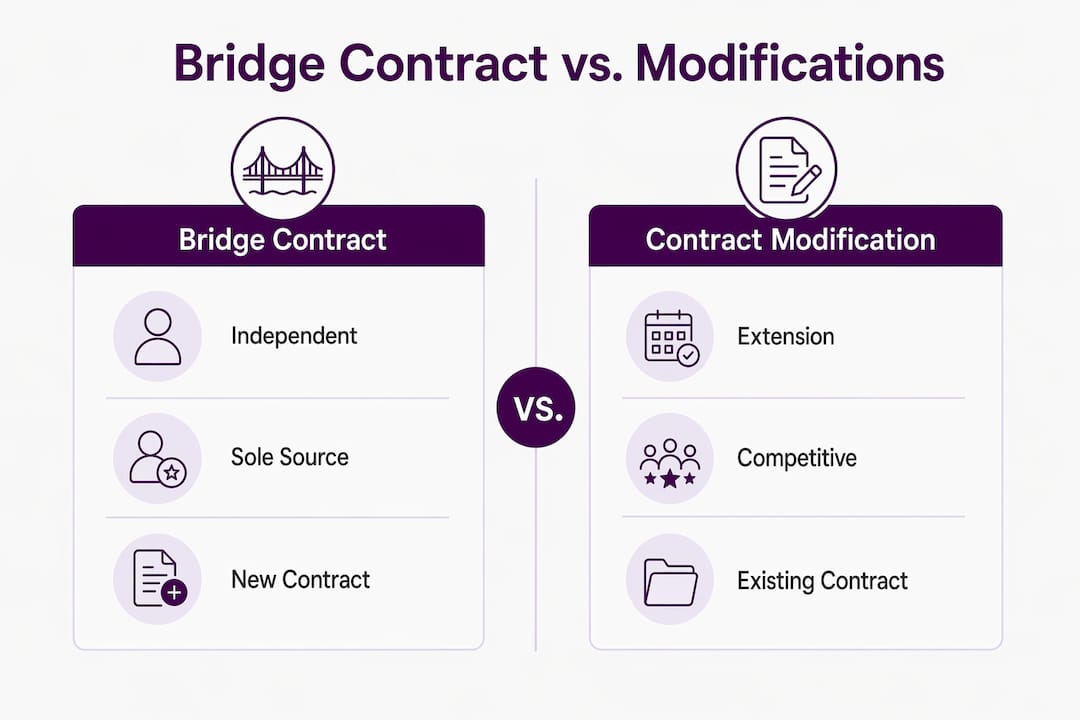
A bridge contract is a formal, independent acquisition, not a modification of an existing contract. DARS defines it as a short-term sole-source award to an incumbent to continue critical services until a competitive follow-on is established. That distinction matters in practice: the contracting officer must issue a new contract number, new terms, and new pricing documentation.

| Instrument | Competitive? | Issued to incumbent only? | Requires new contract action? | Typical trigger |
|---|---|---|---|---|
| Bridge contract | No (sole-source) | Yes | Yes | Follow-on delayed by protest, strategy change, or statute |
| Option-year extension | No | Yes | No (modification) | Preplanned option exercised within original terms |
| Stop-gap task order | Varies | Usually | Varies | Urgent need, short duration |
| Follow-on competitive award | Yes | No | Yes | Normal re-competition |
The practical difference for an SMB: if the agency exercises an option year, you are on familiar ground. A bridge is a new contract with new documentation requirements, even if the work looks identical.
What do FAR, GAO, and agency guidance say about bridge contracts?
No single FAR part uses the phrase “bridge contract” as a defined term. GAO recommended that OFPP develop a government-wide definition and interim guidance precisely because the gap hinders tracking and management. Without a universal definition, agencies have developed their own policies, with inconsistent results.
DLAD 16.191 fills part of that gap for Defense Logistics Agency components. It states plainly:
“Bridge contracts impede competitive awards, and contracting officers shall limit their use.” — DLAD 16.191(b)
The FAR Subpart 16.1 guidance adds that contracting officers must document that the delay is not due to poor planning or inadequate procurement execution. After GAO’s review, the Navy and DLA adopted definitions and tracking procedures. Most other agencies still have limited visibility into how often or how long their bridge actions run.
| Agency / body | Action taken |
|---|---|
| GAO | Recommended OFPP create government-wide definition and guidance |
| DLA | Adopted DLAD 16.191 definition and monthly reporting requirement |
| Navy | Implemented internal definition and tracking policy |
| OFPP/OMB | Recommendation outstanding as of GAO’s report |
When do agencies actually use bridge contracts?
Acquisition guidance lists four valid justifications, and only four. Understanding them helps you predict when a bridge is coming and position accordingly.
- Bid protest. A competitor protests the follow-on award or solicitation, and the agency needs to keep services running during the protest period, which can stretch three to six months or longer.
- Acquisition strategy change. The Head of Contracting Activity (HCA) endorses a shift in how the follow-on will be structured, such as moving from a single-award to a multiple-award vehicle.
- Statutory or regulatory change. A new law or rule requires the solicitation to be revised before award.
- Other non-planning delays. The contracting officer can demonstrate the delay is not their fault, such as a key personnel departure in the requiring activity or a budget continuing resolution that freezes new starts.
GAO’s review found that some bridge contracts spanned multiple years and a large portion covered professional management or IT services. For incumbent SMBs in those categories, a bridge that starts as a six-month stopgap can quietly become a multi-year arrangement if the follow-on keeps slipping.
Non-incumbents should understand the math clearly: these actions are typically sole-sourced to the incumbent to preserve continuity. Your energy is better spent positioning for the competitive follow-on than chasing a bridge you are unlikely to receive.
What are the real risks for contractors and agencies?
For agencies, the risks are competition loss, overpayment, and audit exposure. Without a market test, there is no guarantee the bridge price reflects current rates. GAO auditors observed that the lack of a formal FAR definition increases the risk of reduced competition and overpayments.
For contractors, the risks are subtler but real:
- Pricing lock-in. If you accept bridge rates without updating your GSA Schedule pricelist, you may anchor future negotiations at stale numbers.
- Scope creep. Agencies sometimes expand the work during a bridge period without a formal modification, creating performance and billing disputes.
- Audit exposure. Every bridge contract file is subject to review. If your invoices do not match the approved rates or the period of performance, you face potential recoupment demands.
- Reputational risk. A contractor that pushes for repeated bridges, rather than supporting a timely competitive re-procurement, can damage its relationship with the contracting office.
How do bridge contracts interact with your GSA Schedule?
DLAD 16.191(a) explicitly includes “orders against GSA Schedule contracts” within the definition of bridge contract actions. That means your Schedule can be the vehicle for a bridge, but the order still requires a new, independent action with fresh justification documentation.
“Contracting officers shall not use documents from an existing contract as substitutes for documents required in the bridge contract or incorporate terms and conditions from an existing contract into the new bridge contract by reference.” — DLAD 16.191(d)
For Schedule holders, this has a direct implication: your current pricelist must be active, accurate, and defensible at the moment the bridge order is placed. An outdated pricelist or a lapsed modification can stall the action or force a price negotiation you are not prepared for.
Pro Tip: Review your GSA Schedule pricelist and option periods every quarter, not just at renewal. A bridge order can arrive with 30 days’ notice, and a stale pricelist is the fastest way to lose the action to a sole-source justification problem.
Step-by-step: how should an SMB respond to a bridge opportunity?
Speed and documentation are everything. Here is the sequence that works.
- Verify incumbent status. Confirm in writing with the contracting officer that you are the intended awardee. Do not assume.
- Request J&A visibility. Ask to review the justification document. You have a right to understand the stated rationale and period of performance.
- Update your pricelist. Pull your current GSA Schedule rates and confirm they cover the anticipated scope. If rates need updating, start that process immediately.
- Assemble your response packet. Prepare a cover memo, updated pricelist excerpt, past performance summary (three to five relevant projects), key personnel CVs, and a brief rate justification narrative.
- Confirm the period of performance in writing. Get the start and end dates documented before you mobilize staff or incur costs.
- Stay visible for the follow-on. Attend any industry days, respond to Requests for Information, and submit capability statements for the competitive re-procurement. The bridge is temporary; the follow-on is the prize.
For practical guidance on federal contracting success at each stage, Gsascheduleservices.com has resources mapped to exactly these steps.
- Keep a standing folder with your three most recent past performance write-ups, updated quarterly.
- Maintain a rate justification memo that explains how your GSA Schedule rates compare to market.
- Track the follow-on solicitation on SAM.gov from the moment the bridge is awarded.
Pro Tip: Register for SAM.gov email alerts on the parent procurement number the day the bridge is awarded. Agencies are required to synopsize the follow-on under FAR Subpart 5.2, and you want to be the first to respond.
What do contracting officers need to approve a bridge contract?
The approval chain is more involved than most contractors realize, and understanding it helps you set realistic timeline expectations.
“The approval authorities listed in 16.191©(3) must sign and approve the request before the contracting officer issues a solicitation or otherwise commences negotiations for award of the bridge.” — DLAD 16.191©(2)
For a first bridge, the contracting officer recommends and the HCA approves. The HCA may delegate to the CCO for actions up to $1 million. A second bridge requires HCA recommendation and DLA Competition Advocate approval. Any bridge beyond the second requires HCA, Competition Advocate, and Senior Procurement Executive (SPE) approval. The recommending and approving authorities cannot be the same person at any tier.
The justification document itself must include four specific elements per DLAD 16.191©(1): a clear statement that the action is a bridge, a detailed rationale showing the delay is not due to poor planning, a length justification, and a discussion of steps to avoid future bridge requests. The contracting officer must also prepare a Decision Memorandum before any solicitation or negotiation begins.
Template elements every SMB should prepare in advance
You will not have time to build these from scratch when a bridge surfaces. Keep them ready.
- Cover memo: One page. State your contract number, period of performance, scope summary, and proposed bridge period. Reference the applicable FAR authority.
- Pricelist excerpt: Pull the relevant labor categories or line items from your current GSA Schedule. Include the effective date and any pending modifications.
- Past performance summary: Three to five projects, each with a point of contact, contract value, period of performance, and two sentences on relevance.
- Rate justification narrative: Explain why your rates are fair and reasonable. Reference your GSA Schedule as the price benchmark and note any market comparisons.
- Key personnel CVs: One page each, current, with clearance levels if applicable.
Pro Tip: Frame your rate justification around your GSA Schedule pricing. Contracting officers are already familiar with Schedule rates as a price reasonableness benchmark, and citing your own Schedule pricelist shortens the negotiation considerably.
For contract clause guidance and template language that holds up under audit, external legal-drafting resources can supplement your internal preparation.
How to limit your downside if you accept a bridge contract
Not every bridge is a gift. Some are traps.
- Cap the period of performance. Push for the shortest defensible period, typically 3–6 months. A longer bridge reduces pressure on the agency to complete the follow-on.
- Get the follow-on timeline in writing. Ask the contracting officer to include a projected solicitation release date in the bridge documentation.
- Document your costs separately. Keep bridge-period invoices and timesheets in a dedicated folder. If the bridge is later audited, clean records are your defense.
- Negotiate a clear scope statement. Vague scope in a bridge is an invitation for scope creep. Define deliverables, locations, and personnel requirements explicitly.
“Approval to award a bridge contract does not relieve the contracting officer from any other regulatory requirements that the contracting officer must fulfill before making an award.” — DLAD 16.191(d)
Watch for these red flags: a bridge with no stated follow-on timeline, a period of performance longer than 12 months on a first bridge, or a contracting officer who cannot name the planned competitive vehicle. Any of these suggests the bridge may be a workaround rather than a genuine transition agreement.
Key Takeaways
A bridge contract is a sole-source, independent acquisition that keeps services running while a competitive follow-on is prepared, and GSA Schedule holders must treat it as a new contract action with fresh documentation, updated pricing, and a clear eye on the follow-on competition.
| Point | Details |
|---|---|
| Independent acquisition | A bridge is a new contract, not a modification; it requires its own J&A, Decision Memorandum, and pricing. |
| Incumbent advantage | Bridge actions are typically sole-sourced to the incumbent; non-incumbents should focus on the follow-on. |
| Approval tiers matter | First bridges need HCA approval; second bridges require the Competition Advocate; additional bridges need SPE sign-off. |
| GSA Schedule applicability | Orders against a GSA Schedule can qualify as bridge contracts and still require fresh justification documentation. |
| Gsascheduleservices.com support | Gsascheduleservices.com provides readiness assessments, pricelist updates, and J&A support mapped to bridge documentation requirements. |
What bridge contracts reveal about federal contracting readiness
The contractors who handle bridge situations well are almost never the ones who scramble when the call comes. They are the ones who already have a current pricelist, a clean past performance folder, and a relationship with their contracting officer that goes beyond the last invoice. What bridge contracts actually expose is a readiness gap, and most SMBs do not know the gap exists until the phone rings.
The conventional wisdom is that a bridge is a gift to the incumbent. Sometimes it is. But a bridge awarded at stale rates, with vague scope and no follow-on timeline, can quietly erode your margin and your competitive position at the same time. The smarter play is to treat every bridge as a 90-day clock on the follow-on competition, not as a revenue extension. Use the time to update your capabilities statement, refresh your Schedule pricelist, and get in front of the program office before the solicitation drops.
The GAO’s finding that agencies lack consistent tracking for bridge contracts is not just a government problem. It is a contractor intelligence problem. If your agency does not track bridges systematically, you need to track them yourself, by monitoring SAM.gov, maintaining relationships with contracting officers, and knowing your own contract’s option and expiration dates better than the CO does.
Ready to prepare for your next bridge or follow-on opportunity?
Gsascheduleservices.com offers readiness assessments, GSA Schedule pricelist updates, and J&A support built specifically for SMBs navigating short-term federal opportunities. Whether you are an incumbent preparing for a bridge action or a Schedule holder positioning for a competitive follow-on, the team can help you get your documentation in order before the clock starts. Start your readiness assessment and know exactly where you stand.
Useful sources
The following primary sources underpin the regulatory claims in this article.
“GAO recommended that OFPP develop a government-wide definition and interim guidance to help agencies track and manage bridge contracts.” — GAO-16-15, Sole Source Contracting: Defining and Tracking Bridge Contracts Would Help Agencies Manage Their Use
- DLAD 16.191 Bridge contracts — The primary acquisition regulation governing bridge contract use, justification, approval tiers, and reporting for DLA components. Includes the four valid justifications and the independent-acquisition requirement.
- GAO-16-15 full report — GAO’s in-depth review of bridge contract use across federal agencies, including findings on duration, service categories, and agency-level policy gaps.
- FAR Subpart 16.1, Acquisition.GOV — Governing FAR language on contract type selection, including Decision Memorandum and justification requirements for bridge actions.
- DARS 5817.000 Definitions — Defense Acquisition Regulation Supplement definition of bridge contracts as short-term sole-source awards to incumbents.
- Gsascheduleservices.com Discovery — Applied readiness and J&A support for GSA Schedule holders preparing for bridge or follow-on opportunities.
For a broader view of federal procurement policy and how FAR documentation requirements apply to short-term awards, Gsascheduleservices.com’s blog covers the practical steps in plain language.
FAQ
What exactly is a bridge contract in federal procurement?
A bridge contract is a short-term, sole-source award to an incumbent contractor that keeps services running while a competitive follow-on procurement is finalized. It is issued as an independent contract action, not a modification of the existing contract.
Can a bridge contract be placed against a GSA Schedule?
Yes. DLAD 16.191(a) explicitly includes orders against GSA Schedule contracts within the bridge contract definition, provided the total estimated value exceeds the Simplified Acquisition Threshold and a proper justification is prepared.
How long can a bridge contract last?
There is no hard statutory cap, but acquisition guidance requires the contracting officer to justify the length and document steps to avoid repeat bridges. GAO found that some bridge scenarios extended beyond three years, which is a sign of systemic procurement problems, not normal practice.
Who approves a bridge contract?
For a first bridge, the HCA approves (or delegates to the CCO for actions up to $1 million). A second bridge requires the DLA Competition Advocate. Any bridge beyond the second requires SPE approval. The recommending and approving authorities must be different people at every tier.
What should a non-incumbent SMB do when a bridge contract is awarded to a competitor?
Focus on the competitive follow-on. Monitor SAM.gov for the solicitation, attend any industry days, submit a capability statement to the program office, and ensure your GSA Schedule pricelist is current so you can respond quickly when the re-competition opens.
Recommended
- An Essential Checklist to Maintain Your GSA Schedule Contract
- Considering a GSA Schedule contract? Here’s What You Need to Know
- GSA Contract Eligibility Criteria – Quick Guide
- GSA Contract Eligibility Criteria – Quick Guide