
What are the top Fedmarket.com alternatives right now?
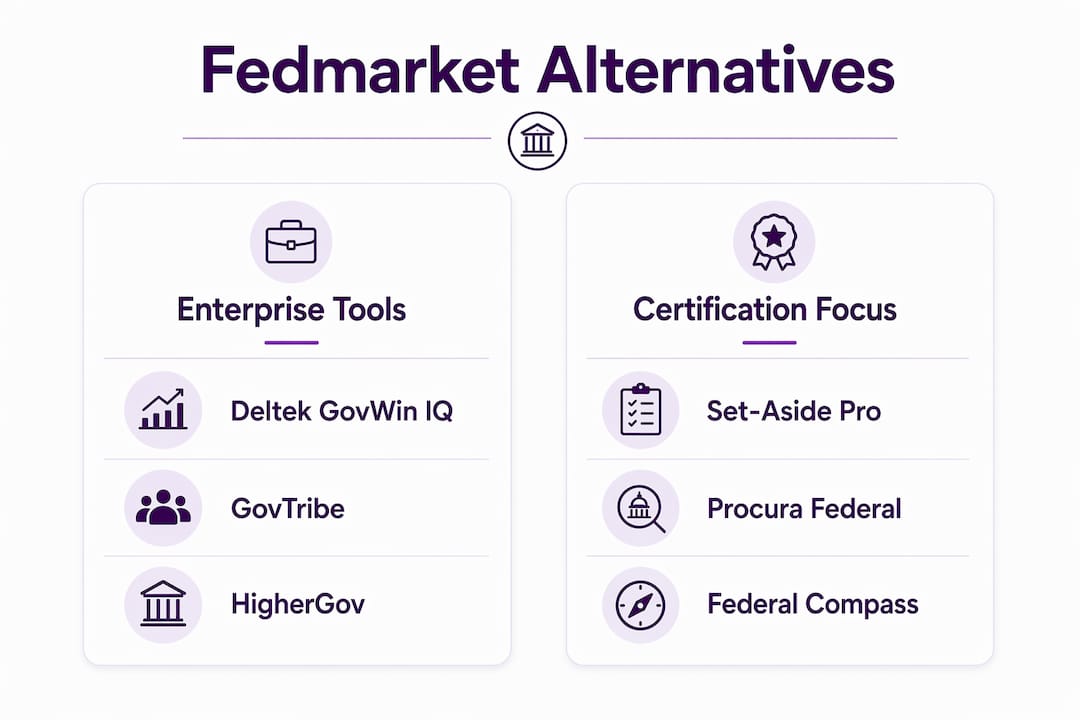
The strongest fedmarket.com alternatives in 2026 are Deltek GovWin IQ for enterprise capture teams, GovTribe and HigherGov for mid-market contractors, Set-Aside Pro for small businesses focused on set-aside certifications, and SAM.gov as the free mandatory baseline every contractor needs. Procura Federal and Federal Compass round out the AI-powered intelligence tier, while USAspending.gov and GSA eBuy fill specific research and RFQ roles at no cost.
Here is what separates a useful platform from an expensive one you barely open: AI-powered opportunity matching, transparent pricing, and coverage that fits your actual contract size. The table below maps each platform against the dimensions that matter most for small and medium contractors.
| Platform | Pricing | Best For | Key Features | Support | Deployment |
|---|---|---|---|---|---|
| Fedmarket Proposal Architect | Not publicly listed | Mid-sized businesses | Proposal authoring, set-aside tracking, opportunity management | Standard | Cloud |
| Set-Aside Pro | Not publicly listed | Small 8(a), SDVOSB, WOSB contractors | Deep set-aside filtering, AI solicitation analysis | Standard | Cloud |
| Procura Federal | Not publicly listed | AI opportunity matching | AI forecasting, proposal support, federal market intelligence | Standard | Cloud |
| Deltek GovWin IQ | — | Large capture teams | Pre-RFP forecasting, agency budgets, relationship intelligence | Dedicated | Cloud |
| GovTribe | Tiered, publicly listed | Mid-market federal and state | SAM.gov integration, pipeline management, opportunity alerts | Standard | Cloud/Mobile |
| HigherGov | Free trial available | Contractors needing real-time AI data | Real-time data integration, AI business development tools, teaming | Analyst support | Cloud |
| Federal Compass | Not publicly listed | Award history and pricing intel | Competitor analysis, award histories, pricing benchmarks | Standard | Cloud |
| SAM.gov | Free | All contractors (mandatory) | Federal solicitations, contractor registration, award data | Gov. support | Web |
| USAspending.gov | Free | Historical award research | Federal spending data, award summaries, agency breakdowns | Gov. support | Web |
| GSA eBuy | Free | GSA Schedule holders | RFQ posting, schedule-based opportunities | Gov. support | Web |
Key qualities to look for across any of these platforms:
- AI tools: Solicitation analysis, go/no-go scoring, and proposal drafting save hours per pursuit.
- Federal and state coverage: Platforms covering both SAM.gov and state/local sources give you a fuller pipeline view.
- Proposal drafting: Built-in drafting tools matter more than most contractors realize until they are staring at a 72-hour turnaround.
- Pricing transparency: Legacy platforms often lock contractors into annual contracts with auto-renewal clauses. Month-to-month options reduce risk for smaller firms.
- Deployment and mobile access: Cloud-based tools with mobile apps let your team track opportunities without being desk-bound.
How do these platforms compare in depth on features and pricing?
The gap between Fedmarket Proposal Architect and its competitors is mostly about scope. Fedmarket Proposal Architect focuses tightly on proposal authoring and opportunity management, with a user-friendly interface and set-aside tracking built in. It suits mid-sized businesses that want one tool for both writing and tracking, but it does not offer the pre-solicitation forecasting or agency budget intelligence that larger platforms provide.
Set-Aside Pro and Procura Federal
Set-Aside Pro fills a specific gap: contractors with 8(a), SDVOSB, HUBZone, or WOSB certifications get deep filtering that generic platforms miss. Its AI solicitation analysis helps small firms quickly assess whether a contract is worth pursuing before spending hours on a bid. Procura Federal takes a broader approach, using AI-driven forecasting and opportunity matching across the full federal market. Both are built for contractors who want speed over depth of pre-RFP intelligence.
Deltek GovWin IQ
GovWin IQ is the category leader for enterprise capture teams. It offers pre-solicitation forecasts, agency budget data, and relationship intelligence that no other platform matches at scale. The catch is the price: this platform is typically very costly and generally suitable only for large-scale contracting pursuits. Enterprise platforms like GovWin IQ are optimized for multi-million dollar pursuits with long sales cycles, often yielding poor ROI for smaller firms. If your pipeline is under $5 million in annual pursuits, the math rarely works out.

GovTribe and HigherGov
GovTribe sits in a comfortable middle ground. Its SAM.gov integration is strong, pipeline management is genuinely usable, and it covers both federal and state sources. Mid-market contractors who need breadth without enterprise pricing tend to land here. HigherGov takes a different angle: it integrates real-time government data with AI-driven business development tools, and its analyst support goes beyond what most platforms offer. One verified user noted that a HigherGov support analyst helped with niche data needs not covered by their plan, which is the kind of thing that rarely happens with larger enterprise vendors.
Federal Compass
Federal Compass is the go-to for contractors who care most about competitive intelligence. Its award history data and pricing benchmarks let you see what competitors have won and at what price, which is genuinely useful when building a price-to-win strategy. The interface is clean, and the competitor analysis tools are more accessible than GovWin’s equivalent features.
Pro Tip: Before committing to any paid platform, ask specifically whether the contract auto-renews and what the notice period is. Legacy intelligence platforms often require 60-day or longer cancellation notices, which can trap small businesses in a second year they did not plan for.
How do you choose the right government contracting platform?
The right platform depends on four things: your business size, your budget, the contract types you pursue, and how much of your workflow you want the tool to handle.
Start with business size and budget. Enterprise tools are best for large capture teams with complex needs, whereas smaller contractors benefit from AI-native platforms tuned for speed and cost. If you are a firm with fewer than 50 employees, an expensive annual subscription to GovWin IQ is almost never justified unless you are actively pursuing very large contracts.
Match features to your actual workflow. A proposal writer who needs drafting support should prioritize platforms with built-in AI proposal tools. A business development manager building a long-term pipeline needs forecasting and alert features. Not every platform does both well.
Evaluation criteria worth checking before you sign anything:
- Pricing structure: Is it monthly or annual? Is pricing published, or do you need a sales call?
- AI integration: Does the platform offer solicitation analysis, fit scoring, or proposal drafting, or just search?
- Target business size: Some platforms are built for teams of 10; others assume you have a dedicated capture department.
- User experience: A tool your team will not use is a tool that costs money for nothing.
- Security and data privacy: Federal contractors handle sensitive data. Check whether the platform is FedRAMP authorized or at minimum SOC 2 compliant.
- Scalability: Can the platform grow with you, or will you need to switch tools in two years?
- Trial periods and demos: Any reputable platform offers a demo or free trial. If they push you straight to a contract, that is a warning sign.
Pro Tip: The best setup for small businesses often combines a self-service discovery tool with free government portals and occasional use of research resources for competitive intelligence. You do not need a single expensive platform to do everything.
Which free government portals should every contractor use?
Three official portals are non-negotiable, regardless of which paid tool you choose.
SAM.gov is the mandatory starting point. SAM.gov is the official government hub for all federal solicitations above a financial threshold, and contractor registration lives here too. You cannot receive a federal contract without an active SAM.gov registration. The search experience is basic, and thousands of contractors invest in paid alternatives specifically because SAM.gov’s filtering and alerting fall short. But it is free, authoritative, and the primary source every commercial tool pulls from.
USAspending.gov gives you the historical award data that SAM.gov does not. You can look up what any agency has spent, who won which contracts, and at what dollar values, going back years. The Federal Spending Guide published by USAspending.gov explains how award and account spending data is structured, including the distinction between financial assistance and contract spending. For market research and price-to-win analysis, this is an underused resource.
GSA eBuy is specifically for GSA Schedule holders. It posts RFQs from federal agencies looking to buy through existing schedule contracts. If you hold a GSA Schedule, checking eBuy regularly is not optional.
Key limitations of these free portals:
- SAM.gov does not offer pre-solicitation forecasting or agency budget intelligence.
- USAspending.gov requires you to know what you are looking for; it does not push alerts or score opportunities.
- GSA eBuy is limited to schedule-based RFQs and does not cover open-market opportunities.
SAM.gov provides a mandatory front door for current opportunities, while platforms like GovWin IQ offer pre-RFP lifecycle intelligence to give bidders early competitive insight. The free portals are the floor, not the ceiling.
How do you build a strong government business development pipeline?
A reliable pipeline does not come from one tool. It comes from combining free portals with a paid platform and running a consistent workflow.
The most effective structure looks like this: use SAM.gov or a paid discovery tool for daily opportunity alerts, USAspending.gov for historical research when entering a new agency or market, and a commercial platform for forecasting and proposal support. Contractors who rely on a single source miss opportunities that show up elsewhere first.
Pipeline-building practices that actually work:
- Set up keyword alerts in your paid platform and in SAM.gov. Opportunities move fast, and manual searching every day is not sustainable.
- Combine free and paid sources. Free portals give you the official data; paid tools give you the context, forecasting, and AI analysis that turn raw data into a bid decision.
- Use AI for proposal drafting, but feed it your own content. AI-powered drafting tools improve proposal production speed but require integration of institutional knowledge for quality output. A generic AI draft without your past performance and resumes will not win. Integrating your own past performance into AI proposal drafting tools is critical to producing high-quality bids.
- Track teaming and subcontractor relationships. Platforms like HigherGov have built specific tools for finding teaming partners, which is one of the harder problems in federal business development.
- Prioritize by probability, not just value. A $500,000 recompete where you know the incumbent is struggling beats a $5 million new award where you have no relationships.
Pro Tip: Use Federal Compass or USAspending.gov to pull competitor award histories before you price a bid. Knowing what the incumbent charged in the last contract period is one of the most direct inputs to a competitive price-to-win analysis.
What every contractor should know about federal procurement policy
Federal procurement policy shapes what platforms need to do and what contractors are required to track. Getting this wrong is expensive.
The Office of Federal Procurement Policy (OFPP) was established by Congress in 1974 to provide overall direction for government-wide procurement policies, regulations, and procedures. OFPP sits within the Office of Management and Budget and reviews approximately 200 rules per year. Its primary tool is the Federal Acquisition Regulation (FAR), the government-wide regulation governing agency acquisitions of goods and services. Every federal contract is governed by the FAR, which means every contracting platform worth using needs to reflect FAR compliance requirements in its templates and workflows.
The distinction between prime contractors and subcontractors matters for platform selection. A prime contractor is an entity contracting directly with the federal government, distinct from subcontractors who perform work under those contracts. Prime contractors carry full regulatory responsibility, including compliance reporting, small business subcontracting plans, and performance documentation. Subcontractors have fewer direct obligations but still need to appear in the right databases to be found by primes looking for teaming partners.
Key regulatory considerations that affect which platform you need:
- SAM.gov registration is mandatory for all prime contractors. No registration, no award.
- Small business set-aside compliance: Platforms like Set-Aside Pro are built specifically to track 8(a), SDVOSB, HUBZone, and WOSB opportunities, which have specific eligibility and compliance rules.
- Subcontracting plans: Larger contracts require prime contractors to submit small business subcontracting plans. Tools that track subcontractor relationships, like HigherGov, directly support this requirement.
- FAR compliance in proposals: Proposal templates and compliance matrices need to reflect current FAR clauses. Platforms that auto-update these templates reduce the risk of submitting a non-compliant bid.
- Data security: Contractors handling Controlled Unclassified Information (CUI) must meet CMMC requirements. Verify that any platform storing your proposal data meets appropriate security standards.
You can find a deeper breakdown of federal procurement policy guidelines that apply specifically to professional services providers, including how OFPP directives translate into day-to-day contracting decisions.
Gsascheduleservices takes a different approach to federal contracting
The platforms compared above focus on opportunity discovery, proposal drafting, and market intelligence. Gsascheduleservices does something different: it helps small and medium businesses get onto the GSA Schedule in the first place, which is the contract vehicle that makes you eligible for a large portion of federal spending.
Getting a GSA Schedule is where many small contractors stall. The paperwork is dense, the negotiation process is unfamiliar, and a rejected application costs months. Gsascheduleservices handles readiness assessments, paperwork, negotiation support, and post-award marketing strategy, so your team is not learning the process from scratch. Once you hold a Schedule, GSA eBuy becomes a direct source of RFQs, and your visibility to federal buyers increases substantially.
If you are evaluating discovery and proposal tools but have not yet secured your GSA Schedule contract, that is the more urgent step. A Schedule opens doors that no amount of opportunity tracking software can open on its own.
FAQ
What is a prime contractor in federal government contracting?
A prime contractor is an entity that contracts directly with the federal government, as defined under FAR 3.502-1. Subcontractors perform work under the prime’s contract but have no direct agreement with the government.
Is HigherGov a legitimate platform?
Yes. HigherGov is a legitimate market intelligence platform that integrates real-time government data with AI-driven business development tools for federal and state contractors. It offers a free trial and has verified reviews on Trustpilot.
What is the difference between SAM.gov and GovWin IQ?
SAM.gov is the free, official government portal for current federal solicitations and contractor registration. GovWin IQ is a commercial platform that adds pre-solicitation forecasting, agency budget data, and relationship intelligence not available on SAM.gov, at an enterprise price point.
Which organization sets government-wide procurement policy?
The Office of Federal Procurement Policy (OFPP), within the Office of Management and Budget, provides overall direction for government-wide procurement policies primarily through the Federal Acquisition Regulation.
Do small contractors really need a paid platform beyond SAM.gov?
SAM.gov covers current solicitations, but it does not offer forecasting, AI analysis, or proposal support. For contractors actively pursuing multiple opportunities, a paid tool that adds those capabilities typically pays for itself in time saved and bids won. The best approach for small businesses combines free portals with a cost-effective discovery tool rather than replacing one with the other.
Key Takeaways
The strongest fedmarket.com alternatives match your business size and budget first, then layer in AI tools and coverage breadth to build a pipeline that actually converts.
| Point | Details |
|---|---|
| Free portals are the floor | SAM.gov, USAspending.gov, and GSA eBuy are mandatory baselines, not replacements for paid tools. |
| Enterprise pricing rarely fits small firms | GovWin IQ is an expensive enterprise tool; smaller contractors generally get better ROI from AI-native platforms designed for speed and cost-efficiency. |
| AI drafting needs your content | Proposal AI tools produce better results when fed your past performance and resumes, not used as generic generators. |
| Set-aside contractors need specialized tools | Set-Aside Pro and similar platforms filter 8(a), SDVOSB, and HUBZone opportunities in ways generic platforms do not. |
| Gsascheduleservices addresses the earlier problem | Before discovery tools matter, you need a GSA Schedule; Gsascheduleservices handles the application, negotiation, and post-award setup for small and medium businesses. |
Recommended
- Explore Top US Government Contractor Jobs Today!
- Explore Top Federal Government Contractor Jobs Today
- Discover Your Comprehensive List of Government Contracts
- Discover Your Comprehensive List of Government Contracts