

A contract is defined as a legally enforceable agreement between two or more parties that creates mutual obligations recognized by law. Contracting basics cover the six core elements every valid agreement must contain, the distinct rules governing government procurement under the Federal Acquisition Regulation (FAR), and the practical steps that determine whether a business wins or loses. Whether you are pursuing a GSA Schedule, negotiating a commercial deal, or writing your first service agreement, the same foundational principles apply. Get them right, and contracts become a growth engine. Miss them, and you face disputes, lost bids, or unenforceable agreements.
What are the essential elements of a legally enforceable contract?
Every enforceable contract in the U.S. must contain six core elements: offer, acceptance, consideration, mutual assent, capacity, and legality. Missing any single element renders the agreement unenforceable. Courts will not step in to save a deal that skips one of these requirements.
Here is what each element means in plain terms:
- Offer: One party proposes specific terms. The offer must be clear enough that the other party can say yes or no without guessing.
- Acceptance: The other party agrees to those exact terms. Silence rarely constitutes acceptance; written or verbal confirmation is required in most cases.
- Consideration: Each side must give something of value. This is the bargained-for exchange. Courts often reject contracts lacking clear consideration, because goodwill alone does not satisfy the legal standard.
- Mutual assent: Both parties must genuinely agree to the same terms. This is sometimes called a “meeting of the minds.”
- Capacity: Each party must be legally able to enter a contract. Minors and individuals under mental incapacity generally cannot form binding agreements.
- Legality: The contract’s purpose must be legal. An agreement to perform an illegal act is void from the start.
One element that trips up business owners more than any other is consideration. A promise to do something you are already legally required to do does not count as consideration. For example, a contractor who promises to complete work already covered under an existing agreement cannot use that promise to demand additional payment without new value offered in return.
The Statute of Frauds requires certain contracts to be in writing to be enforceable. Real estate sales, agreements lasting more than one year, and contracts for goods over $500 all fall under this rule. Many simple service agreements can be oral, but written contracts are always the safer choice.
Pro Tip: Before signing any agreement, run a quick six-element check. If you cannot identify the consideration on both sides, stop and clarify before proceeding.

How does government contracting differ from private-sector contracting?
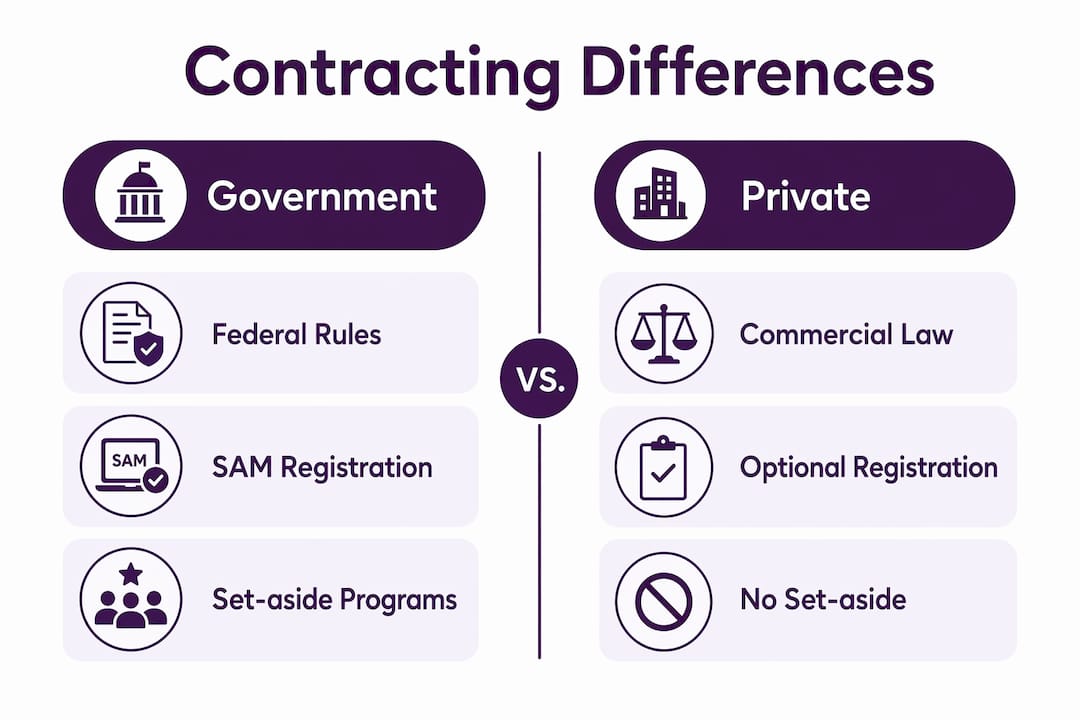
Government contracting operates under a completely different rulebook than commercial deals. The Federal Acquisition Regulation (FAR) governs every federal procurement, dictating how solicitations are posted, how proposals are evaluated, how contracts are awarded, and how performance is administered. No such universal code exists in the private sector.
The table below shows the key differences between the two environments.
| Factor | Government contracting | Private-sector contracting |
|---|---|---|
| Governing rules | Federal Acquisition Regulation (FAR) | Negotiated terms, UCC, state law |
| Registration | SAM.gov registration required | No mandatory registry |
| Bidding process | Formal solicitation (RFP, RFQ, IFB) | Direct negotiation or informal RFP |
| Evaluation criteria | Documented, scored, and auditable | Buyer discretion |
| Payment timeline | 30–60 days per Prompt Payment Act | Negotiated, often net-30 or net-60 |
| Set-aside programs | 8(a), HUBZone, SDVOSB available | Not applicable |
SAM.gov registration is free, takes about 45 minutes, and is mandatory before a business can receive any federal contract or grant. That registration must stay active throughout the contract period. Many small businesses lose awards simply because their SAM.gov record expired.
Set-aside programs like 8(a), HUBZone, and SDVOSB are optional, not required. Businesses without these certifications can still compete effectively for full-and-open competitions. These designations provide a competitive edge, but they are not a prerequisite for entering the federal market.
Payment under federal contracts typically arrives within 30–60 days after proper invoicing through systems like iRAPT. That predictability is one of the genuine advantages of government work over commercial contracts, where payment terms are often contested or delayed. Understanding your federal procurement guidelines before you bid saves significant time during contract administration.
What practical steps should businesses take to manage contracts effectively?
Effective contract management starts before you write a single proposal. The businesses that win consistently follow a disciplined process from market research through final delivery.
Register and verify your SAM.gov profile. Your registration must be active and accurate. Errors in NAICS codes or business size certifications can disqualify a bid before an evaluator reads a word of your proposal. Read the full SAM.gov registration guide to avoid common filing mistakes.
Select 3–7 NAICS codes that match your core capabilities. Disciplined bid/no-bid practices focus efforts on a tight set of NAICS codes aligned with company strengths. Spreading across dozens of codes dilutes your credibility and wastes proposal resources.
Engage agencies before the RFP drops. Early engagement with agencies, 12 or more months before RFP release, significantly improves win rates. Attend industry days, respond to Requests for Information, and build relationships with contracting officers before the competition formally opens.
Apply a strict bid/no-bid filter. Selective bidding raises win rates over chasing every opportunity. Ask three questions before committing: Do you have relevant past performance? Can you meet the technical requirements? Is the budget realistic for your cost structure? If the answer to any of these is no, pass.
Write proposals that address evaluation criteria directly. Government evaluators score proposals against stated criteria. Address each criterion explicitly and in the same order it appears in the solicitation. Proposals that bury key information lose points even when the underlying capability is strong.
Track performance and document everything. Contract disputes almost always come down to documentation. Keep records of deliverables, communications, change orders, and invoices. In government contracting, a Contractor Performance Assessment Reporting System (CPARS) rating follows your business to every future bid.
Pro Tip: Build a simple contract register in a spreadsheet. Track every agreement by start date, end date, key obligations, and renewal deadlines. Missing a renewal window in government contracting can mean starting the entire award process over.
Contract negotiation tips for government work differ from commercial deals. In federal contracting, price reasonableness is a documented requirement. Negotiating means justifying your rates with market data, not just countering a number.
What are common mistakes when dealing with contracting basics?
Most contracting failures trace back to a small set of recurring errors. Recognizing them early prevents expensive problems later.
- Skipping the consideration check. Business owners often draft agreements that are really just letters of intent. Without a clear exchange of value on both sides, the document is not a contract. Courts will not enforce it.
- Treating government contracting like commercial sales. Businesses that apply commercial direct sales tactics to government procurement consistently fail. FAR requires documented evaluations. A relationship alone does not win a federal contract.
- Ignoring unclear obligations. Vague scope-of-work language is the leading cause of contract disputes. If a deliverable is not described with measurable outcomes, both parties will interpret it differently under pressure.
- Waiting for the RFP to engage. Entering a competition cold, with no prior agency contact or market intelligence, puts you at a structural disadvantage. The winning bidder usually started building relationships months earlier.
- Letting compliance slip post-award. Winning a contract is not the finish line. Missing reporting deadlines, failing to update SAM.gov, or ignoring FAR clauses mid-performance can trigger cure notices or termination for default.
- Misreading size standards. Small business size standards under SBA rules are NAICS-code specific. A business that qualifies as small under one code may not qualify under another. Bidding under the wrong size classification is a serious compliance violation.
Key Takeaways
Mastering contracting basics requires understanding the six legal elements of a valid agreement, the specific compliance demands of government procurement, and the disciplined management practices that separate winning businesses from losing ones.
| Point | Details |
|---|---|
| Six elements are non-negotiable | Every contract needs offer, acceptance, consideration, mutual assent, capacity, and legality to be enforceable. |
| SAM.gov is the entry point | Federal contracts require active SAM.gov registration; an expired profile can disqualify an otherwise strong bid. |
| FAR governs all federal deals | Government contracting follows the Federal Acquisition Regulation, which has no equivalent in commercial procurement. |
| Selective bidding wins more | Focusing on 3–7 aligned NAICS codes and applying a strict bid/no-bid filter raises win rates over volume bidding. |
| Documentation prevents disputes | Tracking deliverables, communications, and change orders protects you in both government and private-sector contracts. |
Why most businesses get contracting wrong from the start
Most business owners treat a contract as a formality. They sign quickly, file it away, and move on. That mindset is exactly why disputes happen.
The businesses I have seen succeed in government contracting share one trait: they treat the contract as the operating manual for the relationship, not a legal hurdle to clear. They read every clause. They flag ambiguous language before signing. They know their deliverable schedule better than the contracting officer does.
The bid/no-bid discipline point deserves more emphasis than it usually gets. Chasing every opportunity feels productive. It is not. A business that bids on 20 poorly matched RFPs will almost always lose to a business that bids on four well-matched ones. The math is simple, but the discipline is hard when you feel pressure to generate revenue.
The other thing I would push back on is the idea that government contracting is too complex for small businesses. The FAR is long, but the core rules are consistent. Once you understand how solicitations are structured and how evaluators score proposals, the process becomes predictable. Predictable is good. It means you can build a repeatable system for winning federal contracts rather than relying on luck or relationships alone.
Start with the basics of contract law. Build from there. The businesses that do this work upfront spend far less time in disputes and far more time delivering.
— Josh
How Gsascheduleservices helps you move from basics to contracts
Gsascheduleservices works specifically with small and medium-sized businesses that are ready to enter or grow within the federal market. The platform handles the parts of government contracting that consume the most time: readiness assessments, SAM.gov paperwork, GSA Schedule applications, and compliance reviews. You get expert guidance without needing to become a FAR specialist yourself. If you are serious about turning government procurement into a steady revenue source, the GSA Schedule discovery process is the right place to start. Gsascheduleservices has helped businesses cut months off the registration timeline and position their offerings for real federal demand.
FAQ
What are the six elements of a valid contract?
A valid contract requires offer, acceptance, consideration, mutual assent, capacity, and legality. Missing any one of these elements makes the agreement unenforceable under U.S. law.
Is SAM.gov registration required for all government contracts?
Yes. SAM.gov registration is mandatory before any business can receive a federal contract or grant, and the registration must remain active throughout the award period.
What is the Federal Acquisition Regulation?
The Federal Acquisition Regulation (FAR) is the primary rulebook governing all federal procurement. It covers how contracts are solicited, evaluated, awarded, and administered across U.S. government agencies.
Do I need a set-aside certification to win government contracts?
No. Set-aside certifications like 8(a), HUBZone, and SDVOSB provide competitive advantages but are not required. Businesses without these designations can compete in full-and-open competitions.
How long does it take to get paid on a federal contract?
Federal contracts typically pay within 30–60 days after proper invoicing under the Prompt Payment Act, using systems like iRAPT for invoice submission and tracking.
Recommended
- Unlocking Government Contracts for Small Businesses
- Guide to Becoming a Government Contractor: Your Path To Success
- Your Guide to Securing Government Contracts Successfully
- Mastering the Details: Your Government-Contractor Relationship Guide