
A GSA RFP (Request for Proposal) is the federal government’s official solicitation tool used when agencies need comprehensive proposals to fulfill a complex requirement. Unlike a simple price quote, a GSA RFP asks your business to demonstrate technical capability, management experience, and pricing in a single, structured submission. The General Services Administration manages billions in federal procurement annually, and understanding the GSA RFP process is the first real step toward capturing that revenue. This guide breaks down how the process works, what separates an RFP from other solicitation types, and how to build a proposal that wins.

How does the GSA RFP process work?
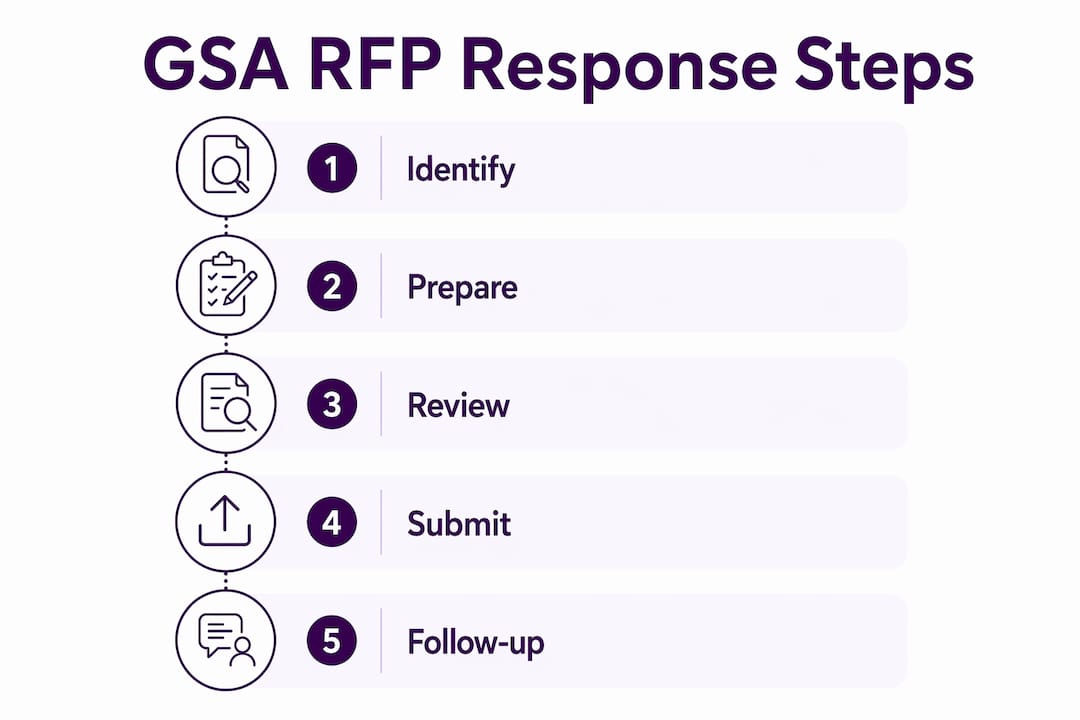
The GSA RFP process follows a defined sequence from publication to contract award. Knowing each stage prevents costly mistakes and keeps your submission on track.
Solicitation publication. GSA and federal agencies post RFPs on SAM.gov and GSA eBuy. SAM.gov covers the full federal marketplace, while GSA eBuy is restricted to Schedule holders with matching Special Item Numbers (SINs). Opportunities on eBuy carry shorter response windows, often 7 to 14 days, so monitoring both platforms daily matters.
Proposal preparation. A compliant submission typically includes a technical approach, a management plan, past performance references, and a detailed price volume. Each section must directly address the requirements in the Statement of Work. Missing a required section is grounds for rejection before evaluation even begins.
Evaluation. GSA RFPs evaluate proposals on best overall value, not the lowest price. Evaluators score technical capability, management experience, past performance, and price together. A strong technical score can outweigh a slightly higher price, which means investing in your technical narrative pays off.
Negotiation and award. After evaluation, the contracting officer may open discussions or request a Best and Final Offer (BAFO). The agency then awards the contract to the vendor offering the best value solution. Award notices appear on SAM.gov.
Post-award compliance. Winning is not the finish line. GSA Schedule holders must maintain minimum sales requirements of $25,000 within the first 24 months. Falling short can affect your contract status, so building a pipeline from day one is non-negotiable.
Pro Tip: Set up SAM.gov email alerts for your NAICS codes and SINs the moment your GSA Schedule is active. Early notification gives you maximum time to prepare a strong proposal before the deadline.
What distinguishes a GSA RFP from RFIs and RFQs?
Federal agencies issue three main solicitation types, and confusing them wastes time and resources. Each one signals a different stage of the buying process and demands a different response.
RFI (Request for Information). An RFI is a market research tool. The agency is not buying yet. It wants to understand what vendors exist, what solutions are available, and what pricing looks like. Responding to an RFI builds visibility with the contracting team but does not result in a contract award.
RFQ (Request for Quotation). An RFQ asks pre-qualified vendors for a price quote on a defined requirement. GSA eBuy posts RFQs exclusively to Schedule holders with the applicable SINs. The evaluation is simpler, usually focused on price and delivery terms rather than a full technical proposal.
RFP (Request for Proposal). An RFP requests a full proposal evaluated on best value. The agency has a complex need and wants vendors to propose complete solutions. This is the most resource-intensive response type and the one that leads to the largest contract awards.
| Solicitation type | Primary purpose | Response required | Evaluation focus |
|---|---|---|---|
| RFI | Market research | Capability statement | Informational only |
| RFQ | Price comparison | Price quote | Price and delivery |
| RFP | Best value solution | Full proposal | Technical, experience, price |
Knowing which type you are responding to shapes how much time and effort you invest. Treating an RFQ like an RFP wastes resources. Treating an RFP like an RFQ loses contracts.
How to prepare a competitive response to a GSA RFP
A winning proposal starts well before you open the solicitation document. Preparation is the difference between a compliant submission and a competitive one.
Align your SINs with the opportunity. Selecting the right SINs determines which solicitations you can access and respond to. If your SINs do not match the requirement, you are ineligible. Review your GSA Schedule regularly and add SINs that reflect your actual service offerings.
Read the solicitation in full before writing a single word. Every RFP contains an evaluation matrix, a Statement of Work, and submission instructions. Contracting officers score proposals against stated criteria. If the RFP weights technical approach at 40% and past performance at 30%, your proposal should reflect that emphasis.
Build a pricing strategy consistent with your GSA Schedule terms. Your proposed prices must align with the rates already negotiated on your Schedule. Offering prices below your Schedule rates without proper justification creates compliance problems. The Federal Acquisition Regulation (FAR) governs pricing transparency, and contracting officers check for consistency.
- Confirm your proposed rates match or fall within your Schedule pricing.
- Document any discounts with a clear rationale tied to volume or scope.
- Include all required certifications, such as Trade Agreements Act compliance, in your submission.
- Submit all required documentation, including past performance references and financial statements, before the deadline.
Avoid the most common pitfalls. Incomplete or late proposals are the leading reasons businesses lose before evaluation begins. A missing signature page or an unsigned certification can disqualify an otherwise strong submission. Build a compliance checklist from the solicitation’s instructions and verify every item before you hit submit.
Pro Tip: Assign one person as your compliance reviewer. Their only job is to check every required document against the solicitation’s submission checklist. Fresh eyes catch errors that proposal writers miss.
A designated Authorized Negotiator must also complete readiness assessments and training before submitting an offer under a Multiple Award Schedule contract. This requirement is not optional, and skipping it delays or voids your submission.
Where and how to find GSA RFP opportunities
Knowing where to look is as important as knowing how to respond. Federal contracting opportunities are spread across multiple platforms, and missing one means missing contracts.
GSA eBuy. This is the primary portal for Schedule-based solicitations. GSA eBuy posts RFQs and RFPs that are visible only to Schedule holders with matching SINs. Log in daily and set up notifications for your SIN categories. Response windows are short, so speed matters.
SAM.gov. The System for Award Management is the government’s central contracting database. All federal agencies post solicitations here. Use keyword searches, NAICS code filters, and set-aside filters (such as small business or woman-owned) to narrow results. Monitoring SAM.gov with saved searches and email alerts keeps your pipeline current without manual searching every day.
Agency-specific procurement sites. Many large agencies, including the Department of Defense and the Department of Veterans Affairs, maintain their own procurement portals alongside SAM.gov. Checking these directly surfaces opportunities that may not appear prominently in broader searches.
Build relationships with contracting officers. Attending GSA-hosted industry days and small business outreach events puts you in front of the people who write solicitations. Contracting officers cannot share non-public information, but they can clarify requirements and confirm whether your capabilities fit upcoming needs. That context improves your proposals significantly.
Leverage your GSA Schedule status. Businesses with a GSA Schedule hold a real competitive advantage. Schedule holders access eBuy solicitations that non-Schedule vendors never see. The GSA Schedule also signals to agencies that your pricing and qualifications have already been vetted, which lowers their risk in awarding you work.
Learning how to become a GSA vendor is the foundational step that unlocks all of these platforms and advantages at once.
Key Takeaways
Winning a GSA RFP requires matching your SINs to the right opportunities, submitting a fully compliant proposal, and treating best-value evaluation criteria as your primary writing guide.
| Point | Details |
|---|---|
| RFP vs. RFQ vs. RFI | Know which solicitation type you face before investing proposal resources. |
| Best-value evaluation | Price alone does not win. Technical capability and past performance carry equal weight. |
| SIN alignment | Your GSA Schedule SINs determine which opportunities you can legally pursue. |
| Compliance first | Incomplete or late submissions are disqualified before evaluation begins. |
| Platform monitoring | Daily checks on GSA eBuy and SAM.gov keep your pipeline ahead of deadlines. |
What I’ve learned about winning GSA RFPs that most guides skip
The advice most businesses receive about federal contracting focuses on process. Follow the steps, submit on time, price correctly. That is all true, and none of it is enough.
The businesses I have seen win consistently share one trait: they treat the proposal as a communication document, not a compliance document. They write to the evaluator, not to the checklist. A proposal that checks every box but reads like a legal filing scores lower than one that tells a clear story about why this vendor solves this problem better than anyone else.
The second thing most guides miss is the value of pre-solicitation engagement. By the time an RFP is published, the agency often has a mental picture of the ideal vendor. Attending industry days, responding to RFIs, and submitting capability statements months before a solicitation drops puts your name in that picture. Contracting officers remember vendors who showed up early and asked smart questions.
Patience is also underrated. Federal contracting cycles run long. An agency you engage with in january may not issue a solicitation until september. Businesses that give up after one or two unsuccessful proposals miss the compounding benefit of relationship-building and proposal iteration. Each submission teaches you something about how that agency evaluates work.
The GSA Schedule consulting process exists precisely because the learning curve is steep and the cost of errors is high. Getting expert guidance early shortens that curve considerably.
— Josh
How Gsascheduleservices helps businesses win federal contracts
Gsascheduleservices works directly with small and medium-sized businesses to navigate the full GSA contracting process, from initial readiness assessment through proposal preparation and post-award compliance. The team handles the paperwork, pricing documentation, and regulatory requirements that slow most businesses down. If you are new to federal contracting or have struggled with past submissions, the discovery process is the right starting point. It identifies your best contracting opportunities and maps a clear path to your first GSA award. Businesses that work with Gsascheduleservices reduce submission errors, respond faster to solicitations, and build federal revenue streams that hold up regardless of economic conditions.
FAQ
What is a GSA RFP?
A GSA RFP is a formal solicitation issued by a federal agency requesting complete proposals from vendors to fulfill a complex requirement. Proposals are evaluated on best value, including technical approach, experience, and price.
Do I need a GSA Schedule to respond to a GSA RFP?
Businesses without a GSA Schedule can bid on federal RFPs posted on SAM.gov, but Schedule holders gain exclusive access to GSA eBuy solicitations and carry a pre-vetted status that gives them a clear competitive advantage.
How long does a GSA RFP response window last?
Response timelines vary by solicitation. GSA eBuy opportunities often allow only 7 to 14 days, while larger SAM.gov solicitations may allow 30 days or more. Setting up platform alerts is the most reliable way to catch opportunities early.
What are the most common reasons proposals are rejected?
Incomplete documentation, missed deadlines, and pricing inconsistencies with GSA Schedule terms are the leading causes of disqualification. A compliance checklist reviewed by a dedicated team member before submission prevents most of these errors.
How does GSA evaluate proposals?
GSA evaluates proposals on best overall value, weighing technical capability, management experience, past performance, and price together. The lowest bid does not automatically win if a higher-priced proposal offers a stronger technical solution.
Recommended
- How to Grow a Small Business Through a GSA Schedule
- GSA Contracts for Dummies
- Government procurement strategies that help SMBs win GSA bids
- GSA Contract Eligibility Criteria – Quick Guide