

Government contract vehicles are pre-negotiated agreements that authorize businesses to sell products and services to federal agencies without repeated full competitions. Think of them as a standing invitation to bid. The federal government uses these frameworks to speed up purchasing and reduce administrative costs. Agencies like the General Services Administration (GSA), NASA, and the Small Business Administration (SBA) manage the most prominent vehicles. For small to medium-sized businesses, understanding these frameworks is the first step toward building a predictable federal revenue stream.
What are the main types of government contract vehicles?
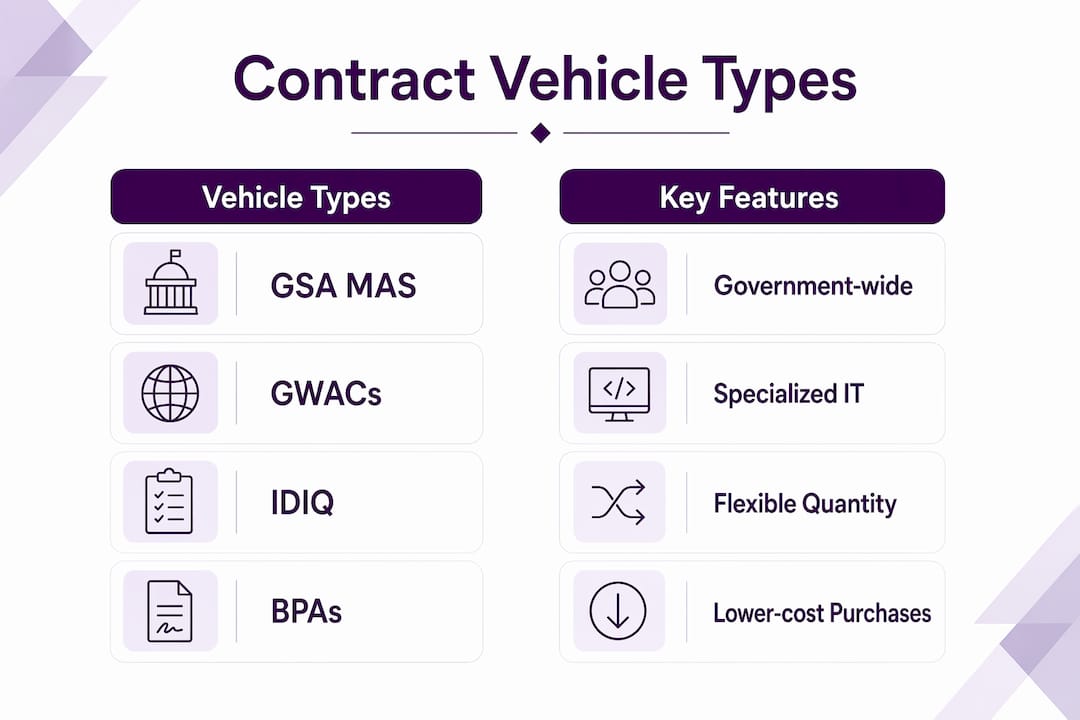
The four primary types of government procurement vehicles each serve a distinct purpose. Knowing the difference helps you pick the right one for your business model and target agencies.
GSA Multiple Award Schedule (MAS) is the most widely used vehicle in federal procurement. The GSA MAS program holds around 12,000 contract holders and generates over $40 billion annually. Contracts last up to 20 years, with a 5-year base term plus three 5-year option periods. That longevity makes MAS the most stable entry point for businesses new to federal contracting.

Government-Wide Acquisition Contracts (GWACs) are specialized IT vehicles managed by agencies like NASA and GSA. GWAC ceilings range from $10 billion to $90 billion, with performance terms of 5–10 years plus options. Competition for task orders is limited to pools of 40–150 pre-qualified contractors. That smaller pool improves your win odds significantly compared to open market bids.
Indefinite-Delivery, Indefinite-Quantity (IDIQ) contracts guarantee a minimum purchase amount but no maximum ceiling. They come in two forms: agency-specific IDIQs that serve one department, and multi-agency IDIQs that serve several. Stand-alone IDIQs typically require a longer ramp-up period than GSA Schedules, but they can offer deeper relationships with specific agencies.
Blanket Purchase Agreements (BPAs) work best for repetitive, lower-cost purchases. BPA orders typically stay below $250,000, with performance periods between 1–5 years and a small vendor pool of 1–10 suppliers. Agencies use BPAs to cut administrative time on routine buys.
| Vehicle | Scope | Typical Ceiling | Vendor Pool | Period |
|---|---|---|---|---|
| GSA MAS | Government-wide | No ceiling | ~12,000 holders | Up to 20 years |
| GWAC | Government-wide IT | $10B–$90B | 40–150 contractors | 5–10 years plus options |
| IDIQ | Agency or multi-agency | Varies | Varies | Varies |
| BPA | Agency-specific | Under $250K per order | 1–10 vendors | 1–5 years |
Pro Tip: If you sell IT services, prioritize understanding Best-In-Class (BIC) designations. The government is consolidating purchases through BIC vehicles like OASIS+ and major GWACs, so being on the right vehicle matters more than being on many vehicles.
How do contract vehicles benefit small to medium-sized businesses?
The biggest advantage for smaller businesses is access. Open market procurements require full competition every time. Contract vehicles remove that barrier and let you focus on winning task orders instead of qualifying repeatedly.
Here is what that access translates to in practice:
- Lower entry barriers. GSA MAS has no on-ramp competition, meaning you do not compete against other firms just to get on the vehicle. You negotiate directly with GSA.
- Pre-negotiated pricing. Your rates are set upfront, which gives agencies confidence and gives you predictable margins across multiple orders.
- Multi-agency reach. A single GSA Schedule lets you sell to virtually every federal civilian agency without separate agreements.
- Set-aside access. Federal agencies set aside task orders for small businesses through programs like 8(a), HUBZone, SDVOSB, and WOSB. These programs help agencies meet mandated small business spending goals. They also let you compete against a much smaller peer group, which raises your win rate.
The set-aside angle is underused by most small businesses. If you qualify for 8(a) or HUBZone status, you are not competing against large defense contractors. You are competing against a focused pool of similarly sized firms. That is a structural advantage most businesses leave on the table.
Pro Tip: Use your GSA Schedule to build past performance before pursuing GWACs or stand-alone IDIQs. Agencies evaluating GWAC proposals look for documented federal experience. A few solid GSA Schedule wins give you that record.
If you are also evaluating how to fund the upfront investment in compliance and proposal preparation, a small business funding guide can help you identify the right financing options before you start the process.
What is the right strategy for pursuing contract vehicles?
The most common mistake businesses make is pursuing too many vehicles at once without the capacity to compete on any of them. A focused sequence works better.
- Obtain your GSA Schedule first. Experts recommend prioritizing GSA Schedule acquisition before pursuing specialized IDIQs or GWACs. The process takes 9–12 months from readiness to award. Budget time for documentation, pricing justification, and compliance setup.
- Build your past performance record. Spend your first 12–18 months on the Schedule actively competing for task orders. Win a few. Document them thoroughly. Those wins become your proof of capability for future vehicles.
- Identify your target agencies. Research which agencies buy what you sell and which vehicles those agencies prefer. Chasing vehicles your target agencies do not use wastes time and money.
- Pursue stand-alone IDIQs or GWACs selectively. Once you have past performance and a clear agency focus, add vehicles that align with your targets. A GWAC like OASIS+ makes sense for professional services firms. An agency-specific IDIQ makes sense if you have a strong relationship with one department.
- Compete actively for task orders. Contract vehicles are frameworks, not guaranteed revenue. Winning a vehicle seat is the beginning, not the finish line. You still need to respond to task order solicitations, build agency relationships, and market your capabilities.
- Avoid vehicle hoarding. Successful contractors focus on aligned vehicles rather than collecting as many as possible. Spreading resources across vehicles you cannot actively support dilutes your capture efforts and your reputation.
Pro Tip: Set a calendar reminder every quarter to review your GSA Schedule pricing and sales reporting. Compliance is not a one-time task. Agencies and GSA auditors check pricing consistency, and falling behind on reporting creates risk that can cost you the contract.
What challenges and misconceptions should you know about?
The biggest misconception in federal contracting is that a vehicle award equals revenue. It does not. Contract vehicles operate as licenses to sell, and lack of active pursuit is the most common reason businesses underperform despite holding them.
Beyond that core misunderstanding, several practical challenges catch contractors off guard:
- The Industrial Funding Fee. GSA Schedule holders pay a 0.75% Industrial Funding Fee on all sales. That fee must be built into your pricing from day one. Ignoring it erodes margins on high-volume contracts.
- Most Favored Customer pricing. GSA requires that your Schedule pricing matches or beats the rates you offer your best commercial customers. Violating this rule triggers audits and potential contract termination.
- Compliance overhead. Maintaining a vehicle requires ongoing reporting, price list updates, and documentation. Small businesses often underestimate this administrative load.
- Task order competition. Even on vehicles with small pools, you still compete for each task order. Agencies evaluate proposals on price, technical approach, and past performance every time.
- Ramp-up time. The 9–12 month timeline for a GSA Schedule means you need to plan well ahead of when you want to start winning federal business.
Pro Tip: Assign one person internally to own compliance tracking for each vehicle you hold. That person should monitor pricing, reporting deadlines, and modification requirements. Treating compliance as a shared responsibility usually means nobody owns it.
Learning more about GSA Schedule advantages before you apply helps you set realistic expectations and prepare the right documentation from the start.
Key Takeaways
The most effective approach to government contract vehicles is to start with the GSA Schedule, build documented past performance, and then pursue specialized vehicles aligned to your target agencies.
| Point | Details |
|---|---|
| Start with GSA Schedule | It has no on-ramp competition and serves as the foundation for all future federal sales growth. |
| Plan for 9–12 months | The GSA Schedule acquisition process requires significant upfront preparation and a long timeline. |
| Factor in the IFF | Build the 0.75% Industrial Funding Fee into your pricing before you negotiate rates with GSA. |
| Vehicles are not revenue | You must actively compete for task orders after award. Passive holders consistently underperform. |
| Use set-asides strategically | Programs like 8(a), HUBZone, and SDVOSB let you compete in smaller, more winnable pools. |
What I have learned from watching businesses pursue contract vehicles
Most businesses treat the GSA Schedule application as the hard part. It is not. The hard part is what comes after.
I have seen contractors spend 12 months getting on a vehicle and then spend the next 12 months waiting for the phone to ring. Federal agencies do not search for you. They search for solutions to specific problems, and they award task orders to contractors who show up consistently, respond to sources-sought notices, and build relationships before a solicitation drops.
The businesses that win on contract vehicles treat them like a sales channel, not a certification. They assign people to monitor agency procurement forecasts. They respond to every relevant Request for Information. They attend industry days. They know the contracting officers in their target agencies by name.
The set-aside programs are also more powerful than most small businesses realize. If you qualify for SDVOSB or HUBZone, you are not competing against Booz Allen or Leidos for those task orders. You are competing against a handful of firms your size. That is a fundamentally different competitive environment, and it rewards businesses that prepare well rather than businesses with the biggest proposal teams.
My honest advice: pick two or three vehicles that align with agencies that actually buy what you sell. Get on those vehicles. Then market aggressively within them. That focused approach beats holding ten vehicles and competing on none of them.
— Josh
How Gsascheduleservices can help you get started
Getting on the right federal contract vehicle takes preparation, pricing knowledge, and compliance discipline. Gsascheduleservices works with small and medium-sized businesses to assess readiness, handle the paperwork, and negotiate GSA Schedule terms that protect your margins. The team has guided contractors through the full 9–12 month acquisition process, from initial documentation to award. If you want a clear picture of which vehicles fit your business and what it takes to compete on them, a personalized discovery session is the right starting point. You will leave with a concrete plan, not a generic checklist.
FAQ
What is a contract vehicle in government?
A government contract vehicle is a pre-negotiated agreement that allows federal agencies to purchase goods and services from pre-approved suppliers without running a full competition each time. Common examples include the GSA Multiple Award Schedule, GWACs, and IDIQs.
How long does it take to get a GSA Schedule?
The GSA Schedule acquisition process takes 9–12 months from readiness to award. That timeline includes documentation preparation, pricing negotiation, and compliance setup.
Are contract vehicles guaranteed revenue?
No. Contract vehicles are frameworks, not guaranteed sales. Businesses must actively compete for individual task orders after receiving a vehicle award.
What is the Industrial Funding Fee for GSA Schedule?
The Industrial Funding Fee is 0.75% of all GSA Schedule sales and must be factored into your pricing to protect profit margins.
Can small businesses compete on GWACs?
Yes. Small businesses can compete on GWACs, and many vehicles include set-aside pools for 8(a), HUBZone, SDVOSB, and WOSB firms. These pools limit competition to similarly sized businesses, which improves win rates for qualifying contractors.
Recommended
- Your Guide to Securing Government Contracts Successfully
- Understanding What is a Government Contractor: A Guide
- Navigating GSA Contract Vehicles: Your Guide
- Navigating GSA Contract Vehicles: Your Guide