
The federal contracts onboarding workflow is a structured process that qualifies small and medium-sized businesses as approved vendors on GSA schedules and other government contract vehicles. Completing this workflow correctly determines whether your company can compete for federal procurement opportunities worth billions annually. The process runs through SAM.gov registration, Unique Entity Identifier (UEI) issuance, documentation submission, and formal approval under the Federal Acquisition Regulation (FAR). Skipping or mishandling any step disqualifies you from awards before you ever submit a proposal. This guide walks you through every phase, from prerequisites to compliance pitfalls, so you enter the federal market ready to win.
What prerequisites and registrations are needed before starting the federal contracts onboarding workflow?
SAM.gov registration is the mandatory first step in any government contract workflow. The System for Award Management issues your Unique Entity Identifier, which replaces the legacy DUNS number and serves as your permanent federal vendor ID. Registration is free and must be renewed annually. An expired registration disqualifies you from receiving an award, even if your proposal is otherwise strong.
Beyond SAM.gov, you need to select the correct North American Industry Classification System (NAICS) codes for your business. These codes define which solicitations you are eligible to bid on. Choosing the wrong codes is a common and costly mistake that limits your visibility to contracting officers.

Documentation requirements are specific and non-negotiable. You must prepare a W-9, an Independent Contractor Agreement if applicable, a Statement of Work, and your representations and certifications under FAR Part 4. Misclassification risk is real: the IRS requires a 1099-NEC for payments over $600, filed by january 31 each year. Getting these documents right before you apply saves weeks of back-and-forth.
| Requirement | Description | Expected Timeline |
|---|---|---|
| SAM.gov registration | Registers your business and issues a UEI | 7–10 business days |
| NAICS code selection | Classifies your services for federal solicitations | 1–3 days |
| W-9 and tax forms | Confirms taxpayer identity for federal payments | 1–2 days |
| Representations & certifications | FAR-required compliance declarations | 3–5 days |
| Small business certifications | SBA programs such as 8(a), HUBZone, WOSB | 30–90 days |
What are the step-by-step stages for GSA schedule onboarding?
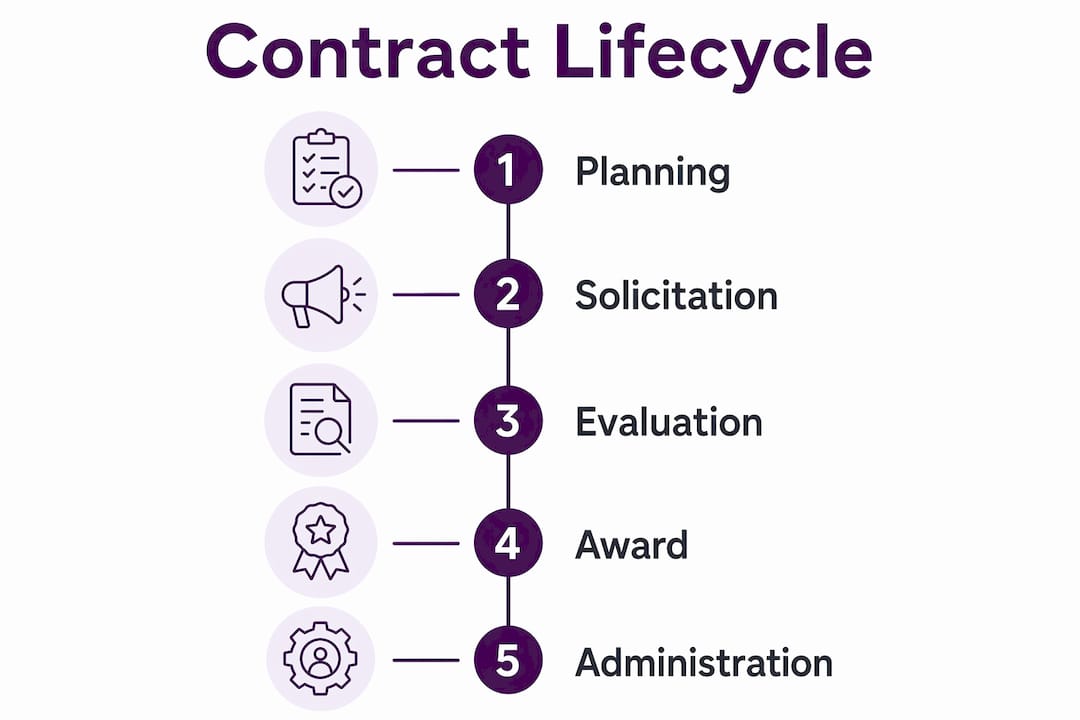
The federal contract life cycle runs through five phases: Planning, Solicitation, Evaluation, Award, and Administration. Planning alone takes 6–18 months. Solicitation runs 30–90 days. Evaluation takes 30–120 days. Award closes in 1–30 days. Administration can last 1–10 years. That full arc means the federal contracting process demands patience and preparation that most private-sector deals never require.
Getting on a GSA Schedule itself takes 3 to 9 months. Federal agencies frequently require schedule membership before they will consider a vendor for task orders. That makes GSA Schedule onboarding a market entry requirement, not just a compliance checkbox.
Pro Tip: Contractors who engage during the Planning phase win contracts at a rate of 40–60%, compared to just 5–15% for those who wait until Solicitation opens. Pre-positioning your company before a solicitation is published is the single highest-return activity in federal sales.
The numbered steps below reflect the full contractor onboarding process for a GSA schedule application.
- Confirm SAM.gov registration is active and your UEI is issued before any other step.
- Select your GSA Schedule category based on your NAICS codes and the products or services you offer.
- Gather all required documents, including past performance records, financial statements, and pricing data.
- Complete the GSA eOffer submission through the GSA’s online portal, attaching all required exhibits.
- Respond to Contracting Officer questions during the evaluation phase promptly and completely.
- Negotiate pricing and terms with the assigned GSA Contracting Officer.
- Receive your GSA Schedule contract number and activate your listing on GSA Advantage.
- Complete internal approvals from your finance, legal, and compliance teams before signing.
The vendor onboarding process formally includes collecting documentation, validating information, assessing risk, and activating the supplier in procurement systems. Internal approvals from procurement, finance, legal, and compliance teams are part of the official process, not optional extras.
| Phase | Duration | Main activities | Key vendor actions |
|---|---|---|---|
| Planning | 6–18 months | Market research, requirements definition | Pre-position, build relationships |
| Solicitation | 30–90 days | RFP/RFQ publication | Prepare proposal, confirm eligibility |
| Evaluation | 30–120 days | Technical and price review | Respond to questions, clarify scope |
| Award | 1–30 days | Contract negotiation and signing | Finalize terms, complete compliance docs |
| Administration | 1–10 years | Delivery, reporting, renewals | Maintain SAM.gov, update schedule |
For a detailed walkthrough of the application itself, the GSA Schedule application guide from Gsascheduleservices covers each submission requirement step by step.
How can automation and digital tools improve the onboarding process for contractors?
Manual workflows create bottlenecks in document collection and approval routing. Automating document submission and validation accelerates onboarding and reduces compliance errors. That matters in federal contracting, where a single missing form can delay your award by months.
Automation embedded within source-to-contract workflows improves compliance while cutting administrative load for both vendors and agencies. The practical benefit is that your team spends less time chasing signatures and more time building the relationships that win renewals.
When selecting onboarding software or digital workflow tools, prioritize these capabilities:
- Automated document validation that flags missing or expired forms before submission
- Approval routing that mirrors your internal hierarchy across procurement, finance, and legal
- Audit trail generation that produces records compliant with FAR documentation requirements
- SAM.gov status monitoring that alerts you before your registration expires
- Risk assessment integration that checks vendor financial stability as part of the approval sequence
Pro Tip: Configure your workflow tool to trigger a SAM.gov renewal reminder 60 days before expiration. Most delays in federal procurement onboarding trace back to a lapsed registration that nobody caught in time.
Risk assessments are increasingly integrated into onboarding workflows, requiring vendors to demonstrate financial stability and risk mitigation as part of formal approval. Building this check into your digital workflow from day one prevents last-minute surprises during the award phase. Contractors in specialized sectors, such as federal onsite training providers, face additional risk documentation requirements that automated workflows handle more consistently than manual review.
What are common mistakes and how do you fix them?
Poor requirements definition is the leading cause of delays and disputes in the federal contracting process. FAR regulations govern solicitation, evaluation, and award, and misunderstanding them creates compliance gaps that contracting officers will reject. The fix is to read the specific FAR clauses referenced in each solicitation before you respond.
Incomplete or expired SAM.gov registration is the most disqualifying error a vendor can make. It is also entirely preventable. Set a calendar reminder for annual renewal and treat it as a hard deadline, not a suggestion.
Common compliance mistakes to avoid:
- Submitting a GSA offer without current past performance documentation
- Using outdated NAICS codes that no longer match your service offerings
- Missing the january 31 deadline for 1099-NEC filings on contractor payments over $600
- Failing to update representations and certifications after a business change
- Skipping the internal legal review before signing a GSA Schedule contract
Compliance deadline alert: SAM.gov registration expires annually. An expired registration disqualifies your business from any federal award, regardless of proposal quality. File your renewal at least 30 days before expiration to account for processing time. For 1099-NEC filings, the IRS deadline is january 31 each year for payments over $600. Missing either deadline creates legal and financial exposure that can take months to resolve.
When your application faces a rejection or delay, request written feedback from the Contracting Officer immediately. Most rejections cite specific deficiencies. Addressing them directly and resubmitting within the allowed window is faster than starting over. The GSA contract acquisition process guide from Gsascheduleservices outlines the most common rejection reasons and how to respond to each one.
Key Takeaways
A successful federal contracts onboarding workflow requires active SAM.gov registration, correct NAICS classification, complete documentation, and early engagement during the Planning phase to maximize award probability.
| Point | Details |
|---|---|
| SAM.gov is non-negotiable | An expired registration disqualifies your business from any federal award, regardless of bid quality. |
| Early engagement wins contracts | Contractors who engage during Planning win at 40–60%, versus 5–15% at Solicitation. |
| GSA Schedule takes time | Plan for 3 to 9 months to complete the GSA Schedule application and receive your contract number. |
| Automate compliance checks | Build SAM.gov renewal alerts and document validation into your workflow to prevent avoidable delays. |
| FAR knowledge prevents rejections | Understanding the specific FAR clauses in each solicitation reduces compliance gaps and resubmission cycles. |
What I have learned about federal onboarding that most guides skip
Most articles on this topic treat the federal contracts onboarding workflow as a checklist. It is not. It is a relationship-building process that happens to require paperwork.
The contractors I have seen succeed consistently are the ones who start engaging with agency program offices 12 to 18 months before a solicitation drops. They attend industry days, respond to Requests for Information, and build familiarity with the contracting officers who will later evaluate their proposals. By the time the RFP publishes, they are not strangers. That pre-positioning advantage is real and measurable.
The compliance side is where most small businesses underinvest. FAR is dense, but the clauses that matter for your specific contract vehicle are finite. Learning those clauses once pays dividends across every proposal you write. Treating compliance as a one-time task rather than an ongoing practice is the mistake that causes good companies to lose awards they should have won.
The trend I watch most closely right now is integrated risk assessment inside onboarding workflows. Agencies are moving toward requiring financial stability documentation earlier in the process, not just at award. Vendors who build this into their standard onboarding package will move faster through evaluation. Those who scramble to produce it on demand will lose time they cannot recover.
The long-term value of a GSA Schedule is not just the contract itself. It is the credibility signal it sends to every agency that sees your listing. Getting on schedule is the beginning of a federal sales program, not the end of an administrative task.
— Josh
How Gsascheduleservices supports your path to federal contract approval
Gsascheduleservices works specifically with small and medium-sized businesses that need to move through the federal procurement onboarding process without losing months to paperwork errors or compliance gaps. The platform handles readiness assessments, document preparation, negotiation support, and GSA Schedule maintenance, so your team focuses on delivering services rather than decoding federal regulations. Whether you are applying for your first schedule or updating an existing one, the personalized onboarding consultation at Gsascheduleservices gives you a clear picture of where you stand and what steps come next. For contractors entering the IT space, the GSA IT Schedule 70 guide provides a specialized walkthrough of that specific application path.
FAQ
What is the federal contracts onboarding workflow?
The federal contracts onboarding workflow is the structured sequence of registrations, documentation submissions, and approvals that qualifies a business as an approved vendor on GSA schedules or other government contract vehicles. It begins with SAM.gov registration and ends with contract activation.
How long does GSA Schedule onboarding take?
Getting on a GSA Schedule takes 3 to 9 months from initial application to contract award. The full federal contract life cycle, including planning and administration, can run 6 to 24 months before a vendor receives an award.
What happens if my SAM.gov registration expires?
An expired SAM.gov registration immediately disqualifies your business from receiving any federal contract award. Renew at least 30 days before expiration to account for processing time and avoid gaps in eligibility.
What documents do I need to start the contractor onboarding process?
You need a W-9, representations and certifications under FAR Part 4, past performance records, financial statements, and a Statement of Work. Small business certifications such as 8(a) or HUBZone require additional documentation and take 30 to 90 days to process.
Why does early engagement improve federal contract win rates?
Contractors who engage during the Planning phase of the federal contract life cycle win at a rate of 40–60%, compared to 5–15% for those who wait until Solicitation. Early engagement builds familiarity with contracting officers and allows vendors to shape requirements before the RFP is finalized.
Recommended
- Government Contract Opportunities 2026: SME Guide
- Guide to Becoming a Government Contractor: Your Path To Success
- Federal Procurement Guidelines Simplified
- Professional Federal Contractor Services in the United States