

The General Services Administration (GSA) is defined as the federal agency responsible for managing government real estate, acquisition services, and shared technology infrastructure across U.S. federal operations. Understanding what is the GSA matters because the agency manages over $84 billion in goods and services annually, supporting more than 1 million federal civilian employees. That scale makes the GSA one of the most consequential entry points for any business pursuing federal revenue. Its two primary divisions, the Public Buildings Service (PBS) and the Federal Acquisition Service (FAS), shape how government buys everything from office space to IT consulting.
What services does the GSA provide to agencies and vendors?
The GSA operates as the federal government’s central purchasing and property manager. Its scope goes well beyond signing contracts. The agency handles leasing, construction, and historic preservation across a real estate portfolio exceeding 363 million square feet in 8,397 buildings nationwide. That footprint supports federal offices in every state.
On the acquisition side, the GSA creates pre-negotiated contract vehicles that federal agencies use to buy commercial products and services without running a full competitive bid each time. This saves agencies months of procurement work. The GSA also manages shared services that most people never think about, including:
- Fleet management: The GSA operates one of the largest civilian vehicle fleets in the country, supplying federal agencies with cars, trucks, and specialized vehicles.
- Travel services: The agency sets federal travel policy, manages the city-pair airfare program, and runs the GSA SmartPay charge card program used by federal employees.
- IT infrastructure: The GSA provides cloud computing, cybersecurity tools, and telecommunications services to agencies that lack the scale to procure these independently.
- GSA Advantage: GSA Advantage is the online shopping portal where federal buyers browse and purchase from approved Schedule contractors, functioning like an Amazon for government procurement.
The GSA is also evolving with federal priorities for operational efficiency, digital transformation, and modernized procurement. Contractors who understand this shift position themselves ahead of agencies that are actively looking for vendors aligned with these goals. The role of AI in procurement is one example of how federal buying is changing in 2026, and vendors who track these trends gain a real edge.
How do GSA Schedule contracts simplify federal sales?

A GSA Schedule contract is a pre-negotiated Indefinite Delivery/Indefinite Quantity (IDIQ) agreement between a vendor and the federal government. The term “IDIQ” means the government commits to buying from you but does not specify an exact quantity upfront. Federal agencies then place orders against your Schedule without running a separate full competition each time.
This structure matters because it shortens the federal sales cycle dramatically. Under FAR Part 8.4 simplified acquisition procedures, agencies can buy from Schedule holders with far less paperwork than a standard open-market procurement requires. The result is faster purchasing decisions and lower transaction costs for both buyer and seller.
The numbers behind GSA Schedules are significant. Federal agencies spend over $75 billion annually through Schedule contracts. That purchasing volume covers professional services, IT products, facilities maintenance, scientific equipment, and hundreds of other categories. A GSA Schedule can last up to 20 years with multiple option periods, giving contract holders a long runway to build federal relationships and grow revenue.
| Feature | What it means for your business |
|---|---|
| IDIQ contract structure | No guaranteed order volume, but open access to all federal buyers |
| FAR Part 8.4 procedures | Agencies buy faster with less red tape compared to open-market bids |
| Up to 20-year contract term | Long-term federal presence without reapplying every few years |
| Commercial off-the-shelf focus | Your existing products and services qualify without custom development |
| GSA Advantage listing | Federal buyers find you through the government’s own purchasing portal |
Pro Tip: Focus your Schedule proposal on the specific Special Item Numbers (SINs) that match your core offerings. Vendors who list too many SINs without strong past performance in each category often face delays and pricing pushback during negotiations.
The commercial off-the-shelf (COTS) focus of GSA Schedules is a feature that surprises many first-time applicants. The GSA wants to buy what you already sell at fair market prices, not custom government solutions. This means your existing service catalog or product line is the foundation of your Schedule proposal. You can learn more about how Federal Supply Schedule contracts work before you start building your application.
What are the key distinctions within the GSA that contractors should understand?
The most common mistake businesses make when approaching the GSA is misunderstanding the distinction between its landlord role and its acquisition role. The Public Buildings Service manages federal real estate. The Federal Acquisition Service manages purchasing. These are separate functions with different budgets, leadership, and contractor relationships.
Contractors pursuing federal sales opportunities focus almost entirely on the Federal Acquisition Service. The FAS administers GSA Schedules, the GSA Global Supply program, and multiple government-wide acquisition contracts (GWACs). The PBS matters primarily to construction firms, architects, and property management companies.
The GSA’s organizational structure also includes 12 staff offices and 11 regional offices that support nationwide service delivery. Regional offices matter for contractors because some federal buyers prefer working with vendors who have a regional presence or understand local agency needs. Here is what contractors should keep in mind about the GSA’s internal structure:
- Federal Acquisition Service (FAS): Your primary target for Schedule contracts, GWACs, and purchasing programs.
- Public Buildings Service (PBS): Relevant only if your business operates in construction, real estate, or facilities management.
- Staff offices: These include the Office of Government-wide Policy, which sets procurement rules that affect how agencies use your Schedule.
- Regional offices: Twelve regions cover the entire country. Building relationships with regional contracting officers can accelerate your first orders.
Pro Tip: Request a capability briefing with your regional GSA office after you receive your Schedule. Regional contracting officers often know which local agencies have active needs that match your SINs.
GSA’s modernization goals under the current administration center on reducing costs, consolidating space, and adopting digital procurement technologies. Contractors who position their offerings around efficiency and digital delivery align with where federal spending is heading.
How can businesses engage with the GSA effectively?
A GSA Schedule is a “license to hunt,” not a guaranteed revenue stream. Businesses that treat their Schedule as a passive asset consistently report limited federal sales. The ones that succeed treat it as the starting point of an active federal business development program.
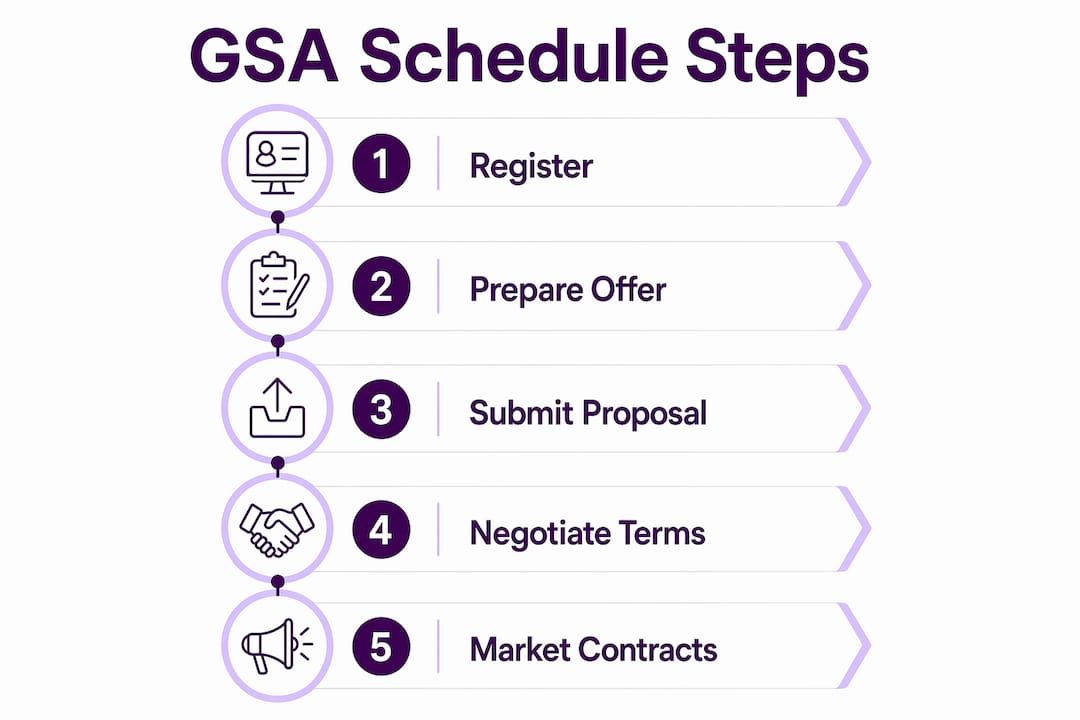
Effective engagement with the GSA requires a sequence of deliberate steps:
- Register in SAM.gov first. The System for Award Management (SAM.gov) is the federal vendor database. No agency can pay you without an active SAM.gov registration. Complete this before anything else.
- Identify your NAICS codes. North American Industry Classification System (NAICS) codes define what your business does. Choosing the right codes determines which Schedule SINs you qualify for and which set-aside programs you can access.
- Document past performance. Federal buyers want evidence that you have delivered similar work before. Gather three to five references from government or commercial clients before you apply.
- Build a federal marketing plan. Getting on Schedule is step one. Reaching federal buyers requires attending agency industry days, responding to Requests for Information (RFIs), and building relationships with contracting officers and program managers.
- Understand GSA contracting terminology. Terms like IDIQ, COTS, SIN, GWAC, and BPA (Blanket Purchase Agreement) appear constantly in federal procurement. Fluency in GSA contract terminology reduces errors and speeds up your application.
Self-education before engaging consultants saves time and money. Businesses that understand their own readiness ask better questions, avoid unnecessary services, and move through the application process faster. That said, consultants vary widely in quality. The best GSA contract consultants provide support beyond the application itself, including business development training, pricing strategy, and ongoing contract management. Consultants who only handle paperwork leave you with a Schedule but no plan to use it. Gsascheduleservices offers readiness assessments and full-service support that covers the application, negotiation, and the federal marketing strategy that follows. You can read more about growing federal service revenue through Schedules to understand what a complete program looks like.
Key Takeaways
A GSA Schedule contract is the most direct path to federal sales, but it requires active marketing, correct registration, and a clear understanding of the Federal Acquisition Service’s role to generate real revenue.
| Point | Details |
|---|---|
| GSA’s core function | The GSA manages federal real estate and acquisition services, spending over $75 billion annually through Schedule contracts. |
| FAS is your focus | Contractors pursuing federal sales target the Federal Acquisition Service, not the Public Buildings Service. |
| Schedules are not passive | A GSA Schedule requires active marketing and federal relationship building to convert access into orders. |
| Preparation reduces cost | Understanding NAICS codes, SAM.gov, and past performance before applying saves time and consultant fees. |
| Contract duration | GSA Schedules can run up to 20 years, giving vendors a long-term federal sales platform. |
What I’ve learned after years of watching businesses misread the GSA
The single most damaging misconception I see is that getting a GSA Schedule means the government will find you. It does not work that way. Federal buyers are busy. They use GSA Advantage and their existing vendor relationships. A Schedule puts your name on the list. It does not put your phone number in a contracting officer’s hand.
The second thing I’ve noticed is that businesses underestimate how much the PBS versus FAS distinction matters. I have spoken with companies that spent months trying to get meetings with the wrong part of the agency. They were chasing real estate opportunities when their product was a software tool. That confusion costs real time and money.
The third observation is about consultants. The market for GSA consulting is uneven. Some firms do excellent work on applications and then disappear. Others build long-term relationships and teach clients how to sell. The difference shows up in revenue, not in the contract itself. A Schedule with no sales strategy is an expensive piece of paper. The businesses I have seen succeed are the ones who treated their Schedule as the beginning of a federal sales program, not the end of a procurement process.
My advice is to do your homework first. Read the FAR Part 8.4 procedures. Understand your SINs. Know your past performance before you talk to anyone. That preparation makes every conversation with a consultant or a contracting officer more productive.
— Josh
How Gsascheduleservices supports your federal market entry
Gsascheduleservices works with small and medium-sized businesses at every stage of the GSA Schedule process. The platform covers readiness assessments, application preparation, pricing negotiation, and the federal marketing strategy that turns a Schedule into actual revenue. Businesses that work with Gsascheduleservices avoid the most common pitfalls: incomplete applications, mismatched SINs, and Schedules that sit unused. If you are ready to find out whether your business qualifies and what a realistic federal sales plan looks like, start with a GSA readiness assessment to get a clear picture of where you stand and what comes next.
FAQ
What does GSA stand for?
GSA stands for the General Services Administration, the U.S. federal agency that manages government real estate, acquisition contracts, and shared services for federal agencies nationwide.
What is GSA Advantage?
GSA Advantage is the federal government’s online purchasing portal where agencies buy directly from approved GSA Schedule contractors. It functions as the government’s primary e-commerce platform for Schedule purchases.
What is the GSA application process?
The GSA Schedule application process requires SAM.gov registration, a completed offer submitted through the GSA’s eOffer system, and documentation of pricing, past performance, and relevant experience. Review and negotiation typically follow submission before a contract is awarded.
Why use GSA consultants?
GSA consultants help businesses prepare accurate applications, negotiate fair pricing, and build the federal marketing strategies needed to generate revenue from a Schedule. The best GSA schedule consulting services go beyond paperwork and provide ongoing contract management support.
How much does the federal government spend through GSA Schedules?
Federal agencies spend over $75 billion annually through GSA Schedule contracts, making Schedules one of the largest federal procurement vehicles available to commercial businesses.
Recommended
- GSA Federal Agencies: Procurement & Services Guide
- GSA Contracts for Dummies
- GSA Contract Eligibility Criteria – Quick Guide
- GSA Contract Eligibility Criteria – Quick Guide