

Government contracting is the formal process by which federal agencies purchase goods and services from private businesses, governed primarily by the Federal Acquisition Regulation (FAR). The U.S. government contracting market is one of the largest in the world, with total federal procurement estimated at $2 trillion annually across federal, state, and local purchases. For small and medium-sized business owners, this market is not a closed club. Federal law mandates that a minimum of 23% of prime contract dollars go to small businesses, translating to over $160 billion reserved for small business competition every year. Government contracting 101 starts with one truth: the rules are built to let small businesses win.
What is the government contracting process step by step?
The government contracting process follows a defined sequence, and skipping any step disqualifies you before you submit a single bid. Registration on SAM.gov is the mandatory first step for federal contract eligibility. SAM stands for System for Award Management, and every business that wants to sell to the federal government must be active in this database.
Here is the government contracting process in order:
- Get your Unique Entity ID (UEI). The UEI replaced the DUNS number as the federal identifier for all contractors. You obtain it free through SAM.gov.
- Register on SAM.gov. The SAM.gov registration process typically takes 2–4 weeks. Plan for this timeline before any solicitation deadlines.
- Select your NAICS codes. NAICS codes define your industry and determine your eligibility for set-aside programs. Contracting officers use these codes to find and price your business, so choose them carefully.
- Renew annually. SAM.gov registrations expire every year. A lapsed registration makes you ineligible for awards, even mid-contract.
- Find opportunities. All federal solicitations over $25,000 are posted publicly on SAM.gov. You can also use agency procurement forecasts and the government contract website tools to identify upcoming work before it hits the open market.
Pro Tip: Set a calendar reminder 60 days before your SAM.gov renewal date. Lapsed registrations are one of the most common and easily avoidable reasons small businesses lose contract eligibility.
The FAR exceeds 2,000 pages governing all federal contractors. You do not need to memorize it, but you do need to know which sections apply to your contract type and industry.
What types of government contracts and solicitations exist?
Government contracts are not one-size-fits-all. The federal government uses different contract types and solicitation methods depending on the dollar value and complexity of the purchase.
Contract types by dollar threshold
| Contract Type | Dollar Range | Key Feature |
|---|---|---|
| Micro-purchase | Under $10,000 | No competition required; often paid by government purchase card |
| Simplified Acquisition | $10,000–$250,000 | Streamlined procedures; less documentation |
| Sealed Bid (IFB) | Varies | Award goes to lowest responsive, responsible bidder |
| Negotiated RFP | Typically over $250,000 | Best value evaluation; 30–60 day response window |
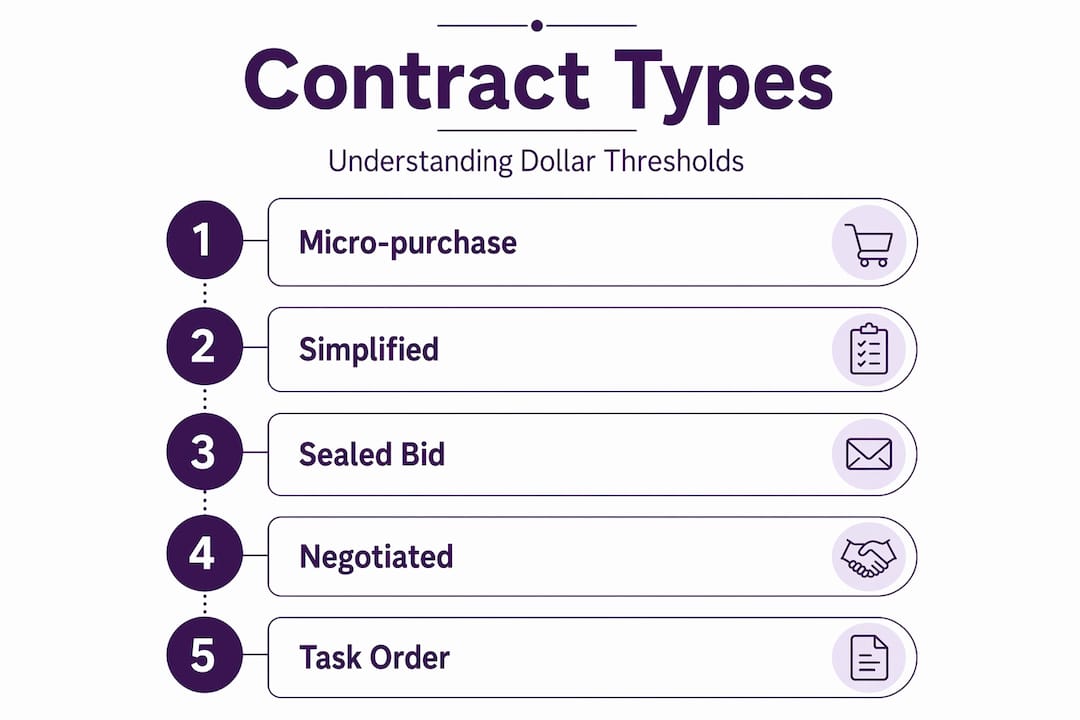
Micro-purchases under $10,000 are often awarded using government purchase cards with no required competition. This makes them the single best entry point for businesses with no past performance record.
Solicitation types follow a different logic. Here is how the three most common ones differ:
- RFI (Request for Information): The agency is doing market research. No contract is awarded at this stage, but responding positions your firm early.
- RFQ (Request for Quotation): The agency wants a price for a defined product or service. Used primarily for simplified acquisitions.
- RFP (Request for Proposals): The agency evaluates both technical approach and price. These are the most complex solicitations and require detailed written responses, typically within 30–60 days.
Understanding which document type you are responding to determines how much time and resources to invest. Treating an RFI like an RFP wastes resources. Ignoring an RFI entirely is a missed opportunity to shape the competition before it starts.
How do SBA set-aside programs and the Rule of Two help small businesses?

The SBA set-aside system is the most powerful structural advantage available to small businesses in federal contracting. The Rule of Two under FAR 19.502-2 requires contracting officers to set aside a procurement exclusively for small businesses if at least two qualified small businesses can fulfill the contract at fair market prices. Many small business owners underestimate this rule. It is their strongest lever for gaining access to contracts that would otherwise go to large enterprises.
The SBA offers four primary certification programs that expand your access even further:
- 8(a) Business Development Program: Designed for socially and economically disadvantaged business owners. Provides access to sole-source contracts and a nine-year program of mentorship and support. Learn more about 8(a) certification benefits before applying.
- HUBZone Certification: For businesses located in Historically Underutilized Business Zones. Provides a 10% price evaluation preference in full-and-open competitions.
- WOSB (Women-Owned Small Business): Targets industries where women-owned firms are underrepresented. Allows set-aside and sole-source awards in qualifying NAICS codes.
- SDVOSB (Service-Disabled Veteran-Owned Small Business): Provides set-aside and sole-source access for veterans with service-connected disabilities.
These certifications can provide sole-source and preferential access to contracts, meaning you can win work without competing against anyone. That is not a minor benefit. That is a category of revenue most businesses in the commercial market never access.
Pro Tip: You can hold multiple SBA certifications simultaneously. A woman-owned, service-disabled veteran business can qualify for both WOSB and SDVOSB set-asides, doubling the pool of targeted opportunities.
Eligibility for each program depends on factors like revenue size, ownership structure, and business location. The SBA administers the certification process, and timelines vary by program. Start the application process at least six months before you plan to bid on set-aside contracts.
What are the best practices for bidding on government contracts?
Winning government contracts requires a focused strategy, not a high-volume approach. Bid-blindness, the habit of indiscriminately bidding on every relevant opportunity, is the most common mistake new contractors make. It burns resources and produces losses. The better approach is to qualify every opportunity before investing in a proposal.
Follow this sequence when evaluating any opportunity:
- Start with simplified acquisitions. Contracts in the $10,000–$250,000 range require less documentation and have faster award cycles. Winning these builds the past performance record you need to compete for larger contracts later.
- Respond to RFIs strategically. Responding to RFIs is a business development tool, not a formality. Thoughtful RFI responses shape the market research phase and can influence how the final solicitation is written. Firms that respond to RFIs often have an informational edge when the RFP drops.
- Qualify before you bid. Ask four questions before committing to a proposal: Does this fit your NAICS codes? Do you meet the size standard? Do you have relevant past performance? Can you deliver on time and within budget?
- Align your proposal with the agency’s mission. Agencies seek solutions tailored to their specific missions. A proposal that reads like a product brochure loses to one that demonstrates a clear understanding of the agency’s problem. Research the agency’s strategic plan and budget priorities before writing a single word.
- Maintain FAR compliance throughout. Non-compliance with FAR requirements, such as missing certifications or incorrect representations, disqualifies proposals regardless of technical quality. Use a government bidding checklist to verify compliance before submission.
Past performance is the currency of government contracting. Every small win builds the record that unlocks larger opportunities. Treat your first few contracts as investments in your competitive position, not just revenue events.
Key Takeaways
Winning in federal contracting requires registration, the right certifications, and targeted bidding, not volume or luck.
| Point | Details |
|---|---|
| Register on SAM.gov first | SAM.gov registration takes 2–4 weeks and must be renewed annually to stay eligible. |
| Know your contract types | Micro-purchases under $10,000 require no competition and are the best entry point for new contractors. |
| Use the Rule of Two | FAR 19.502-2 requires set-asides when two qualified small businesses can compete, giving you structural access. |
| Get certified strategically | SBA programs like 8(a), HUBZone, WOSB, and SDVOSB provide sole-source access and bypass full competition. |
| Qualify before you bid | Focused bidding on simplified acquisitions builds past performance faster than chasing large RFPs too early. |
What I’ve learned after years of watching small businesses enter this market
The single biggest misconception I see is that government contracting is a numbers game. Business owners assume that submitting more proposals increases their odds. It does not. It dilutes their focus and produces generic proposals that lose to firms that spent their time understanding one agency deeply.
The businesses that win consistently treat contracting as a relationship-driven process. They show up at industry days. They respond to RFIs. They build relationships with small business specialists at target agencies before a solicitation ever appears. By the time the RFP drops, they are not strangers to the contracting officer. That context does not guarantee a win, but it changes the quality of the proposal you write.
Certifications are another area where I see underinvestment. Business owners treat them as badges rather than tools. An 8(a) certification is not a trophy. It is a mechanism to access sole-source contracts worth millions without competing against anyone. The firms that use certifications as strategic tools, not resume items, are the ones building real federal revenue.
My honest advice: pick one agency, one problem, and one contract vehicle. Get registered, get certified if you qualify, and build one strong past performance reference. Then expand. The government contracting process rewards patience and precision far more than speed and volume.
— Josh
How Gsascheduleservices helps small businesses get federal contracts
Gsascheduleservices works specifically with small and medium-sized businesses that want to access federal procurement without getting buried in paperwork and compliance requirements. The platform handles GSA Schedule registration, readiness assessments, negotiation support, and ongoing compliance, so business owners can focus on delivering their services rather than decoding federal acquisition rules. For businesses that qualify for set-aside programs, Gsascheduleservices provides guidance on certification pathways and how to position a GSA Schedule contract for maximum visibility with federal buyers. If you are ready to move from learning the basics to securing a GSA contract, the team at Gsascheduleservices can assess your eligibility and map out a clear path forward.
FAQ
What is government contracting in simple terms?
Government contracting is the process by which federal, state, and local agencies buy goods and services from private businesses under regulated rules. The Federal Acquisition Regulation governs all federal purchases.
How long does SAM.gov registration take?
SAM.gov registration typically takes 2–4 weeks to process. Businesses must renew their registration annually to maintain federal contract eligibility.
What is the Rule of Two in government contracting?
The Rule of Two, under FAR 19.502-2, requires contracting officers to restrict a procurement to small businesses only if at least two qualified small businesses can fulfill it at fair market prices.
What SBA certifications help small businesses win government contracts?
The SBA offers four main certifications: 8(a), HUBZone, WOSB, and SDVOSB. Each provides access to set-aside contracts and, in some cases, sole-source awards without competition.
What is the best first contract type for a new government contractor?
Micro-purchases under $10,000 require no competition and are awarded quickly, making them the best entry point for businesses with no prior federal past performance.
Recommended
- Guide to Becoming a Government Contractor: Your Path To Success
- Understanding What is a Government Contractor: A Guide
- Your Guide to Securing Government Contracts Successfully
- Unlocking Government Contracts for Small Businesses