
GSA approval is the official authorization that certifies a business to sell products or services through the General Services Administration’s Multiple Award Schedule (MAS) program, the federal government’s primary vehicle for streamlined procurement. Getting onto the GSA vendors list opens direct access to billions of dollars in annual federal spending, with agencies ranging from the Department of Defense to the Department of Veterans Affairs buying through the MAS catalog every day. For small and medium-sized businesses, GSA approval is not a nice-to-have. It is the entry point to a market that does not disappear during recessions, budget cycles, or economic downturns. Gsascheduleservices helps businesses navigate this process from eligibility assessment through contract award.
What does it mean to be GSA approved?
Being GSA approved means your business has passed the General Services Administration’s review process and holds an active MAS contract. That contract places you on the GSA list of approved vendors, making your offerings visible and purchasable by federal buyers without a separate competitive bid for each order. The MAS program covers thousands of product and service categories, from IT hardware to professional consulting.
The distinction between “listed” and “approved” matters. Any business can register in SAM.gov, but only those with an active MAS contract are GSA approved vendors with the right to receive federal task orders under pre-negotiated pricing terms. GSA pricing guidelines set the ceiling rates agencies pay, which means your approved pricing is already vetted and trusted by buyers.

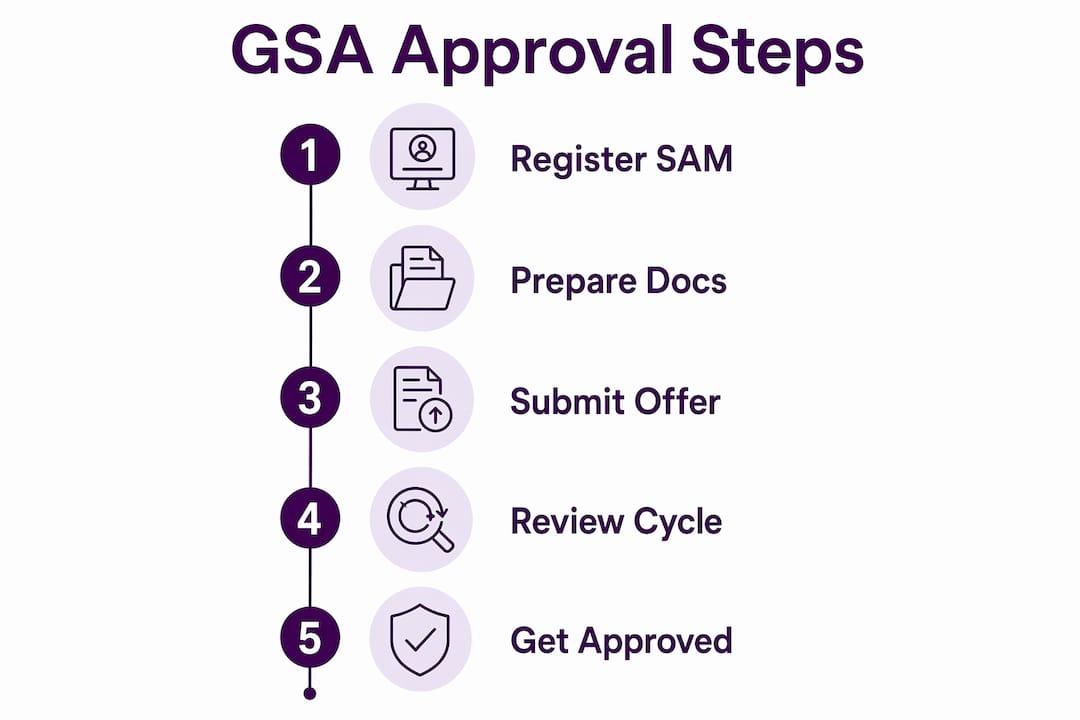
SAM.gov registration is mandatory before you can apply. It assigns your business a Unique Entity Identifier (UEI) and CAGE code, both required for eligibility and payment processing. Your SAM registration must stay active for the entire life of your contract.
What does it take to be GSA approved?
GSA approval has clear eligibility requirements, and most rejections trace back to documentation gaps rather than business quality.
The baseline criteria include:
- Two years in business. GSA requires at least two years of operational history and financial stability. Newer firms are not automatically excluded. The Startup Springboard program offers a pathway for companies under two years old that can demonstrate strong past performance through other means.
- Past performance. You need documented evidence of delivering on contracts or commercial projects. References, project summaries, and client evaluations all count.
- Financial stability. GSA reviews financial statements to confirm your business can sustain contract performance. Audited financials or reviewed statements carry more weight than tax returns alone.
- Complete documentation. Incomplete administrative, technical, or pricing documentation is the primary cause of rejection. Every section of your offer must be filled out correctly before submission.
Documentation falls into three categories. Administrative documents cover your business registration, licenses, and SAM.gov records. Technical documents include past performance write-ups, quality control plans, and relevant certifications. Pricing documents require a commercial price list, a pricing narrative, and supporting data for any discounts you offer the government.
Pro Tip: Run a full pre-submission review against the GSA solicitation checklist before you upload anything. A single missing exhibit can trigger a deficiency letter and add weeks to your timeline.
How long does the GSA approval process take?
The timeline varies more than most applicants expect. GSA targets 90 days to review a complete offer, but that clock only starts when your package is genuinely complete. Real-world timelines look different.
| Application scenario | Expected timeline |
|---|---|
| Complete, deficiency-free offer | 3–6 months |
| One deficiency round required | 4–8 months |
| Multiple deficiency rounds | 6–12 months |
| Complex catalog or pricing structure | 6–18 months |
The biggest driver of delays is the deficiency resolution cycle. When a Contracting Officer (CO) finds a problem, they issue a deficiency letter. If you respond slowly, your application moves to the back of the review queue. Responding within 24–48 hours keeps your file active and prevents a full queue reset.
Many delays stem from deficiency cycles rather than the initial review stage. That means the quality of your first submission has a larger impact on total approval time than anything you do afterward.
There is no formal expedite process. Submitting a deficiency-free offer is the only reliable way to shorten your timeline. Businesses that treat the application as a one-shot submission, rather than an iterative back-and-forth, consistently reach approval faster.
Pro Tip: Keep a dedicated folder with every document you submitted, along with the date and version. When a deficiency letter arrives, you can respond the same day without hunting for files.
Proactive communication with your assigned CO also matters. Vendors who engage professionally and respond promptly tend to move through the process faster than those who treat the CO as an obstacle. A brief, polite check-in email every few weeks is appropriate and often appreciated.
How to use your GSA approval to grow your business
Getting approved is the beginning, not the finish line. The businesses that generate real revenue from their GSA contracts treat their listing as an active sales channel, not a passive directory entry.
Your first priority after approval is your GSA eLibrary profile. Federal agencies compare multiple vendors via GSA eLibrary and often award contracts without ever making direct contact with vendors. Your profile description, SIN categories, and contract terms must be accurate, complete, and written for a buyer who is comparing you against five other options.
The GSA Advantage platform is the e-commerce portal where federal buyers place direct orders. Your product and service listings feed from your eLibrary data, so keeping that data current directly affects your Advantage visibility. Agencies use Advantage to search, compare, and buy, often without issuing a formal solicitation.
Strategies that consistently drive results for GSA compliant vendors include:
- Optimize your GSA Advantage listings. Use specific, searchable language in product descriptions. Buyers search by keyword, so generic descriptions lose to specific ones. The GSA Advantage optimization guide covers ranking tactics in detail.
- Use USASpending.gov and FPDS.gov for competitive intelligence. Top-performing contractors analyze award patterns and agency purchasing trends to refine their offerings and pricing. These tools show you which agencies are buying what, and at what price points.
- Target agencies that already buy in your category. Spending data from USASpending.gov tells you which agencies have active budgets in your space. A targeted outreach to a procurement officer who already buys your type of service is far more effective than cold marketing.
- Use GSA eBuy for solicitation opportunities. The eBuy system allows agencies to post Requests for Quotes directly to approved vendors. Monitoring eBuy regularly puts you in front of opportunities that never appear on public bid boards.
Pairing your GSA presence with digital outreach to government buyers increases your visibility beyond the catalog itself. Agencies research vendors online before they ever open GSA Advantage.
Common challenges in maintaining GSA approval and staying compliant
Winning a GSA contract is one challenge. Keeping it in good standing is another. Many businesses underestimate the ongoing compliance workload after approval.
The core maintenance requirements include annual reporting through the GSA’s Vendor Support Center, timely contract modifications when your pricing or offerings change, and consistent communication with your assigned CO. Failure to meet ongoing requirements can result in contract termination or delayed renewals.
The most common compliance failures are:
- Missing modification deadlines. If your commercial pricing changes, your GSA pricing must be updated within the timeframe specified in your contract. Selling at prices that differ from your approved schedule is a serious compliance violation.
- Letting SAM.gov registration lapse. An expired SAM registration suspends your ability to receive payments. Set a calendar reminder 60 days before your annual renewal date.
- Ignoring CO communications. Contracting Officers send routine requests for information, modification approvals, and compliance checks. Slow responses signal poor contract management and can affect your standing.
- Failing to report sales. GSA requires quarterly sales reporting through the 72A Reporting System. Missed reports trigger compliance reviews.
The businesses that maintain strong GSA contracts treat compliance as a scheduled task, not a reactive scramble. Assign a specific person or team to own contract administration. Review your contract terms at least quarterly to catch any requirements that are coming due.
Key takeaways
Getting and keeping a GSA contract requires a complete first submission, fast deficiency responses, and active post-approval sales management.
| Point | Details |
|---|---|
| GSA approval defined | An active MAS contract certifies your business to sell directly to federal agencies at pre-approved pricing. |
| Eligibility baseline | Most businesses need two years of operation, strong past performance, and complete documentation across all three categories. |
| Timeline reality | A deficiency-free offer targets 3–6 months; multiple deficiency rounds can push timelines to 18 months. |
| Post-approval growth | Treat GSA eLibrary and GSA Advantage as active sales tools, not static listings, and use USASpending.gov for targeting. |
| Compliance is ongoing | Annual reporting, SAM.gov renewal, and timely modifications are non-negotiable for keeping your contract active. |
What I’ve learned from watching businesses get this wrong
The single most expensive mistake I see is treating the GSA application as a form-filling exercise. Contractors rush the submission, get hit with three rounds of deficiency letters, and spend nine months on a process that should have taken four. The math is brutal. Every month without an active contract is revenue you cannot recover.
The second mistake is going quiet after approval. I have watched businesses land their GSA contract, update their eLibrary profile once, and then wonder why no orders come in. Federal buyers do not find you by accident. Competitive intelligence tools like USASpending.gov exist precisely so you can identify which agencies are spending in your category and reach them directly. The contractors who use that data consistently outperform those who wait for the phone to ring.
The third thing most articles get wrong is the deficiency letter advice. Everyone says “respond quickly.” What they do not say is that responding quickly with an incomplete answer is almost as bad as not responding at all. Your response to a deficiency letter needs to be complete, correct, and documented. Speed matters, but accuracy matters more.
The GSA process rewards preparation. Businesses that invest in a thorough pre-submission review, maintain clean SAM.gov records, and build a real post-approval sales plan consistently reach contract award faster and generate more revenue from their contracts. The process is not easy, but it is predictable. Predictable processes can be managed.
— Josh
How Gsascheduleservices helps you get approved and sell more
Gsascheduleservices works with small and medium-sized businesses at every stage of the GSA contract process. From readiness assessments that identify documentation gaps before submission to negotiation support and post-approval marketing, the platform covers the full cycle. Businesses that work with Gsascheduleservices avoid the most common deficiency triggers and reach contract award faster than those who navigate the process alone. If you are ready to assess where you stand and what your next steps should be, the GSA readiness assessment is the right starting point. It gives you a clear picture of your eligibility and a concrete plan for moving forward.
FAQ
What is GSA approval?
GSA approval is the status a business receives when the General Services Administration awards it an active Multiple Award Schedule contract, certifying it to sell to federal agencies at pre-negotiated prices.
How long does it take to get GSA approved?
A complete, deficiency-free application typically takes 3–6 months. Applications with multiple deficiency rounds can take 6–18 months from submission to contract award.
What are the basic requirements to become GSA approved?
Most businesses need at least two years of operation, documented past performance, financial stability, and complete administrative, technical, and pricing documentation. The Startup Springboard program offers an alternative path for newer firms.
What is the GSA vendor support center?
The GSA Vendor Support Center is the portal where approved vendors submit quarterly sales reports, manage contract modifications, and access compliance resources for maintaining their MAS contracts.
Do I need SAM.gov registration to apply for GSA approval?
Yes. Active SAM.gov registration is mandatory before submitting a GSA Schedule application. It provides your UEI and CAGE code, both required for eligibility and payment processing throughout your contract.
Recommended
- Government procurement strategies that help SMBs win GSA bids
- How Small Businesses Can Get Started With A GSA Contract? 5 Steps!
- How to Grow a Small Business Through a GSA Schedule
- How to Get a GSA Schedule: A Step by Step Guide