

A GSA contract gap is defined as any discrepancy between what your contract requires and what your business currently practices. Knowing how to assess GSA contract gaps is the difference between a contract that generates steady federal revenue and one that triggers a corrective action from your GSA Contracting Officer. The Federal Acquisition Regulation (FAR) and GSA Multiple Award Schedule (MAS) program set specific obligations around pricing, reporting, and registration. Missing any one of them puts your contract at risk. This guide walks you through the most common gaps, the tools you need, and a step-by-step process to find and fix them.
How to assess GSA contract gaps: the core framework
GSA contract gap analysis is the formal term for this process. It means systematically comparing your contract’s written requirements against your actual business practices, documentation, and reporting history. The goal is to find the gaps before a GSA auditor does.
Three compliance areas generate the most gaps for small businesses: pricing, reporting, and registration. The Price Reduction Clause requires you to notify your GSA Contracting Officer within 15 days of offering a discount to your Most Favored Customer that drops prices below your GSA schedule rates. That 15-day window is short, and most small businesses miss it because their sales and compliance teams are not coordinated. Missing it is a pricing gap. It is also one of the most common triggers for a formal audit.

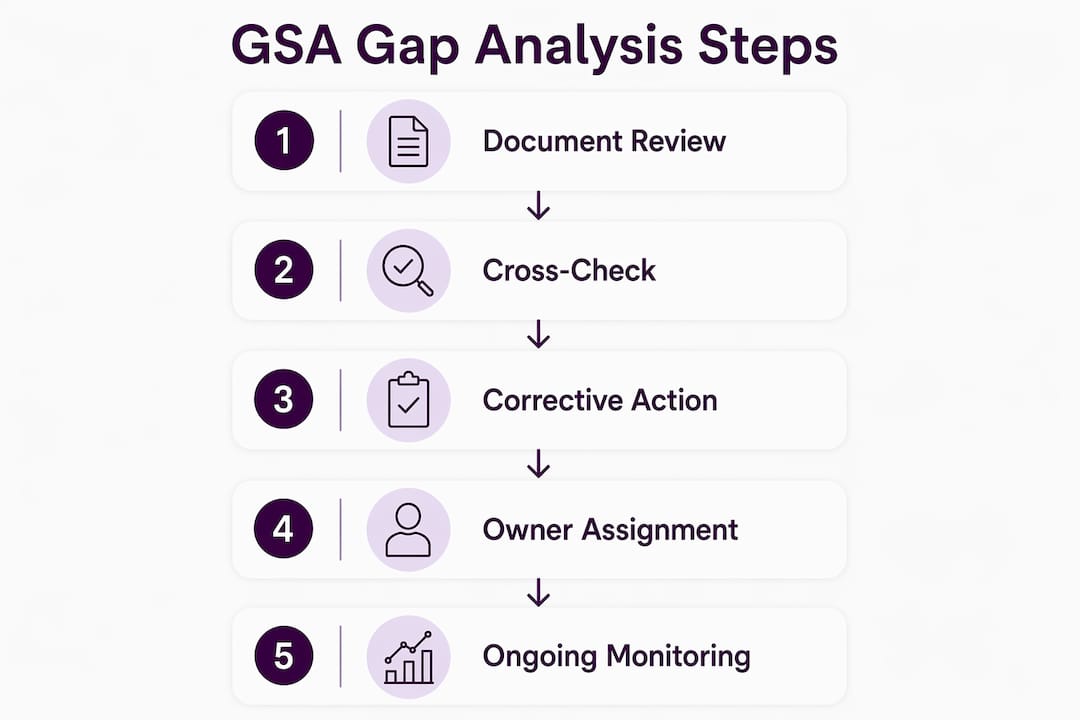
The framework for any gap analysis has three phases: document review, cross-check, and corrective action. Each phase builds on the last. You cannot fix what you have not found, and you cannot find it without the right documentation in front of you.
What are the common types of gaps in GSA contracts?
GSA contract weaknesses cluster into five categories. Recognizing them by name speeds up your review.
- Pricing compliance gaps. These occur when your commercial pricing drops below GSA schedule rates and you fail to notify your Contracting Officer within the required window. GSA auditors review Price Reduction notifications as a standard part of every compliance review.
- Reporting and documentation gaps. Contractors must file 72A quarterly sales reports and remit Industrial Funding Fee (IFF) payments on time. IFF payments are due quarterly, 30 days after each quarter ends. Late or inaccurate filings are among the most common gaps found during audits.
- Contract modification gaps. Mass modifications require you to sign and implement changes within 90 days of receipt. Many contractors miss this deadline because no one owns the modification tracking process internally.
- SAM.gov and catalog maintenance gaps. An expired SAM.gov registration freezes payments and makes you ineligible for new awards. Annual SAM.gov renewal is mandatory, and public responsibility information must be updated every six months under FAR regulations.
- Performance and past performance gaps. Federal buyers check GSA Advantage listings, CPARS ratings, and pricing competitiveness when evaluating vendors for orders above the micro-purchase threshold. An incomplete GSA Advantage profile or an outdated CPARS record is a gap that costs you orders without triggering a formal audit.
What tools and documentation do you need for a GSA contract gap analysis?
Every gap analysis requires the same core set of resources. The table below maps each compliance area to the tool or portal that governs it.
| Compliance area | Tool or portal | What to check |
|---|---|---|
| Sales reporting | FAS Sales Reporting Portal | 72A quarterly reports filed on time and by SIN |
| IFF remittance | FAS Sales Reporting Portal | Payments submitted within 30 days of quarter end |
| Contract documents | Vendor Support Center | Current price list, contract clauses, modification history |
| SAM.gov registration | SAM.gov | Active registration, semi-annual updates completed |
| Catalog accuracy | GSA Advantage | Product and service listings match current contract |
| Modification tracking | GSA Mass Mod Portal | All mass mods signed within 90 days |
| Past performance | CPARS | Ratings current and contractor responses filed |
The Vendor Support Center holds your full contract history, including every modification and the original solicitation clauses. Pull this first. It gives you the baseline against which you measure everything else. SAM.gov and the FAS Sales Reporting Portal are the two portals where most reporting gaps surface. Access both before you begin any internal review.
Pro Tip: Set calendar reminders for every quarterly IFF deadline and your annual SAM.gov renewal date. These two items alone account for a large share of preventable compliance gaps.
Step-by-step process to identify and evaluate GSA contract gaps
A structured review catches gaps that informal checks miss. Follow these six steps in order.
Review your contract terms and schedule requirements. Pull your contract from the Vendor Support Center. Read every clause, including the Price Reduction Clause, the IFF remittance terms, and your reporting obligations. Note every deadline and threshold. This step takes time, but skipping it means you are reviewing compliance against your memory rather than the actual contract language.
Cross-check your pricing against Most Favored Customer discounts. List every customer category you sell to commercially. Identify your Most Favored Customer. Compare the discounts you have offered that customer over the past two to three years against your GSA schedule rates. If any commercial discount dropped below your GSA rate and you did not notify your Contracting Officer within 15 days, you have a pricing gap. Document each instance with dates and discount amounts.
Verify timely filing of all required reports and fees. Log into the FAS Sales Reporting Portal and pull your 72A report history. Confirm that every quarter has a filed report and that IFF payments were submitted on time. Contractors must track sales by Special Item Number and remit IFF accurately. Any quarter with a missing or late report is a documented gap.
Audit your contract modifications for compliance with deadlines. Go to the GSA Mass Mod Portal and review every modification issued against your contract. Confirm that each one was signed within 90 days. If any modification was signed late or not at all, flag it. Unsigned modifications can void specific contract terms and expose you to corrective action.
Inspect your SAM.gov profile and GSA Advantage catalog. Confirm your SAM.gov registration is active and that your semi-annual public responsibility updates are current. Then review your GSA Advantage listing. Check that your product and service descriptions, pricing, and contact information match your current contract. Outdated listings cost you orders and signal poor contract management to federal buyers.
Conduct an internal performance review. Pull your CPARS ratings for the past three years. Review any negative ratings and confirm that you filed a contractor response. Check your past performance tracking records to verify that all relevant project data is documented. Gaps here are less likely to trigger an audit but directly affect your win rate on new task orders.
Pro Tip: Build a simple spreadsheet that maps each compliance obligation to a deadline, a responsible person, and a status. Reviewing this document quarterly takes less than an hour and catches gaps before they compound.
How to address identified gaps and avoid future compliance risks
Finding a gap is only useful if you act on it. Each gap type requires a specific corrective response.
- Pricing gaps. Contact your GSA Contracting Officer immediately. Disclose the pricing discrepancy in writing and provide documentation of the commercial discount. GSA Contracting Officers may issue corrective actions if you fail to report proactively, but voluntary disclosure consistently results in better outcomes than gaps discovered during an audit.
- Reporting gaps. File any missing 72A reports through the FAS Sales Reporting Portal as soon as possible. Calculate and remit any outstanding IFF payments with applicable interest. Document the corrective filing with dates and amounts for your compliance records.
- Modification gaps. Contact your Contracting Officer to discuss any unsigned modifications. In most cases, you can still sign and implement them, but you need to address the delay in writing. Assign one person internally to own modification tracking going forward.
- SAM.gov gaps. Renew your registration immediately if it has lapsed. Complete the semi-annual public responsibility update if it is overdue. Contractors must update SAM semi-annually to maintain good standing under FAR regulations. Set automated reminders so this never lapses again.
- Catalog gaps. Update your GSA Advantage listing to match your current contract. Remove discontinued products or services. Confirm that pricing on the listing matches your approved schedule rates exactly.
The most effective preventive measure is assigning clear internal ownership. Every compliance obligation needs a named person responsible for it. Without ownership, gaps recur. Review the GSA compliance checklist at least twice per year and update it when your contract changes.
Common challenges in GSA contract gap assessments
Even experienced contractors run into obstacles when reviewing their contracts. These are the most common ones and how to address them.
- Tracking commercial pricing to MFC levels. Commercial pricing changes frequently, especially for businesses with large sales teams. The fix is a centralized pricing log that captures every discount offered, the customer category, and the date. Without this log, cross-checking against GSA rates is guesswork.
- Managing timely reporting with limited staff. Small businesses often have one person handling compliance alongside other responsibilities. Quarterly IFF deadlines and 72A reports slip when that person is overloaded. Scheduling compliance tasks as recurring calendar events, not ad hoc reminders, solves this.
- Addressing discrepancies found during a GSA audit. If a GSA auditor identifies a gap before you do, respond in writing within the timeframe specified in the audit notice. Provide documentation for every item requested. Auditors typically request two to three years of sales reports, CSP-1 disclosures, and modification records. Having these organized in advance shortens the response time significantly.
- Coordinating across sales, legal, and compliance teams. Pricing decisions happen in sales. Compliance obligations sit with legal or operations. When these teams do not communicate, gaps form at the handoff. A shared compliance calendar and a brief monthly check-in between teams closes this gap faster than any software tool.
For a broader view of where contractors go wrong before and after award, the most common GSA contract mistakes resource from Gsascheduleservices covers both application and maintenance errors in detail.
Key takeaways
A systematic GSA contract gap analysis, conducted at least twice per year, is the most reliable way to maintain compliance and protect your contract from corrective action.
| Point | Details |
|---|---|
| Price Reduction Clause | Notify your Contracting Officer within 15 days of any discount that drops below your GSA schedule rate. |
| IFF and 72A reporting | File quarterly sales reports and remit IFF payments within 30 days of each quarter end, tracked by SIN. |
| Mass modification deadlines | Sign and implement all mass modifications within 90 days of receipt to stay compliant. |
| SAM.gov maintenance | Renew SAM.gov annually and complete semi-annual public responsibility updates under FAR requirements. |
| Internal ownership | Assign a named person to each compliance obligation and review your compliance checklist twice per year. |
What I have learned from watching contractors miss the same gaps repeatedly
The contractors who get into trouble with GSA compliance are rarely careless. They are busy. They won a contract, started selling, and assumed that staying compliant meant filing reports when they remembered to. That assumption is the gap.
The Price Reduction Clause catches more contractors off guard than any other requirement. I have seen businesses offer a routine volume discount to a commercial client, forget to notify their Contracting Officer, and then face a formal audit two years later when the pattern showed up in their sales data. The 15-day notification window is not a technicality. It is a hard contractual obligation, and missing it repeatedly signals to GSA that your compliance program does not exist.
The other pattern I see constantly is SAM.gov lapsing. It sounds trivial. It is not. A lapsed registration stops payments and disqualifies you from new awards until it is renewed. For a small business, that can mean weeks of lost revenue while you work through the renewal process.
My honest advice: treat your GSA contract like a second set of books. It needs the same regular attention as your financials. Build a compliance calendar, assign ownership, and review it on a fixed schedule. The contractors who do this rarely face audits. The ones who do not are the ones calling their Contracting Officer to explain a two-year reporting gap.
For a deeper look at compliance challenges specific to professional services, the gap analysis strategies outlined by Heights Consulting Group offer a useful parallel framework.
— Josh
Gsascheduleservices can help you find and fix contract gaps
Gsascheduleservices works with small and medium-sized businesses to identify exactly where their GSA contracts fall short of compliance requirements. The team reviews pricing history, reporting records, SAM.gov status, and modification timelines to build a clear picture of where gaps exist and what corrective steps are needed. This is not a generic review. It is a focused assessment built around your specific contract terms and business practices. If you are unsure where your contract stands or want a professional review before your next audit cycle, the GSA contract assessment service from Gsascheduleservices is the right starting point.
FAQ
What is a GSA contract gap?
A GSA contract gap is any area where your business practices do not meet the requirements written into your GSA Multiple Award Schedule contract, including pricing, reporting, registration, and modification compliance.
How often should I conduct a GSA contract gap analysis?
Conduct a full gap analysis at least twice per year, and review your compliance calendar quarterly to catch reporting and registration deadlines before they lapse.
What happens if GSA finds a gap during an audit?
GSA Contracting Officers may issue corrective actions or require documentation if contractors fail to comply with contract terms, particularly around price reductions or reporting obligations.
What is the Price Reduction Clause and why does it matter?
The Price Reduction Clause requires you to notify your GSA Contracting Officer within 15 days any time you offer a discount to your Most Favored Customer that drops prices below your GSA schedule rates. Missing this notification is one of the most common compliance gaps.
Does an expired SAM.gov registration affect my GSA contract?
Yes. An expired SAM.gov registration freezes payment processing and makes you ineligible for new contract awards until the registration is renewed and active.
Recommended
- GSA Compliance: Don’t Get Lost | GSA Focus
- Avoid Rough Seas with your GSA Contract
- An Essential Checklist to Maintain Your GSA Schedule Contract
- (Infographic) 25 Reasons GSA Contracts are Rejected