

A GSA Schedule is a long-term government contract that pre-negotiates prices and terms between the General Services Administration and commercial vendors, giving federal buyers a fast, compliant path to purchase. Also called a Multiple Award Schedule (MAS), it is the federal government’s primary vehicle for commercial procurement across hundreds of product and service categories. For small and mid-sized businesses, holding a GSA Schedule contract means direct access to billions of dollars in annual federal spending without competing in a full open-market bid every time. Platforms like GSA Advantage! and eBuy connect contract holders to active federal buyers around the clock.
What is a GSA Schedule and who qualifies?
Eligibility for a GSA Schedule contract is more specific than most business owners expect. The General Services Administration requires at least 2 years of operating history, supported by tax returns and financial statements that demonstrate stability. Past performance documentation, such as client references and project summaries, is equally critical. Weak financials or thin project histories are the most common reasons GSA rejects applications before they reach a contracting officer.

Newer companies are not automatically excluded. The GSA Startup Springboard program allows businesses under two years old to qualify if they meet specific professional services criteria. The Startup Springboard program is a narrow exception, not a workaround, so newer businesses still need strong leadership credentials and documented client work to pass review.
The eligibility checklist every applicant needs to prepare:
- Two years of business operating history (or Startup Springboard qualification)
- Federal tax returns for the past two fiscal years
- Financial statements showing positive cash flow or clear revenue trends
- Three or more past performance references with verifiable contract details
- Active SAM.gov registration with no exclusions or debarments
- A clear scope of offerings mapped to relevant Special Item Numbers (SINs)
SIN selection matters more than most applicants realize. Each SIN represents a specific product or service category within the GSA catalog. Choosing the wrong SINs limits your visibility on GSA Advantage! and restricts which RFQs you can respond to on eBuy.
How does the GSA Schedule application process work?
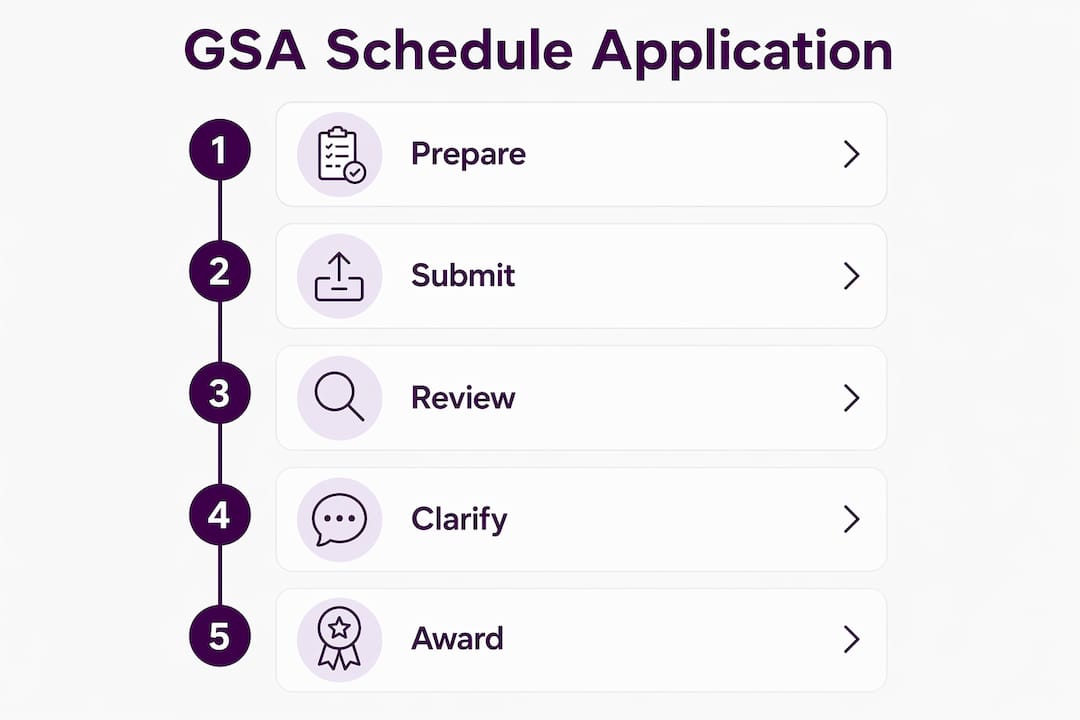
The GSA Schedule application process follows a defined sequence, but the timeline surprises most first-time applicants. The full process typically spans 6 to 12 months from submission to award, depending on offer complexity and how complete your documentation is at submission.
Here is a realistic step-by-step breakdown:
- Assess eligibility and gather documentation. Collect two years of tax returns, financial statements, past performance references, and a commercial price list. This preparation phase takes 4 to 8 weeks and is consistently underestimated by applicants.
- Select your SINs and build your technical proposal. Each SIN requires a narrative explaining your relevant experience, qualifications, and approach. Vague narratives are a leading cause of delays.
- Submit through the eOffer portal. GSA’s eOffer system is where all formal submissions go. Incomplete uploads or mismatched documents trigger immediate clarification requests that add weeks to your timeline.
- Negotiate with your contracting officer. GSA assigns a contracting officer who reviews pricing, past performance, and technical content. This negotiation phase determines your final approved price list.
- Receive your contract award and activate your listings. Once awarded, you must set up your GSA Advantage! profile and confirm your SIN listings are accurate and visible to buyers.
Pro Tip: Submit a complete, error-free offer the first time. Every clarification request from GSA resets your position in the review queue and can add 30 to 60 days to your timeline.
GSA’s internal goal is to process applications within 90 days. In practice, complex offers with multiple SINs or pricing structures routinely take longer. The step-by-step application guide from Gsascheduleservices breaks down each phase with specific documentation checklists for professional services businesses.
How does GSA pricing work, and what is the IFF?
GSA pricing requires that you offer the federal government rates equal to or better than those you give your most favored commercial customer. This is called the Most Favored Customer (MFC) analysis, and it requires a Commercial Sales Practice disclosure at the time of application. Misrepresenting your commercial pricing during this disclosure is a compliance violation with serious legal consequences.
| Pricing concept | What it means for your business |
|---|---|
| Most Favored Customer (MFC) rate | Your GSA price must match or beat your best commercial customer’s rate |
| Commercial Sales Practice disclosure | You must document how your commercial pricing compares to your GSA offer |
| Industrial Funding Fee (IFF) | A 0.75% fee on all GSA sales, reported quarterly through the 72A system |
| Pricing 2.0 compliance | Machine-readable, audit-ready documentation required as of mid-2026 |
The IFF is a fixed contractual cost. Every dollar of GSA revenue you report triggers this fee, and quarterly reporting through the 72A system is mandatory. Missing a quarterly report puts your contract in jeopardy.
The 2026 Pricing 2.0 reforms add a new layer of documentation discipline. GSA now requires that all line items map to approved templates and that pricing records be machine-readable and audit-ready. Internal audits are required every six months under these rules. Businesses that relied on spreadsheets and PDFs for pricing records need to update their systems before a contracting officer requests a review.
Pro Tip: Build your pricing documentation in a format that can be exported cleanly for audit. A well-organized pricing file takes hours to prepare in advance and days to reconstruct under pressure.
What does post-award GSA contract management require?
Winning a GSA contract is the beginning of an ongoing compliance obligation, not the finish line. Post-award management is where many small businesses lose good standing without realizing it until they receive a cure notice.
The core ongoing requirements every GSA contract holder must meet:
- Quarterly sales reporting and IFF payment. Report all GSA sales through the 72A system each quarter and pay the 0.75% IFF on time. Late payments trigger compliance flags.
- Trade Agreements Act (TAA) compliance. Every product on your schedule must originate from a TAA-designated country. Non-compliant products must be removed immediately when identified.
- Mass modification acceptance. GSA issues mass modifications to update contract terms across all holders. Contractors must accept these within 30 days to avoid contract disruption.
- GSA Advantage! listing accuracy. Product descriptions, pricing, and availability must stay current. Outdated listings confuse buyers and reduce your order volume.
- Annual contract reviews. GSA contracting officers conduct periodic reviews. Businesses with clean records and consistent sales face fewer complications.
The Trade Agreements Act requirement catches businesses off guard most often when they add new products or switch suppliers. A product that was TAA-compliant last year may not be this year if your supplier changed manufacturing locations.
How do you grow federal sales with your GSA contract?
Holding a GSA Schedule does not guarantee sales. Federal buyers are not automatically directed to your listings. You have to find them, respond to their needs, and build relationships that generate repeat orders.
The businesses that grow federal revenue consistently do these things:
- Monitor eBuy daily for RFQs. eBuy is where federal agencies post Requests for Quotations. Responding quickly and accurately to relevant RFQs is the fastest path to initial orders.
- Optimize your GSA Advantage! listings. Clear product descriptions, competitive pricing, and accurate SIN categorization all affect how often buyers find your offerings. The guide on maximizing GSA Advantage! orders covers specific listing tactics that increase visibility.
- Pursue subcontracting partnerships. Larger prime contractors often need GSA-certified subcontractors. Positioning your business as a reliable subcontractor builds revenue while you develop direct agency relationships.
- Track your SIN performance. SIN selection directly impacts visibility on GSA Advantage! and eligibility for specific RFQs. Review your SIN performance quarterly and add or remove SINs as your service offerings evolve.
- Build agency-specific relationships. Agencies have preferred vendors they return to repeatedly. Attending agency industry days and responding to Sources Sought notices puts your business in front of contracting officers before a formal solicitation opens.
The businesses that treat their GSA contract as a passive credential rarely see meaningful federal revenue. The ones that treat it as a sales channel and work it consistently build steady, recession-resistant government income.
Key Takeaways
A GSA Schedule contract creates access to federal procurement, but eligibility, accurate pricing, and active post-award management determine whether that access translates into real revenue.
| Point | Details |
|---|---|
| Eligibility requirements | Businesses need 2 years of operating history, financial statements, and past performance references before applying. |
| Application timeline | The full process takes 6 to 12 months; preparation alone requires 4 to 8 weeks of documentation work. |
| IFF and pricing compliance | A 0.75% Industrial Funding Fee applies to all GSA sales and must be reported quarterly through the 72A system. |
| Pricing 2.0 reforms | Mid-2026 rules require machine-readable, audit-ready pricing documentation with internal audits every six months. |
| Active sales management | Holding a GSA contract does not generate automatic orders; consistent eBuy responses and GSA Advantage! optimization drive revenue. |
What I’ve learned after years of watching businesses misread their GSA contract
The most common mistake I see is businesses treating a GSA Schedule award like a sales guarantee. They spend months on the application, celebrate the award, set up their GSA Advantage! profile, and then wait. Six months later, they have zero orders and no idea why.
A GSA contract is a license to compete, not a contract to sell. The federal government does not route buyers to you because you hold a schedule. You have to show up on eBuy, respond to RFQs faster than your competitors, and build your GSA Advantage! listings with the same care you would give a commercial product page.
The second thing I see businesses get wrong is SIN selection. Owners pick SINs based on what sounds closest to their work rather than what federal buyers actually search for. Spending two hours reviewing active RFQs on eBuy before you finalize your SINs will tell you more about buyer behavior than any category description ever will.
The Pricing 2.0 changes in 2026 are the biggest compliance shift in years. Businesses that have been managing pricing in spreadsheets are going to face audit requests they are not prepared for. The time to build clean, machine-readable pricing documentation is now, not when a contracting officer asks for it.
The businesses I see succeed long-term are the ones that treat their GSA contract as a living sales tool. They review their SIN performance, respond to mass modifications immediately, and stay current on agency priorities. That discipline compounds over time into a federal revenue stream that holds up even when commercial markets soften.
For more on building a real federal sales strategy, the guide on growing your service business with a GSA Schedule is worth your time.
— Josh
How Gsascheduleservices helps you secure and manage your contract
Gsascheduleservices works with small and mid-sized businesses at every stage of the GSA Schedule process. The team handles eligibility assessments, documentation preparation, and pricing strategy so your application goes in complete and accurate the first time. For businesses already holding a contract, Gsascheduleservices provides compliance support for Pricing 2.0 requirements, mass modification responses, and GSA Advantage! listing optimization. If you are preparing your financials for the application, the 2026 small business funding checklist is a useful starting point for organizing your documentation. When you are ready to move forward, the GSA Schedule discovery session is the fastest way to assess where your business stands and what steps come next.
FAQ
What is a GSA Schedule contract?
A GSA Schedule, also called a Multiple Award Schedule, is a long-term government contract that pre-negotiates prices and terms between the GSA and commercial vendors. It gives federal agencies a compliant, fast path to purchase products and services without running a full competitive bid each time.
How long does the GSA Schedule application process take?
The process typically takes 6 to 12 months from submission to award. Pre-application preparation alone takes 4 to 8 weeks, and complex offers with multiple SINs often extend the GSA review period beyond the agency’s 90-day processing goal.
What is the Industrial Funding Fee?
The Industrial Funding Fee is a 0.75% fee applied to all sales made under a GSA Schedule contract. Contractors report and pay it quarterly through the GSA 72A system, and failure to report on time is a compliance violation.
Do I need to be an established business to apply?
Most applicants need at least two years of operating history and supporting financial documentation. Newer businesses may qualify through the GSA Startup Springboard program if they meet specific professional services criteria.
What do the 2026 Pricing 2.0 rules require?
Pricing 2.0 requires GSA contract holders to maintain machine-readable, audit-ready pricing documentation mapped to approved GSA templates. Internal pricing audits are required every six months, and non-compliant documentation can trigger contract modifications.
Recommended
- GSA Contracts for Dummies
- GSA Schedule Contracts: Your Guide to Success
- How to Grow a Small Business Through a GSA Schedule
- Government Contract Opportunities 2026: SME Guide