

A Social Insurance Number (SIN) is a unique 9-digit identifier issued by the Government of Canada that every individual needs to work legally, file taxes, and access federal benefits. Service Canada manages the entire process, and the application is free. Most Canadians receive a SIN early in adulthood and use it for the rest of their working lives. Business owners also interact with SINs regularly when hiring employees, processing payroll, and filing with the Canada Revenue Agency (CRA). Understanding what a SIN number does, who needs one, and how to protect it is not optional knowledge. It is the foundation of financial and legal compliance in Canada.
What is a SIN number and what does it do?
A SIN is a 9-digit administrative number, not an identity document. The Government of Canada uses it to track employment income, tax contributions, and eligibility for federal programs like Employment Insurance (EI) and the Canada Pension Plan (CPP). Every time you start a new job, open an interest-bearing bank account, or apply for a government benefit, your SIN is the key that connects your activity to the right government records.
The SIN number meaning goes beyond just a reference code. It is the thread that ties your entire financial and employment history to the CRA and Service Canada. Without it, employers cannot issue T4 slips, banks cannot report interest income on T5 slips, and you cannot receive CPP retirement benefits you have spent decades earning.

One detail many people miss: the SIN is strictly an administrative tool. Physical SIN cards were discontinued in 2014 to reduce fraud and discourage people from carrying the number in their wallet. That decision reflects how seriously the government treats SIN security.
Why is a SIN number important for individuals and business owners?
The importance of a SIN number shows up in three areas: employment, taxation, and government program access. Each one carries legal weight.
Employment and payroll
Every employer in Canada must collect your SIN before processing your first paycheck. The employer uses it to file T4 slips with the CRA at year end. Those T4 slips report your employment income and the taxes withheld. Without your SIN, your employer cannot complete this filing accurately, and you cannot file your personal tax return correctly.
Tax filing and financial accounts
The CRA requires your SIN on every personal tax return. Financial institutions also collect it for accounts that generate interest, dividends, or investment income. The bank reports that income to the CRA using your SIN as the identifier. Refusing to provide your SIN when legally required carries a $100 penalty from the CRA. That penalty is small, but the compliance obligation is real.
Government benefits
Your SIN is the access key for EI, CPP, Old Age Security (OAS), and other federal programs. Every contribution you make to CPP through payroll deductions is recorded under your SIN. When you retire or become disabled, the government uses that record to calculate your benefit. No SIN means no traceable contribution history, which means no benefit.
Pro Tip: Business owners hiring their first employee should collect the employee’s SIN on the first day of work. Waiting until payroll time creates compliance risk and delays T4 filing.
- Collect the employee’s SIN before the first pay period.
- Record it securely and use it only for payroll and tax purposes.
- Never store SINs in unsecured spreadsheets or shared drives.
- Remind employees that providing their SIN is a legal requirement, not optional.
How to get a SIN number: application process and requirements
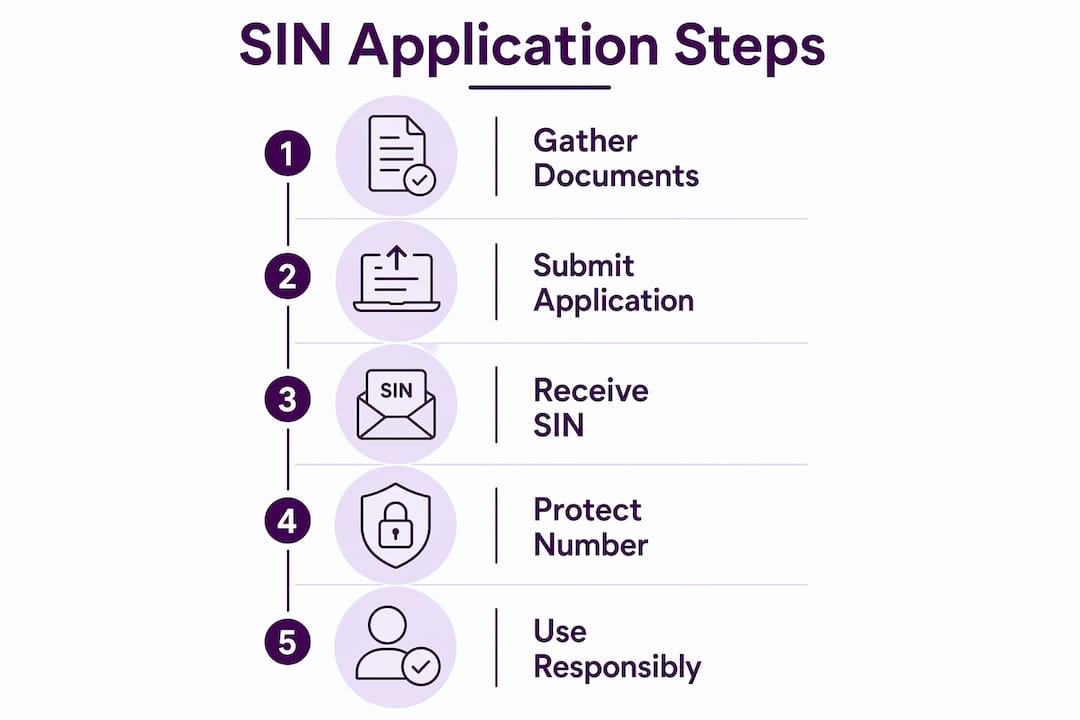
Getting a SIN is straightforward. Service Canada issues all SINs at no cost. The application process has three methods: online, in person at a Service Canada Centre, or by mail.
Who is eligible?
- Canadian citizens can apply at any age. Parents often apply for newborns through the Newborn Registration Service.
- Permanent residents apply after receiving their Confirmation of Permanent Residence document.
- Temporary residents including international students, foreign workers, and temporary visa holders can apply with valid immigration documents.
What documents do you need?
The required documents depend on your status. Canadian citizens typically need a birth certificate or Canadian passport. Permanent residents need their immigration documents. Temporary residents need a valid work or study permit. Service Canada reviews these documents and issues a confirmation letter. There is no physical card.
The temporary SIN starting with ‘9’
Temporary residents receive a SIN that begins with the digit 9. This SIN expires when the immigration document it was issued under expires. If you renew your work permit, you must also update your SIN record with Service Canada. Employers should check the expiry date on a temporary SIN to stay compliant.
Canadian citizens and permanent residents receive a permanent SIN that never expires. You keep the same 9-digit number for life.
Pro Tip: Apply for your SIN as soon as you are eligible. Waiting until you have a job offer creates unnecessary delays. Service Canada processes most applications within 5 business days when documents are in order.
When and to whom should you provide your SIN?
The SIN is confidential. Employment and Social Development Canada advises treating it like a password and sharing it only when legally required. That guidance exists because SIN misuse is the most common entry point for identity theft in Canada.
Three categories of organizations have the legal right to request your SIN:
- Employers need it for payroll and T4 reporting.
- Federal and provincial government agencies need it for tax administration and benefit programs.
- Financial institutions need it for accounts that generate taxable income, such as savings accounts, GICs, and investment accounts.
Outside these categories, most requests for your SIN are not legally required. A landlord asking for your SIN on a rental application does not have a legal basis for that request. A gym, retailer, or private club has no legal right to collect it at all. Organizations that collect SINs improperly expose individuals to fraud risk and may violate the Privacy Act.
“The SIN is not a general-purpose identifier. It was designed for a specific administrative purpose, and using it beyond that purpose creates real harm for individuals.” — Government of Canada, SIN Code of Practice
The Privacy Act requires organizations to collect only the minimum SIN data necessary for a specific, lawful purpose. If you are unsure whether a request is legitimate, ask the organization which law requires them to collect your SIN. A legitimate requester will have a clear answer.
Canadian SIN vs. U.S. SIN: clearing up the confusion
The acronym SIN means two completely different things depending on which side of the border you are on. Canadian and American business owners working across borders run into this confusion regularly.
The Canadian SIN is a personal 9-digit identifier for individuals. The U.S. equivalent is the Social Security Number (SSN), issued by the Social Security Administration. These two numbers serve the same general purpose but are issued by different governments and are not interchangeable.
In U.S. federal contracting, SIN stands for Special Item Number. A Special Item Number is an alphanumeric code used under the GSA Multiple Award Schedule (MAS) program to classify specific products and services. It has nothing to do with personal identification. A Canadian business owner pursuing a GSA contract will encounter SINs in this entirely different context. Understanding NAICS codes and GSA SINs as classification tools is critical for federal contract compliance.
| Term | Country | Purpose | Format |
|---|---|---|---|
| SIN (Social Insurance Number) | Canada | Personal tax and benefits identifier | 9 digits |
| SSN (Social Security Number) | United States | Personal tax and benefits identifier | 9 digits |
| SIN (Special Item Number) | United States | GSA contract product/service classification | Alphanumeric |
| NAICS Code | United States | Business activity classification | 6 digits |
The table above shows why context matters. When a Canadian business owner reads about “SIN” in a U.S. government contracting document, it refers to product classification, not personal identity. Mixing these up creates real compliance errors. Businesses pursuing GSA Schedule contracts need to understand both systems clearly.
Key Takeaways
A SIN is a mandatory 9-digit number issued by Service Canada that connects every Canadian’s employment, tax, and benefits history to the federal government.
| Point | Details |
|---|---|
| SIN is free to obtain | Service Canada issues SINs at no cost through online, in-person, or mail applications. |
| Legal obligation to provide SIN | Refusing to provide your SIN when legally required carries a $100 CRA penalty. |
| Temporary SINs start with 9 | These expire with immigration documents and require renewal when permits are extended. |
| Physical cards were discontinued | Canada stopped issuing SIN cards in 2014 to reduce fraud and misuse. |
| Canadian SIN differs from U.S. SIN | In U.S. contracting, SIN means Special Item Number, a product classification code, not a personal identifier. |
Why SIN protection deserves more attention than it gets
Most Canadians treat their SIN like a password they never change. They write it on forms, hand it to landlords, and store it in email threads without a second thought. That casual attitude is a real problem.
The government’s decision to stop issuing physical SIN cards in 2014 was a signal. It was an acknowledgment that the number had become too easy to misuse. The shift to confirmation letters and digital records was a deliberate move to reduce the number of physical copies floating around. Most people did not notice. They kept treating the number the same way.
What I find most concerning is how often businesses collect SINs when they have no legal basis to do so. A rental application, a loyalty program sign-up, a contractor intake form. These are not legal collection points. The Privacy Act is clear on this, but enforcement is inconsistent. The burden falls on individuals to push back and ask the right questions.
For business owners, the risk runs in both directions. You need to collect SINs from employees for payroll. But you also need to store and protect that data properly. A data breach that exposes employee SINs is not just an IT problem. It is a legal liability. The organizations that handle this well treat SIN data the same way they treat banking credentials: minimum collection, encrypted storage, and strict access controls.
The SIN system works well when everyone uses it for its intended purpose. The problems start when it drifts into contexts it was never designed for.
— Josh
Government compliance resources for Canadian and cross-border businesses
Navigating government registration and compliance requirements is one of the most time-consuming parts of running a business. Whether you are managing employee SIN records for Canadian payroll or working through U.S. federal contracting classifications, the paperwork and rules are dense. Gsascheduleservices specializes in helping small and medium-sized businesses cut through that complexity, particularly for companies pursuing GSA Schedule contracts. If your business operates across the Canadian-U.S. border and you need to understand how government contract classification works on the American side, Gsascheduleservices offers readiness assessments and hands-on support to get you compliant and positioned for federal sales.
FAQ
What is a SIN number in Canada?
A SIN is a unique 9-digit number issued by Service Canada that Canadians use to work, file taxes, and access government benefits like EI and CPP. The application is free.
Who needs a SIN number?
Anyone who works in Canada, files a Canadian tax return, or applies for federal government benefits needs a SIN. This includes citizens, permanent residents, and eligible temporary residents.
How do you get a SIN number?
Apply through Service Canada online, in person at a Service Canada Centre, or by mail with the required identity documents. There is no fee, and most applications are processed within 5 business days.
Does a SIN number expire?
SINs issued to Canadian citizens and permanent residents are permanent and never expire. SINs issued to temporary residents begin with the digit 9 and expire when the holder’s immigration documents expire.
Is a Canadian SIN the same as a U.S. SSN?
No. A Canadian SIN and a U.S. Social Security Number serve similar purposes but are issued by different governments and are not interchangeable. In U.S. federal contracting, SIN refers to Special Item Number, a product classification code with no connection to personal identity.
Recommended
- Maximize Federal Sales with a Solid GSA NAICS Code Strategy
- GSA CDM SIN 541519CDM (132-44) – What is it?
- SAM.gov MPIN Guide: Secure Your Access!
- Understanding What is a Cage Code Number: A Comprehensive Guide