

GSA readiness is defined as the full preparation a business must complete before it can effectively pursue and manage a contract through the GSA Multiple Award Schedule (MAS). This is not a formality. It is the single most reliable predictor of whether your federal contracting effort will generate revenue or drain resources. The importance of GSA readiness becomes clear the moment you understand that the MAS application process spans three to six months, involves mandatory training, and demands documented operational history before GSA reviewers will take your offer seriously. Small and medium-sized businesses that skip this preparation stage do not just face rejection. They lose application fees, consultant costs, and months of staff time on offers that were never viable.
What is involved in the GSA readiness assessment process?
A GSA readiness assessment is a structured evaluation that determines whether your business has the operational capacity, compliance infrastructure, and market fit to succeed with a MAS contract. The role of readiness assessment in GSA is to surface problems before they become expensive mistakes. Think of it as a pre-flight checklist, not a rubber stamp.
The assessment covers five core areas:
- Eligibility verification. Your business must meet minimum criteria: typically two or more years in operation, a valid SAM.gov registration, and a clean financial record.
- Operational history and past performance. Reviewers look for documented commercial sales that align with what you plan to offer the federal government.
- Demand analysis. The assessment examines federal spending data and existing contracts to confirm that real procurement demand exists for your products or services.
- Internal capacity review. This covers staffing, pricing strategy, and whether your team can handle the compliance workload post-award.
- Compliance readiness. This includes your ability to meet Trade Agreements Act requirements, maintain accurate pricing records, and fulfill reporting obligations.
Before you even submit an offer through the GSA eOffer system, you must complete the mandatory Pathways to Success training. This is a non-negotiable prerequisite, and your designated authorized negotiator must be identified before the process begins. The MAS application phases include preliminary review (one to two months), financial assessment (one to three months), price negotiation (two to four months), and final processing (two to three months). That timeline assumes your documentation is complete and accurate from day one.
A proper readiness assessment prevents wasted fees and saves months of staff time on offers that have no realistic chance of approval. Businesses that skip this step often discover fatal gaps mid-application, at the worst possible moment.

Pro Tip: Complete your Pathways to Success training and run a mock readiness assessment at least 90 days before you plan to submit your MAS offer. This gives you time to close documentation gaps without rushing.
How does GSA readiness affect your chances of winning and managing federal contracts?
Readiness does not just affect your application. It determines whether your contract produces revenue after award. GSA contracts require ongoing management, compliance, and active utilization. A contract award is not a sales guarantee. It is a license to compete, and businesses that are not operationally ready to use that license consistently underperform.
Here is what readiness directly affects once you hold a MAS contract:
- Review delays and rework. Incomplete or inconsistent documentation is the leading cause of extended review cycles. Businesses with strong readiness profiles move through the negotiation phase faster because their pricing and past performance records are already in order.
- Compliance maintenance. GSA contractors must submit annual sales reports, maintain current pricing, and respond to modification requests. Without internal compliance processes in place before award, these obligations become a crisis instead of a routine.
- Federal buyer relationships. Successful firms treat the GSA contract as a foundation for marketing and relationship-building with federal buyers, not as a passive revenue source. That requires sales capacity and a clear utilization plan.
- Premature entry risk. Businesses that pursue a GSA contract before they are ready often win the contract and then fail to use it. An unused or underutilized contract can be terminated, and that record follows your company.
“Small and mid-sized businesses succeed when they approach GSA contracts intentionally, with clear planning and a compliance focus from day one.”
Operational maturity is not a vague concept here. Most successful GSA contractors have been in business at least two years with consistent commercial sales that demonstrate they can deliver at scale. If your revenue is inconsistent or your internal processes are informal, the GSA review process will expose that quickly.
For a practical breakdown of what the acquisition process looks like step by step, the GSA contract acquisition guide from Gsascheduleservices is worth reviewing before you start.
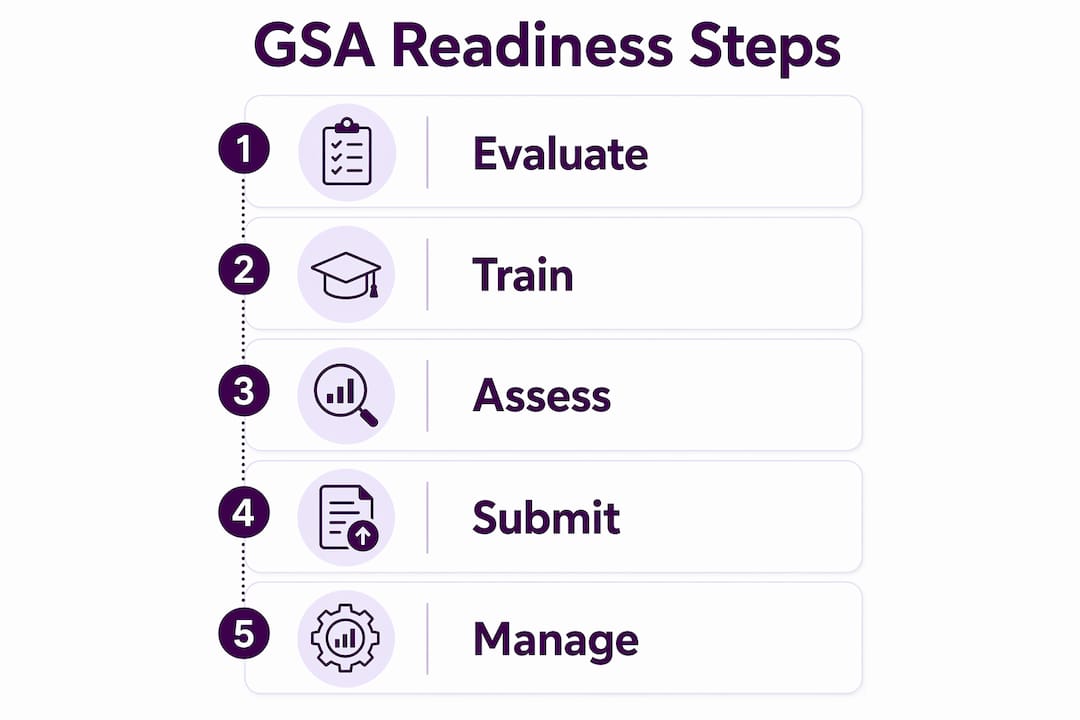
What are common gaps in readiness and how can businesses address them?
Most businesses that struggle with their MAS application do not fail because they lack a good product or service. They fail because of process gaps that a proper readiness assessment would have caught. Many businesses discover readiness gaps like pricing issues, incomplete documents, or insufficient internal resources during the assessment phase. Catching these early is the entire point.
The table below maps the most common gaps to practical solutions:
| Common gap | How to address it |
|---|---|
| Pricing strategy not documented | Build a commercial price list with at least six months of consistent sales history before applying |
| Incomplete past performance records | Collect signed customer references and project summaries that match your intended GSA offerings |
| No internal compliance owner | Assign a specific team member to own GSA compliance obligations before award, not after |
| Unclear utilization plan | Write a 12-month federal sales plan that identifies target agencies, procurement vehicles, and outreach tactics |
| Leadership and communication gaps | Conduct an internal audit of who owns the GSA effort and how decisions get made across your team |
The last gap in that table is the one most businesses overlook. Organizational readiness for change requires leadership alignment, clear internal communication, and genuine motivation across the team. If your leadership team is not committed to the federal sales effort, no amount of documentation will compensate for that. Compliance and cybersecurity consulting firms like TandT LLC emphasize this point when working with professional services firms preparing for federal contracts: readiness is a culture, not a checklist.
Readiness is not a one-time evaluation. It is an ongoing capability. Firms that build feedback loops into their contract management process, reviewing pricing, compliance status, and sales activity on a quarterly basis, consistently outperform those that treat readiness as something they achieved at the application stage.
Pro Tip: Run a readiness audit every six months after contract award. Check your pricing currency, sales reporting status, and modification history. Catching drift early costs far less than a compliance review initiated by GSA.
When is the right time for small and medium-sized businesses to pursue a GSA contract?
Eligibility and readiness are not the same thing. Distinguishing eligibility from readiness is one of the most important decisions a small business owner can make before investing time and money in the MAS process. You can meet every minimum eligibility requirement and still not be ready to pursue a contract productively.
The signals that indicate genuine readiness include:
- Two or more years of consistent commercial sales in the category you plan to offer through GSA
- Documented past performance with at least three to five references that align with your intended federal offerings
- A named compliance owner inside your organization who has time allocated to manage GSA obligations
- A written federal sales plan that identifies which agencies buy what you sell and how you plan to reach them
- Confirmed federal demand through market research, including a review of USASpending.gov data and existing GSA Advantage listings in your category
The risk of premature pursuit is real and specific. Businesses that apply before they have a utilization plan often win a contract, pay ongoing maintenance costs, and generate zero federal revenue. That is not a hypothetical. It is a pattern that repeats across the small business federal contracting space every year.
The right time to start exploring a GSA contract is earlier than you think, but the right time to apply is later than most businesses want to wait. Use the exploration phase to conduct demand analysis, review the GSA MAS structure, and build the internal capacity you will need post-award. That preparation period is not wasted time. It is the work that makes the contract worth having.
Key takeaways
GSA readiness is the foundational capability that determines whether a MAS contract generates federal revenue or becomes a costly, underutilized obligation.
| Point | Details |
|---|---|
| Readiness precedes eligibility | Meeting minimum criteria does not mean your business is operationally prepared to manage a GSA contract. |
| Assessment prevents costly mistakes | A readiness assessment identifies pricing, documentation, and compliance gaps before they derail your application. |
| Timeline demands preparation | The MAS process takes three to six months; entering without complete documentation extends that significantly. |
| Ongoing management is required | GSA contracts demand active compliance, annual reporting, and a federal sales strategy to generate real revenue. |
| Readiness is a continuous capability | Quarterly internal audits of pricing, compliance, and sales activity keep your contract viable long after award. |
Why most businesses misread what GSA readiness actually demands
I have worked with dozens of small and medium-sized businesses at various stages of the GSA process, and the pattern I see most often is not a lack of capability. It is a misreading of what readiness actually requires. Business owners assume that if they qualify on paper, they are ready to apply. That assumption costs them months and real money.
The businesses that succeed treat readiness as a living standard, not a threshold they crossed once. They assign internal ownership of the compliance function before award. They build their federal sales plan before they have a contract to sell through. They run demand analysis before they invest in the application. That sequence feels counterintuitive because most businesses want to win the contract first and figure out the rest later. The GSA MAS process does not reward that approach.
The significance of GSA readiness is not just about passing a review. It is about building the internal infrastructure that makes a federal contract worth holding. If you are not sure where your gaps are, the most productive first step is an honest assessment of your pricing documentation, past performance records, and internal compliance capacity. Avoid the most common application mistakes by doing that work before you submit, not after you receive a deficiency notice.
— Josh
Take the next step toward GSA readiness with Gsascheduleservices
Gsascheduleservices works directly with small and medium-sized businesses to evaluate where they stand before they invest in the MAS application process. The readiness assessment and consultation services at Gsascheduleservices are built to identify your specific gaps in pricing, documentation, compliance capacity, and federal demand, then give you a clear path forward. Rather than discovering problems mid-application, you address them on your schedule. For businesses serious about federal contracting as a long-term revenue channel, professional guidance at the readiness stage reduces risk, shortens the application timeline, and significantly improves the odds that your contract generates real sales after award.
FAQ
What is a GSA readiness assessment?
A GSA readiness assessment is a structured evaluation that determines whether a business has the operational capacity, compliance infrastructure, and market fit to pursue and manage a MAS contract. It covers eligibility, past performance, demand analysis, internal resources, and compliance readiness.
How long does the GSA MAS application process take?
The MAS application process typically takes three to six months, with phases covering preliminary review, financial assessment, price negotiation, and final processing. Incomplete documentation at any stage extends that timeline significantly.
What is the difference between GSA eligibility and GSA readiness?
Eligibility means meeting the minimum criteria to apply, such as two years in business and a SAM.gov registration. Readiness means your business has the internal capacity, compliance processes, and sales plan to actively manage and utilize the contract after award.
What are the most common readiness gaps businesses face?
The most common gaps include undocumented pricing history, incomplete past performance records, no internal compliance owner, and the absence of a federal sales plan. Identifying these gaps through an assessment before applying prevents costly rework during the review process.
Do GSA contracts automatically generate federal sales?
GSA contracts do not automatically generate demand. Successful contractors treat the MAS contract as a foundation for active marketing and relationship-building with federal buyers, supported by a clear utilization plan and ongoing compliance management.
Recommended
- (Infographic) 25 Reasons GSA Contracts are Rejected
- GSA Contract Eligibility Criteria – Quick Guide
- GSA Contract Eligibility Criteria – Quick Guide
- Utilizing the Federal GSA Process in Your Business