

GSA FASt Lane is a federal expedited processing program that shortens contract award and modification timelines for IT vendors under the GSA Multiple Award Schedule (MAS) IT Large Category. The program gives eligible vendors faster access to government contracts while giving federal agencies quicker access to emerging technologies. For IT-focused business owners and government contractors, understanding how FASt Lane works is the difference between waiting months for a contract action and closing one in days.
The core value is speed. FASt Lane new offers can be approved in as little as 45 days, and eMod approvals can come through in as little as 2 days. That is significantly faster than traditional MAS processing, which can stretch well beyond 90 days for new awards. For vendors competing for time-sensitive agency opportunities, this program is a genuine competitive advantage.
What is GSA FASt Lane and who does it serve?
GSA FASt Lane is defined as an IT-focused vendor onboarding program that provides shorter processing times for contract actions under the MAS IT Large Category. It serves two groups simultaneously: IT vendors who need faster contract access to respond to agency demand, and federal agencies that need rapid procurement of technology solutions. The General Services Administration designed the program specifically to support agency outcomes, not simply to reduce vendor wait times as a general convenience.

The program sits within the IT Category (ITC) structure of the MAS program. Contracting officers assigned to the ITC manage all FASt Lane submissions, which means the program has a dedicated administrative track separate from the broader MAS acquisition process. This separation is what makes the speed possible. ITC contracting officers focus exclusively on IT-related contract actions, which reduces the queue and increases processing velocity.
FASt Lane is not a shortcut for every GSA vendor. It is a narrowly scoped program with specific eligibility rules, strict responsiveness requirements, and defined submission procedures. Vendors who qualify and prepare correctly gain a real procurement advantage. Those who enter the process unprepared risk losing their expedited status entirely.
Who qualifies for GSA FASt Lane?
Eligibility requires being a MAS offeror or current schedule holder assigned under the IT Category with an ITC contracting officer. This is the foundational requirement. If your contract is managed under a different MAS category, FASt Lane does not apply to you regardless of what you sell.
Beyond the category assignment, the following criteria must be met before submitting a FASt Lane request:
- ITC SIN alignment: Your submission must include only IT Category Special Item Numbers (SINs). Ancillary SINs from the Miscellaneous category are allowed in limited circumstances, but non-ITC MAS items are not eligible for accelerated processing.
- FASt Lane Eligibility Checklist: You must submit this checklist with every FASt Lane offer or modification. It is mandatory, not optional.
- Documented agency opportunity: The checklist requires evidence of a specific procurement opportunity, such as an agency Request for Quotation (RFQ), Request for Information (RFI), or solicitation. You cannot self-certify need. The agency demand must be real and documented.
- ITC contracting officer assignment: Your submission must be reviewed by an ITC-assigned contracting officer. If you are unsure of your assignment, contact the GSA IT Category office directly before submitting.
The scope restriction is deliberate. FASt Lane serves agency outcomes by fast-tracking ITC-assigned vendors and SINs, not by offering a general acceleration for all MAS contracts. If your offerings span multiple MAS categories, only the ITC-aligned portion of your contract can move through FASt Lane. Understanding this boundary before you apply saves significant time and prevents submission errors that delay the entire process.
Pro Tip: Before investing time in the FASt Lane Eligibility Checklist, confirm your SIN assignments match the ITC structure. Review the GSA contract eligibility criteria to verify your offerings are correctly categorized before you submit.
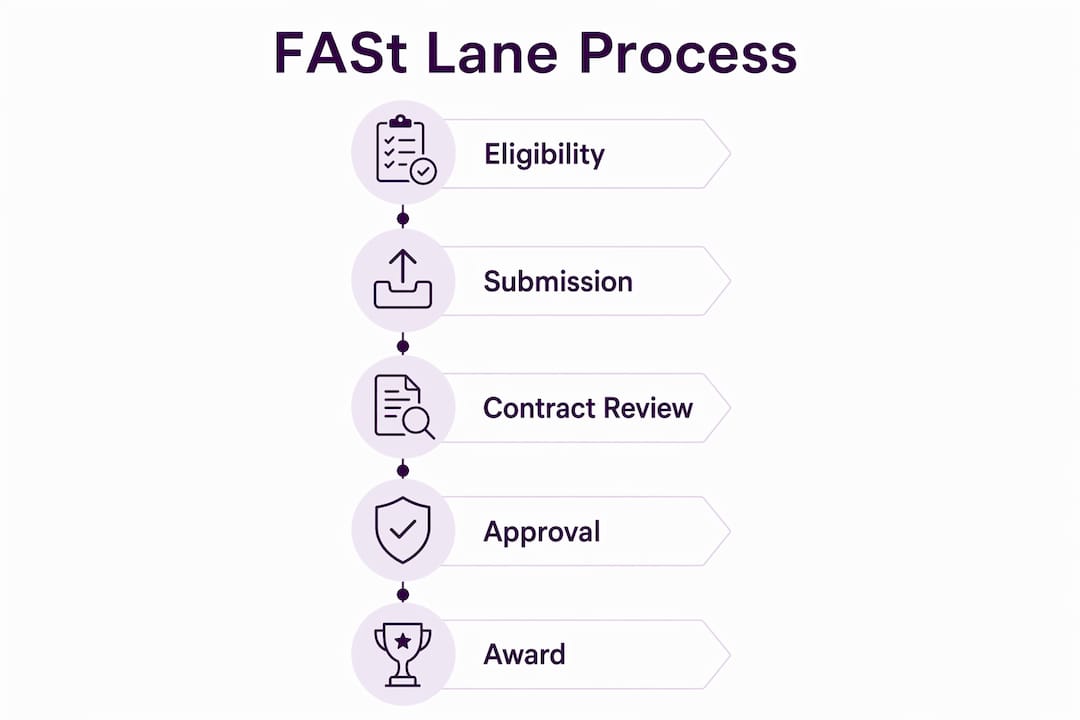
How GSA FASt Lane works: processes and timelines
The operational mechanics of FASt Lane depend on two platforms: eOffer for new contract submissions and eMod for contract modifications. Both are GSA portals that ITC contracting officers use to review and process submissions. Understanding the workflow within these platforms is critical to maintaining your FASt Lane status.
Here is how the process unfolds from submission to award:
- Submit the FASt Lane Eligibility Checklist with your eOffer or eMod. The checklist must accompany every submission. Missing it removes you from the expedited track immediately.
- Complete technical reviews before submitting modifications. For eMods specifically, technical documentation and commercial agreements must be finalized before submission. Submitting incomplete materials is the most common reason vendors lose FASt Lane eligibility mid-process.
- Monitor your eOffer inbox within 24 hours. Once your eOffer is submitted, your ITC contracting officer may send inquiries. You must respond within 24 hours. Missing this window removes you from FASt Lane for that submission.
- Monitor your eMod inbox within 2 hours. The eMod response window is tighter. Contractors must respond within 2 hours of a contracting officer inquiry. This is a strict service-level agreement (SLA), not a guideline.
- Receive award or modification approval. If all steps are completed correctly and responsiveness requirements are met, new offers can be approved in as little as 45 days and eMods in as little as 2 days.
The 2-hour eMod response window is the requirement that catches most vendors off guard. Federal agencies operate during business hours, but contracting officer inquiries do not always arrive at convenient times. Vendors who treat FASt Lane as a passive process rather than an active one consistently miss these windows.
Pro Tip: Set up an internal ticketing or alert system specifically for FASt Lane submissions. Assign a dedicated point of contact who monitors eOffer and eMod inboxes during all business hours when a submission is active. One missed 2-hour window ends your expedited status for that contract action.
How FASt Lane compares to standard GSA MAS processing
Understanding the difference between FASt Lane and the standard MAS acquisition process helps you decide when to pursue the expedited track and when the standard path is sufficient.
| Factor | GSA FASt Lane | Standard MAS Process |
|---|---|---|
| New offer processing time | As little as 45 days | Typically 90 or more days |
| Modification approval time | As little as 2 days | Weeks to months |
| Eligibility scope | ITC vendors and SINs only | All MAS categories |
| Response requirement | 24 hours (eOffer), 2 hours (eMod) | No strict SLA for vendors |
| Checklist requirement | Mandatory FASt Lane Eligibility Checklist | Not required |
| Agency opportunity proof | Required (RFQ, RFI, or solicitation) | Not required |
| Risk of losing expedited status | High if SLAs are missed | Not applicable |
The standard MAS process is more forgiving. There are no response SLAs for vendors, no mandatory checklists, and no risk of losing an expedited track. The tradeoff is time. If you are responding to a specific agency opportunity with a defined timeline, the standard process may not move fast enough to keep you competitive.
FASt Lane is specifically designed for situations where an agency has an active IT need and wants to move quickly. The FASt Lane program exists to support those agency outcomes, which is why the eligibility requirements include documented proof of demand. Vendors who use FASt Lane without a genuine agency opportunity behind their submission are misusing the program and will likely fail the checklist review.
The administrative burden under FASt Lane is also higher on the vendor side. You must have your technical documentation complete before submission, your team must be available to respond within hours, and your SIN structure must be precisely aligned with the ITC. For vendors with strong internal processes, this is manageable. For vendors operating without dedicated contracting staff, the standard MAS path may be more practical until internal capacity improves.
Practical steps to succeed with GSA FASt Lane
Preparation before submission is what separates vendors who maintain FASt Lane eligibility from those who lose it mid-process. The following practices apply whether you are submitting a new offer through eOffer or a modification through eMod.
- Finalize all technical documentation before you submit. This includes product descriptions, pricing support, and any commercial agreements relevant to your SINs. Submitting incomplete materials and expecting to fill gaps during the review process does not work under FASt Lane timelines.
- Map your offerings precisely to ITC SINs. Review the current ITC SIN structure and confirm every product or service in your submission falls under an eligible SIN. Non-ITC items in your submission will disqualify the entire action from FASt Lane processing. The GSA eOffer process guide provides a detailed walkthrough of how to structure your submission correctly.
- Secure documented agency demand before applying. Contact the agency contracting officer or program office to obtain an RFQ, RFI, or solicitation document. This is not optional. The FASt Lane Eligibility Checklist requires evidence of specific opportunities such as agency RFQs or solicitations.
- Assign a dedicated FASt Lane point of contact. This person owns all communication with the ITC contracting officer during the active submission period. They monitor eOffer and eMod inboxes continuously and have the authority to respond or escalate immediately.
- Build an internal escalation workflow. If your primary point of contact is unavailable, a backup must be ready to respond within the SLA window. Document this workflow before you submit, not after a missed inquiry.
- Contact your ITC contracting officer proactively. Before submitting, reach out to confirm your eligibility, verify your SIN assignments, and ask about any current processing priorities. ITC contracting officers are accessible and a brief pre-submission conversation can prevent costly errors.
The vendors who succeed consistently with FASt Lane treat it as a project with defined milestones and assigned owners. Those who approach it as a form submission exercise consistently underestimate the operational demands.
Key takeaways
GSA FASt Lane accelerates IT contract actions to as little as 2 days for modifications and 45 days for new offers, but only for ITC-assigned vendors who meet strict eligibility and responsiveness requirements.
| Point | Details |
|---|---|
| Program definition | FASt Lane is an expedited processing track for MAS IT Category vendors, not a general MAS acceleration program. |
| Eligibility requirement | Vendors must be ITC-assigned, submit the FASt Lane Eligibility Checklist, and provide documented agency demand. |
| Response SLAs | eOffer inquiries require a 24-hour response; eMod inquiries require a 2-hour response or eligibility is lost. |
| Pre-submission preparation | All technical documentation and commercial agreements must be complete before submitting a modification. |
| Competitive advantage | FASt Lane gives IT vendors a real speed advantage when responding to active agency procurement opportunities. |
Why FASt Lane rewards the prepared and punishes the reactive
I have worked with enough IT contractors to know that the vendors who struggle most with FASt Lane are not the ones who lack technical expertise. They are the ones who treat the program as a paperwork exercise rather than an operational commitment.
The 2-hour eMod response window is the clearest example. Most contracting teams are not structured to monitor a federal portal continuously during business hours. They check email, they attend meetings, they handle other contracts. A 2-hour window sounds reasonable until a contracting officer sends an inquiry at 3:45 PM on a Friday. I have seen vendors lose expedited status on modifications that were otherwise perfectly prepared because no one was watching the inbox.
The fix is not complicated, but it requires deliberate planning. Assign a named owner to every active FASt Lane submission. Build a backup. Set calendar alerts. Treat the SLA window like a client deadline, because it is one. Federal contracting officers are not unsympathetic, but the program rules are clear. Missing response windows removes you from the expedited track for that action, full stop.
The other mistake I see regularly is submitting before the technical documentation is complete. Vendors assume they can resolve open items during the review. Under standard MAS processing, that sometimes works. Under FASt Lane, it does not. The program is built on the assumption that your submission is ready. If it is not, you are not using FASt Lane. You are just slowing down the standard process with an eligibility checklist attached.
FASt Lane is genuinely worth pursuing for IT vendors with active agency relationships and the internal capacity to meet its demands. For vendors who are still building their federal contracting infrastructure, getting the foundational processes right first will make the FASt Lane experience far more productive.
— Josh
Get expert support for your GSA FASt Lane application
Navigating the FASt Lane eligibility requirements, SIN alignment, and response SLAs is manageable with the right preparation. But for many small and mid-sized IT vendors, the process reveals gaps in documentation, SIN structure, or internal workflows that slow everything down.
Gsascheduleservices specializes in helping IT contractors and business owners get GSA Schedule contracts faster and with fewer errors. From readiness assessments and eligibility reviews to full application support and modification management, the team at Gsascheduleservices handles the details so you can focus on winning agency business. If you are ready to explore whether FASt Lane is the right path for your company, start with a discovery session to get a clear picture of where you stand and what steps come next.
FAQ
What is GSA FASt Lane in simple terms?
GSA FASt Lane is an expedited contract processing program for IT vendors under the GSA Multiple Award Schedule IT Large Category. It shortens new offer approvals to as little as 45 days and modification approvals to as little as 2 days.
Who is eligible for GSA FASt Lane?
Eligibility is limited to MAS offerors or schedule holders assigned under the IT Category with an ITC contracting officer. Submissions must include only ITC Special Item Numbers and must be accompanied by the FASt Lane Eligibility Checklist.
What happens if I miss a FASt Lane response window?
Missing the 24-hour eOffer or 2-hour eMod response window removes your submission from the expedited track for that contract action. You revert to standard MAS processing timelines.
Do I need proof of an agency opportunity to apply?
Yes. The FASt Lane Eligibility Checklist requires documented evidence of a specific agency opportunity, such as an RFQ, RFI, or solicitation. Self-certification of need is not accepted.
Is GSA FASt Lane available for all MAS categories?
No. FASt Lane is narrowly scoped to the IT Category and applies only to ITC-assigned vendors and SINs. Vendors in other MAS categories must use the standard acquisition process.
Recommended
- Navigating GSA Contract Vehicles: Your Guide
- Navigating GSA Contract Vehicles: Your Guide
- A 3 Steps Guide to the GSA Contract Acquisition Process
- FAST Lane Program: Making it Easier to Get on GSA Schedules