

Performance metrics for GSA contracts are measurable indicators, including sales thresholds, delivery punctuality, reliability, and quality standards, that determine whether a Multiple Award Schedule (MAS) contractor stays compliant and qualifies for contract renewal. The General Services Administration tracks these contract performance indicators across every active schedule, and missing even one benchmark can trigger enforcement action or block your option period. MAS contractors must hit $100,000 in prime sales during the base period and $125,000 in each option period. That number is not a suggestion. GSA is actively enforcing it again in 2026, and contractors who treat these thresholds as background noise are the ones scrambling at renewal time.
What are the essential performance metrics for GSA contracts?
GSA contract evaluation criteria fall into four measurable categories: sales volume, punctuality, reliability, and quality. Each one feeds directly into how your contracting officer assesses your contract health and whether your option period gets approved.
Sales volume thresholds are the most concrete and most enforced. The minimum sales requirement applies to prime sales only. Subcontracting revenue does not count toward your threshold, a distinction many contractors miss until it is too late. If your internal sales reports include subcontract work in the GSA column, you are overstating your compliance position.
Punctuality metrics measure whether you deliver products or services on time and meet the scheduling commitments written into your contract. On-time delivery rates and adherence to project timelines directly influence contract evaluations. A pattern of late deliveries signals operational unreliability to your contracting officer, even if your sales numbers look strong.

Reliability covers consistency in service delivery and reporting accuracy. Consistent reporting reduces risk during contract renewals and audits. A contractor who submits reports late, submits incorrect figures, or skips quarters creates a paper trail that works against them at every review.
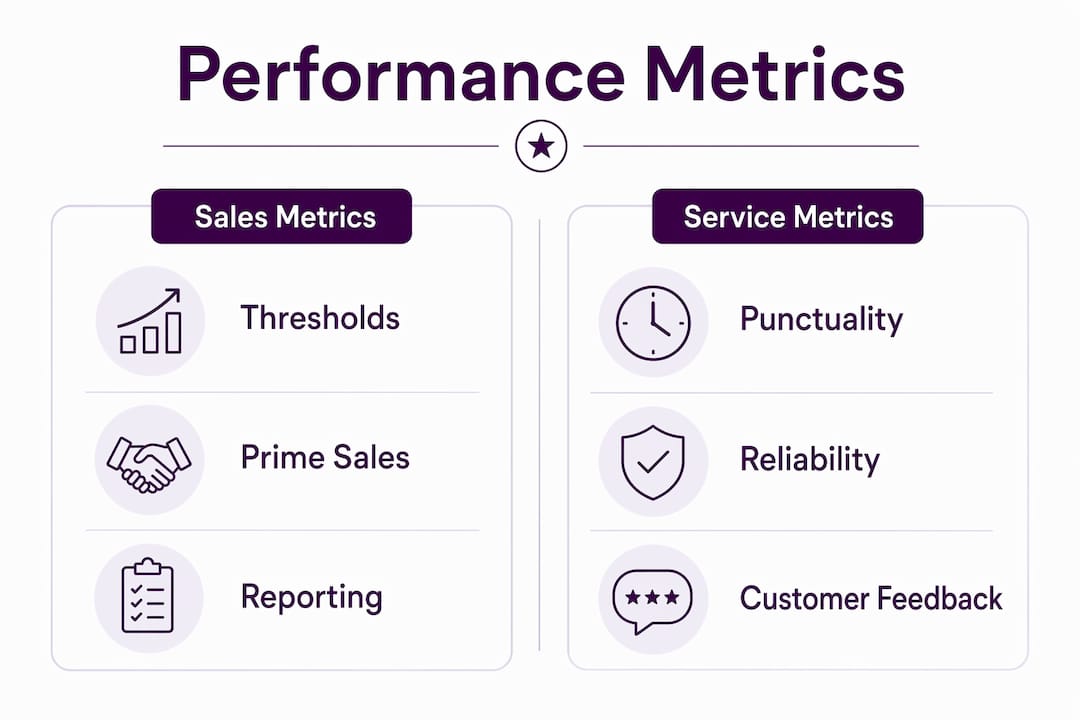
Quality is measured by how closely your deliverables match the specifications in your contract terms. Quality issues can trigger compliance concerns and put contract continuation at risk. Customer complaints, rejected deliverables, and unresolved disputes all feed into this metric.
Here is a quick reference for the four core government contract metrics:
- Sales volume: Prime sales only, tracked against base and option period minimums
- Punctuality: On-time delivery rate and schedule adherence across all task orders
- Reliability: Reporting accuracy, submission timeliness, and service consistency
- Quality: Conformance to contract specifications and resolution of customer issues
Pro Tip: Never assume subcontract revenue counts toward your GSA sales minimum. Only prime sales under your MAS contract apply, and conflating the two is one of the most common compliance errors Gsascheduleservices sees among new schedule holders.
How to accurately track and report GSA contract performance
Accurate GSA performance measurement starts with understanding which reporting model applies to your contract. Two models exist, and they carry very different operational demands.
Identify your reporting model. Traditional quarterly aggregate reporting requires you to submit total sales figures four times per year through the GSA’s 72A Reporting System. Transactional Data Reporting (TDR), which is expanding and likely to become standard, requires monthly line-item submissions. If your contract has been modified to TDR, monthly operational readiness is not optional.
Reconcile internal accounting with GSA reporting every quarter. Pull your GSA-specific revenue from your accounting system and compare it line by line against what you have reported to GSA. Misalignments in reported sales create stressful account cleanups before renewals. Catching a $12,000 discrepancy in Q2 is manageable. Discovering a $40,000 gap three weeks before your option renewal is not.
Build an audit-ready documentation folder. This folder should contain quarterly sales reports, proof of Industrial Funding Fee (IFF) payments, and any correspondence with your contracting officer. Clean audit-ready documentation is the single most effective defense against compliance challenges at renewal time.
Monitor mass modifications and solicitation refreshes. GSA uses mass modifications to implement solicitation refreshes that change contract terms and reporting requirements. Treat each modification notice like a project with a deadline. Assign someone to review it, accept it, and update your internal processes accordingly.
Set a quarterly internal audit date. Proactive quarterly audits identify and fix sales reporting gaps before they compound. Block the time on your calendar the same way you would for a tax filing deadline.
Pro Tip: Align your GSA sales reporting with your internal accounting practices from day one. Retrofitting your books to match GSA requirements six months before renewal is far more expensive than building the habit early.
What tools and strategies optimize your GSA contract performance?
Improving your performance benchmarks for GSA requires more than reactive reporting. The contractors who consistently hit their thresholds and earn strong evaluations treat GSA compliance as an ongoing operational function, not an annual event.
The table below compares reactive versus proactive approaches to managing GSA contract assessment tools and workflows:
| Approach | Reactive | Proactive |
|---|---|---|
| Sales tracking | Reviewed before renewal | Monitored monthly against threshold |
| Reporting | Submitted at deadline | Reconciled and submitted early |
| Mass modifications | Addressed when flagged | Reviewed and accepted immediately |
| Quality issues | Resolved after complaint | Caught through internal review |
| IFF payments | Processed at quarter end | Scheduled automatically |
The proactive column is not aspirational. It describes what contractors with clean renewal histories actually do.
Setting up a performance dashboard specific to your GSA contract is the most direct way to shift from reactive to proactive. Your dashboard should display current-period prime sales against your threshold, pending IFF payments, open task orders with delivery deadlines, and any unaccepted contract modifications. Tools like Microsoft Excel, Google Sheets, or dedicated contract management platforms like Deltek Costpoint all support this kind of tracking.
Customer feedback is an underused lever for improving quality and reliability scores. Soliciting structured feedback after each task order completion gives you data to act on before a contracting officer sees a pattern. A simple post-delivery survey asking three questions about timeliness, accuracy, and communication takes less than five minutes for your customer to complete and gives you early warning on quality drift.
Cross-functional alignment matters more than most contractors realize. Your sales team, accounting department, and contract manager need to operate from the same data. When sales closes a new task order, accounting needs to know immediately to track it against the GSA threshold. When accounting processes an IFF payment, contract management needs confirmation for the audit folder. Siloed operations are where reporting errors originate.
What are common mistakes in managing GSA contract metrics?
The most costly errors in assessing GSA contract performance share a common thread: they are all avoidable with consistent process.
Counting subcontract revenue toward the sales minimum. Many contractors mistakenly include subcontract sales in their GSA threshold calculations. Only prime sales under the MAS contract count. Discovering this error at renewal means you may be further from your minimum than you thought, with no time to close the gap.
Ignoring reporting model changes. When GSA modifies your contract to TDR, your reporting cadence shifts from quarterly to monthly. Contractors who miss this change and continue submitting quarterly reports fall out of compliance without realizing it. Check every mass modification for reporting requirement changes before accepting it.
Letting discrepancies accumulate. A single quarter of misaligned data between your accounting system and your GSA reports is correctable. Four quarters of misalignment becomes a material discrepancy that requires a formal correction process and can delay your option renewal. Review your GSA compliance posture at least quarterly.
Missing IFF payment deadlines. The Industrial Funding Fee is 0.75% of your reported GSA sales. Late or missing IFF payments are a direct compliance violation and one of the clearest signals to GSA that a contractor is not managing their contract actively.
Waiting until renewal to address performance gaps. Option renewals are not the time to discover you are $30,000 short of your sales minimum or that your delivery punctuality records are incomplete. Contractors who avoid contract performance risks do so by treating every quarter as a mini-renewal review.
The fix for all five of these mistakes is the same: build a documented, recurring process for tracking and reporting your contract performance indicators. Assign ownership, set calendar reminders, and treat GSA compliance as a standing operational responsibility rather than a periodic task.
Key takeaways
Effective performance metrics management is the difference between a GSA contract that generates steady federal revenue and one that gets terminated at the first option renewal.
| Point | Details |
|---|---|
| Know your sales threshold | Prime sales must reach $100,000 in the base period and $125,000 per option period. |
| Prime sales only count | Subcontract revenue does not apply to mandatory minimums, so track the right number. |
| Match your reporting model | TDR requires monthly submissions; quarterly aggregate reporting has different deadlines. |
| Audit quarterly, not annually | Quarterly reconciliation catches discrepancies before they become renewal-blocking problems. |
| Treat modifications as projects | Every mass modification may change your reporting obligations and must be reviewed immediately. |
Why most contractors get this wrong until it hurts
I have worked with enough MAS contractors to recognize a pattern. The ones who struggle with performance metrics are not careless. They are busy. They won a GSA Schedule, celebrated, and then folded the compliance requirements into the background noise of running a business. GSA reporting became something they handled when it demanded attention, not something they managed proactively.
The uncomfortable truth is that GSA contract compliance is not self-managing. The system does not send you a warning six months before your option renewal to tell you that your sales are $18,000 short. It does not flag the quarter where your IFF payment was late. It just records the data, and when renewal comes, the record speaks for itself.
What I have found actually works is treating your GSA contract like a separate business unit with its own monthly close. Thirty minutes at the end of each month to reconcile sales, confirm IFF payments, and check for pending modifications is enough to stay ahead of every common compliance failure. That is not a significant time investment for a contract that can generate six or seven figures in federal revenue annually.
The contractors I see succeed long-term are the ones who build this habit early, usually with help from a specialist who knows where the traps are. The ones who struggle are the ones who assume the contract will manage itself. It will not.
— Josh
How Gsascheduleservices can help you stay on track
Managing performance metrics for GSA contracts requires consistent attention to sales thresholds, reporting accuracy, and contract modifications. Gsascheduleservices works directly with MAS contractors to verify sales alignment, audit IFF payment records, and prepare compliant documentation before option renewals. If you are unsure whether your current reporting model matches your contract requirements, or if you want a second set of eyes on your compliance posture before your next renewal window, the GSA Schedule discovery process is the right starting point. Specialist support does not just reduce paperwork. It reduces the risk of losing a contract you worked hard to earn.
FAQ
What are the minimum sales requirements for a GSA MAS contract?
MAS contractors must generate $100,000 in prime sales during the base period and $125,000 in each option period. Only sales made directly under the MAS contract as the prime contractor count toward these thresholds.
Does subcontract revenue count toward GSA sales minimums?
No. GSA calculates minimum sales requirements based on prime sales only. Subcontracting revenue does not apply, and including it in your threshold calculations creates a false picture of your compliance position.
What is the difference between quarterly reporting and TDR?
Traditional quarterly aggregate reporting requires total sales submissions four times per year. Transactional Data Reporting (TDR) requires monthly line-item submissions and is expanding across MAS contracts. Check your contract modifications to confirm which model applies to you.
How often should I reconcile my GSA sales data?
Quarterly reconciliation between your internal accounting records and your GSA-reported sales is the minimum standard. Monthly reconciliation is better, especially if your contract is under TDR requirements.
What happens if I miss the GSA sales minimum at option renewal?
Missing the mandatory sales threshold at option renewal gives GSA grounds to decline the option period and terminate your contract. Contractors who identify a shortfall early can sometimes address it through documented outreach and sales activity, but there is no guaranteed remedy once the option period arrives.
Recommended
- Government Contract Opportunities 2026: SME Guide
- (Infographic) 25 Reasons GSA Contracts are Rejected
- Navigating GSA Contract Vehicles: Your Guide
- Navigating GSA Contract Vehicles: Your Guide