

Getting a GSA Schedule contract is a genuine milestone. But knowing how to leverage GSA for business growth after you have one is where most small and medium-sized businesses get stuck. The contract sits in a drawer, a few orders trickle in, and the transformational government revenue you expected never quite materializes. The problem is not the Schedule itself. The problem is that most businesses treat it like a trophy instead of a tool. This guide walks you through the preparation, execution, and ongoing optimization that actually converts your GSA Schedule into a reliable growth engine.
Table of Contents
- Key Takeaways
- How to leverage your GSA Schedule for real business growth
- Active execution using GSA platforms and tools
- Common pitfalls that stall GSA growth
- Measuring results and refining your strategy
- My honest take on GSA growth strategy
- Ready to stop leaving GSA revenue on the table?
- FAQ
Key Takeaways
| Point | Details |
|---|---|
| Preparation comes first | Verify your SAM.gov registration, small business status, and pricing compliance before pursuing any opportunity. |
| Daily platform engagement pays off | Checking eBuy every day for new RFQs dramatically increases your chances of timely, winning submissions. |
| Compliance is a growth issue | Failing to meet TAA requirements or reporting obligations can derail your contract and your revenue. |
| Focus beats diversification early | Concentrate on your strongest growth lever before trying to scale in multiple directions at once. |
| Treat your Schedule as dynamic | Regular catalog updates, SIN optimization, and agency outreach are ongoing activities, not one-time tasks. |
How to leverage your GSA Schedule for real business growth
The phrase “how to leverage GSA for business growth” gets searched by thousands of contractors every month. Most of the articles they find describe the same surface-level tactics. What they actually need is a framework. Think of your GSA Schedule less like a license and more like a government sales channel that requires active management. You have to stock the shelves, price competitively, show up where buyers shop, and build relationships with the people placing orders.
Government agencies pursue annual small business contracting goals and track their achievement through formal scorecards. That means agencies are actively looking to spend money with qualified small businesses. Your job is to make sure they can find you, understand what you offer, and trust that you can deliver.
Eligibility and registrations you cannot skip
Before any growth strategy works, your foundation has to be solid. Start with your SAM.gov registration. It must be current, accurate, and reflect your real business profile including your socio-economic status certifications such as woman-owned, veteran-owned, or HUBZone. These designations unlock set-aside opportunities that competitors without certifications simply cannot touch.
Your GSA Advantage! catalog also needs to be fully populated and competitively priced. An incomplete or stale catalog signals to buyers that you are not serious. Regular catalog updates and SIN optimization are among the highest-return activities you can do to attract government buyers.
Pro Tip: Review your catalog pricing against your commercial price list quarterly. GSA’s Price Reductions Clause requires that your Schedule prices never exceed those you offer to comparable commercial customers.
Targeting the right agencies from day one
Growth without targeting is just guessing. Pull your Schedule’s Special Item Numbers and map them against actual agency procurement histories. GSA’s own market research tools, including USASpending.gov, show you which agencies are buying what you sell and at what volume. That data should define your outreach list. Chasing every agency with a budget is a fast way to exhaust yourself with little to show for it.

Active execution using GSA platforms and tools
Knowing your tools is one thing. Using them strategically every single day is another. The businesses that consistently generate meaningful revenue from their GSA Schedules share one habit: they treat platform monitoring as a non-negotiable daily task.
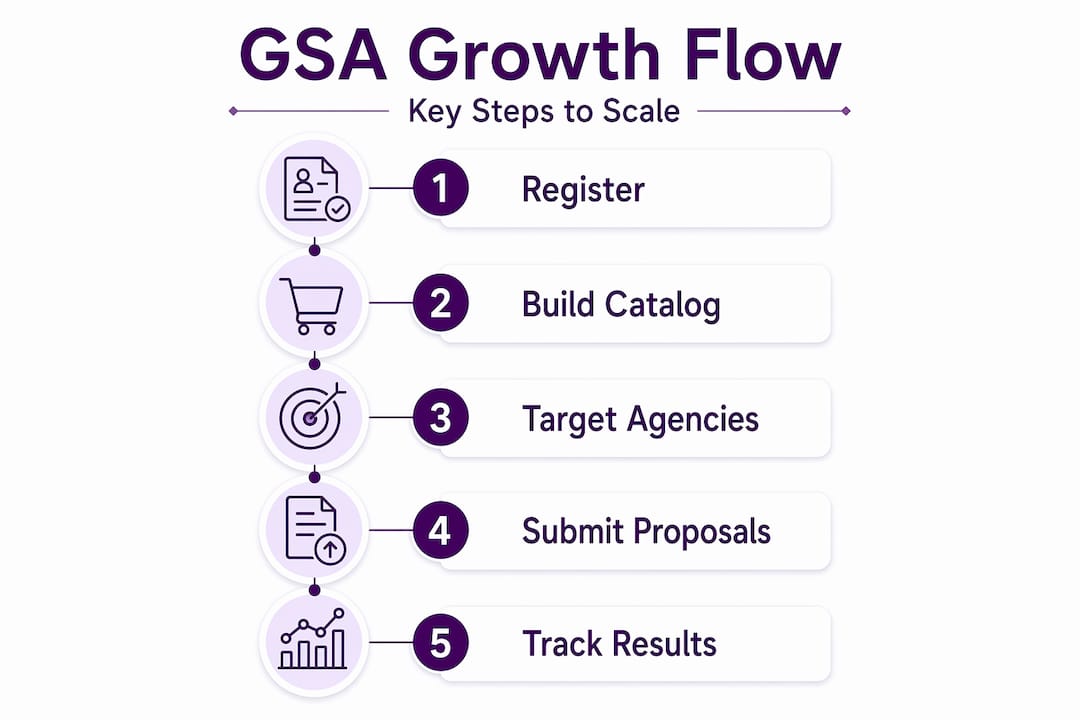
Here is a practical execution sequence that works:
- Monitor eBuy every morning. Daily eBuy platform checks let you catch RFQs the moment they are posted, giving you maximum time to prepare a strong response. Agencies set tight deadlines, and late submissions are dead on arrival.
- Optimize your SINs for demand alignment. Check which categories are generating the most activity and confirm your listings use language buyers actually search for. Government buyers are not marketers. They search functional terms.
- Use the Forecast of Contracting Opportunities. The FCO tool gives early visibility into planned procurements months before formal solicitations drop. That head start lets you reach out to the contracting officer, position your capabilities, and sometimes even influence the scope.
- Conduct capability briefings with target agencies. Proactive outreach to contracting officers through scheduled briefings builds the kind of familiarity that often makes the difference between a competitive win and a no-look award.
- Pursue subcontracting and teaming agreements. Many prime contractors carry subcontracting plans that require small business participation. Teaming also lets you pursue larger contracts that you could not win as a solo prime.
- Respond to every relevant RFQ you find. Volume matters early. The more proposals you submit with strong compliance and clear value messaging, the faster your past performance record builds.
Pro Tip: When writing proposals, always address every single requirement in the Statement of Work. Many firms lose bids simply because they skip line items or assume the evaluator will infer their capability.
Here is a quick comparison of the primary GSA platforms and what each one does for your growth:
| Platform | Primary function | Best use case |
|---|---|---|
| GSA Advantage! | Product and service catalog | Passive visibility with government buyers |
| eBuy | RFQ solicitation and response | Active bidding on specific agency needs |
| Forecast of Contracting Opportunities | Procurement pipeline preview | Early agency engagement before solicitations |
| SAM.gov | Vendor registration and certifications | Eligibility verification and set-aside status |
| USASpending.gov | Market research and spend data | Identifying target agencies and contract values |
Common pitfalls that stall GSA growth
Even experienced contractors make mistakes that cost them real money. Knowing what to avoid is just as valuable as knowing what to do.
The single most overlooked issue involves small business size verification. Small business size status is evaluated at the task-order level in Multiple Award Contracts, not just at the time of Schedule award. If your business has grown past the relevant size standard since you originally certified, you could be disqualified from a set-aside opportunity after you have already invested time preparing a proposal.
Other critical mistakes include:
- Letting your catalog go stale. Outdated pricing or discontinued offerings frustrate buyers and reduce your search visibility on GSA Advantage!
- Skipping Transactional Data Reporting. Ignoring TDR requirements or failing TAA compliance reviews can trigger contract modifications, audits, or termination.
- Spreading your team too thin. Trying to simultaneously master eBuy bidding, teaming outreach, subcontracting, and capability briefings without adequate staff leads to mediocre execution across all fronts.
- Ignoring proposal quality. A compliant proposal that does not clearly articulate your specific value proposition is nearly indistinguishable from a losing one.
- Treating outreach as optional. Contracts do not come to businesses that wait. Agencies reward vendors they know and trust.
“Your GSA Schedule is not a lottery ticket. It is an infrastructure investment. The agencies that fund your growth next year are the ones you are building relationships with today.”
Poor proposal compliance is a silent killer. Evaluators work through dozens of submissions, and anything that requires extra interpretation is a risk they will often just skip.
Measuring results and refining your strategy
Growth without measurement is just activity. The businesses using GSA for success long-term are the ones that track their metrics obsessively and adjust based on what the data actually says.
Start by establishing a baseline. How many RFQs did you respond to last quarter? What was your win rate? What was the average contract value? Without those numbers, you cannot know if you are improving.
The table below shows two approaches to tracking GSA performance and why one outperforms the other:
| Approach | What gets tracked | Outcome |
|---|---|---|
| Reactive tracking | Total sales at year end | No ability to course-correct during the year |
| Proactive tracking | Win rate, pipeline value, RFQ volume monthly | Clear signals for strategy adjustments in real time |
Optimizing your listings on GSA platforms is not a one-time setup task. Demand shifts. Agency priorities change with budget cycles and administration priorities. Review your SINs at least twice a year against active procurement trends and use modification requests to add new offerings that match emerging agency needs.
When your win rate on a particular type of contract stalls, look at your past performance references. Strong past performance is the currency of government contracting. Request written assessments from satisfied agency customers and use those narratives in future proposals.
Pro Tip: Assign one person on your team to own your GSA Schedule as a dedicated role, even part-time. Contractors who treat their Schedule as a shared side responsibility consistently underperform those with a designated owner.
The GSA advantages for businesses compound over time. A strong year two looks very different from year one, because your past performance record, agency relationships, and catalog visibility have all matured. The key is staying consistent long enough to let that compounding work.
My honest take on GSA growth strategy
I have worked with enough Schedule holders to see a clear pattern. The businesses that struggle are almost always the ones that won their contract and then waited for the phone to ring. The ones that succeed treat their Schedule like the active federal sales channel it is.
Here is what I have learned that most articles will not tell you. Focusing on one primary growth lever, whether that is eBuy bidding, capability briefings, or subcontracting, will outperform a scattered approach every time. B2B firms that concentrate on their best acquisition channel consistently outperform those spreading attention across too many tactics at once. Pick the one that fits your capacity and your market, and go deep before going wide.
I have also seen too many smart contractors get blindsided by compliance issues they assumed someone else was managing. TAA compliance, size certifications, pricing obligations. None of these are passive. They require periodic attention or they quietly create problems that surface at the worst possible time.
The mindset shift that changes everything is this: treat your Schedule as a dynamic contract that requires constant tending, not a credential you hang on the wall. The businesses that grow through GSA are not always the most experienced. They are the most consistent.
— Josh
Ready to stop leaving GSA revenue on the table?
At Gsascheduleservices.com, we work directly with small and medium-sized businesses that have GSA Schedules and are not seeing the growth they expected. Our consulting team handles the parts that slow most contractors down: catalog management, compliance monitoring, SIN optimization, and proposal strategy. We identify your strongest growth lever and build a focused plan around it so your team can spend less time on paperwork and more time winning contracts. If you are ready to turn your Schedule into a real revenue source, start with a discovery call to see exactly where your biggest opportunities are. You can also explore whether GSA consulting is worth it for businesses at your stage before committing.
FAQ
What does leveraging a GSA Schedule actually mean?
Leveraging a GSA Schedule means actively using the contract to win government business through platforms like eBuy and GSA Advantage!, not simply holding the contract. It requires daily engagement, agency outreach, and continuous catalog optimization.
How do small businesses meet GSA small business goals?
Agencies are required to meet annual small business contracting targets, and they actively seek qualified vendors to fulfill them. Small businesses maximize their chances by maintaining current certifications, registering relevant socio-economic status designations, and responding consistently to set-aside solicitations.
How often should I update my GSA catalog?
Review your GSA Advantage! catalog at minimum twice a year, and immediately whenever your commercial pricing changes. Keeping your catalog current and competitively priced is one of the highest-impact activities for maintaining visibility with government buyers.
Can I participate in GSA contracts as a subcontractor?
Yes. Many prime contractors are required by their contracts to include small business subcontractors. Teaming and subcontracting agreements are legitimate and often underused pathways for smaller businesses to build past performance and revenue without winning a prime award.
What is the most common reason GSA Schedule holders fail to grow?
The most common reason is passivity. Holding a Schedule without actively monitoring platforms, updating catalogs, and building agency relationships produces little revenue. Consistent daily and monthly execution is what separates contractors who grow from those who stagnate.
Recommended
- 5 Ways to Leverage GSA’s Federal Supply Schedule to Grow Your Revenue
- Utilizing the Federal GSA Process in Your Business
- Learn the Secret to Tap Into Billions with a GSA Contract
- Government Contract Opportunities 2026: SME Guide