

Getting a GSA contract feels like unlocking a door to billions in federal spending. But what is GSA revenue potential, really? Many business owners assume the contract itself generates revenue. It doesn’t. A GSA Multiple Award Schedule (MAS) contract is an authorization, not a guarantee. What you earn depends entirely on how actively you pursue and manage federal sales. This article breaks down the real structure behind GSA contract earnings, the thresholds you must hit to stay active, the scale of the market you’re entering, and what you actually need to do to turn a Schedule into real, recurring revenue.
Table of Contents
- Key takeaways
- What is GSA revenue potential and how the MAS structure shapes it
- Sales thresholds and compliance requirements that define real earnings
- The scale of the federal market and realistic GSA earnings
- Challenges and strategies for maximizing GSA revenue growth
- How to assess whether GSA aligns with your revenue goals
- My honest take on GSA revenue potential after working with SMBs
- Turn GSA knowledge into real federal revenue with Gsascheduleservices
- FAQ
Key takeaways
| Point | Details |
|---|---|
| GSA is an opportunity, not income | A GSA contract gives you access to federal buyers, but you generate revenue through active sales efforts. |
| Revenue runway up to 20 years | MAS contracts span a 5-year base plus three 5-year option periods, giving contractors a long planning horizon. |
| Sales thresholds are non-negotiable | You must hit $100,000 in sales within your first 5 years or face contract cancellation. |
| The market scale is massive | The federal government spends roughly $490 billion annually, with GSA MAS accounting for over $52 billion. |
| Catalog discipline drives retention | Active pricing management and catalog updates are what keep your contract competitive and your sales growing. |
What is GSA revenue potential and how the MAS structure shapes it
Understanding GSA revenue potential starts with understanding the contract you’re actually holding. The GSA Multiple Award Schedule is not a single purchase order. It’s a pre-negotiated, long-term contract vehicle that authorizes federal agencies to buy from you at agreed-upon prices. The revenue you generate flows through individual task orders and purchase orders placed against that contract by government buyers.
The MAS contract structure is built for longevity. Each contract begins with a 5-year base period plus three option periods, each lasting five years, giving you a potential 20-year revenue runway. That’s a planning horizon most commercial contracts simply don’t offer. For a small or mid-sized business, that kind of long-term stability can reshape how you model federal revenue.
There’s one more layer most contractors don’t account for early enough: task orders solicited before contract expiration can extend revenue up to 5 years after the contract end date. That means a contract you win today could generate income well into the 2040s if managed correctly.
Here’s a quick look at the MAS revenue timeline:
| Contract phase | Duration | Revenue opportunity |
|---|---|---|
| Base period | 5 years | Initial sales, relationship building |
| Option period 1 | 5 years | Expanded agency reach |
| Option period 2 | 5 years | Catalog maturity, higher volumes |
| Option period 3 | 5 years | Established buyer relationships |
| Post-expiration task orders | Up to 5 years | Revenue from pre-expiration awards |
- Your total active contract life can reach 20 years with consistent option renewals.
- Task orders placed before expiration keep generating cash after the contract closes.
- Each option period renewal depends on meeting sales thresholds and compliance requirements.
Pro Tip: Start thinking about your option period renewal strategy at least 12 months before each period ends. GSA reviews your performance record, so gaps in sales activity close to renewal time work against you.
Sales thresholds and compliance requirements that define real earnings
Here’s where many contractors underestimate what it takes to hold a GSA contract. Understanding GSA revenue isn’t just about knowing how much money is available. It’s about knowing the minimum you must sell to keep your contract active.

GSA sets clear sales thresholds every contractor must meet. Fail to hit them, and your contract gets cancelled. The program is designed for active sellers, not passive listings.
The specific requirements are:
- You must generate at least $100,000 in sales within your first five years on the Schedule.
- In each subsequent five-year period, your threshold rises to $125,000 in cumulative sales.
- You must file quarterly sales reports through the GSA’s 72A Reporting System, documenting all MAS sales.
- You owe an Industrial Funding Fee (IFF) of 0.75% on all reported sales. This fee funds the MAS program itself.
- You must keep your GSA Advantage! catalog current, pricing accurate, and product or service descriptions compliant with your contract terms.
These aren’t suggestions. Contractors who treat the Schedule as a passive listing risk failing sales thresholds and losing the contract entirely, along with all future GSA profit potential tied to it.
The compliance side of MAS contracts often blindsides first-time contractors. Quarterly reporting, catalog maintenance, Trade Agreements Act compliance, and price reduction clause monitoring all require ongoing attention. This is not a set-it-and-forget-it program. GSA contract earnings are earned through consistent work, not just contract award.
Pro Tip: Set up a recurring internal calendar reminder for quarterly 72A reporting deadlines. Missing a filing period is one of the fastest ways to trigger a compliance review that slows down your sales pipeline.
The scale of the federal market and realistic GSA earnings
To put GSA revenue potential in concrete terms, you need to understand the size of the opportunity. The federal government spends approximately $490 billion annually on goods and services, making it the largest single buyer in the world. No commercial sector comes close.
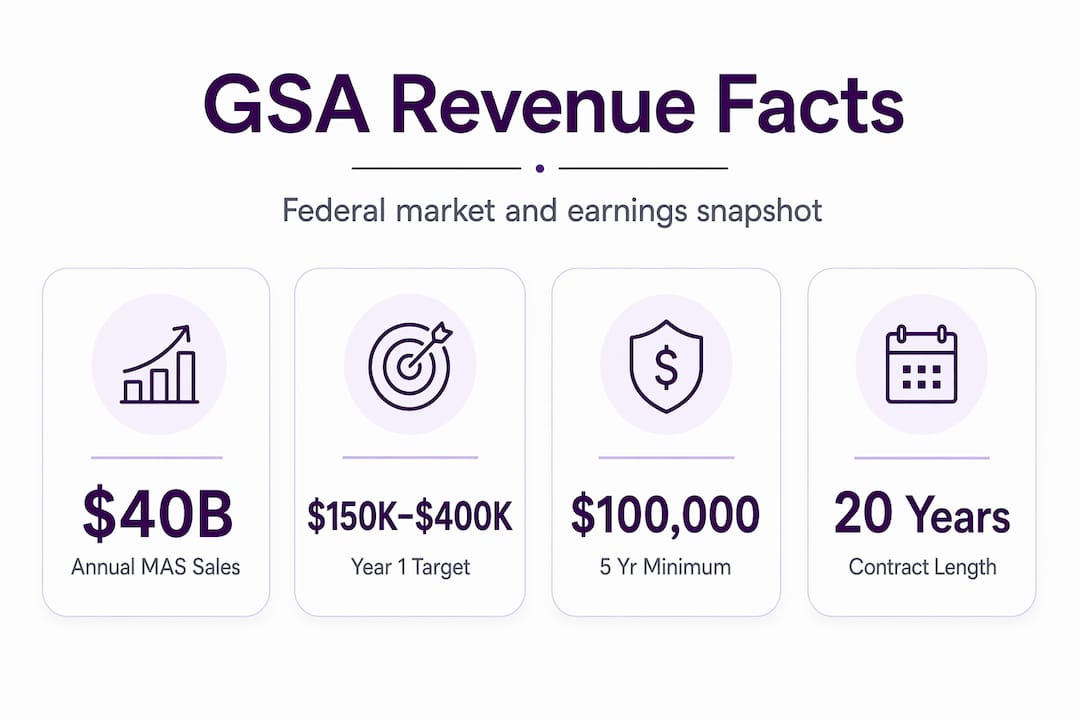
Within that universe, the GSA MAS program accounts for over $52 billion in annual procurement. That’s a significant slice of federal buying happening through a single contract vehicle. For you, it means the buyers are already there. They’re already using the platform. Your job is to get in front of them with the right offer at the right price.
That said, the size of the market does not translate directly into individual contractor earnings. You’re one of thousands of approved vendors across hundreds of Special Item Numbers (SINs). Here’s what actually shapes how much of that $52 billion flows to you:
- Your SIN selection. Not all product and service categories attract equal federal demand. Some SINs move hundreds of millions annually; others barely generate enough to meet the $100,000 threshold.
- Your pricing competitiveness. Federal buyers compare options. If your catalog prices don’t reflect real market conditions, buyers move on without a second look.
- Your agency relationships. Many MAS purchases happen through direct outreach and established relationships, not just public solicitations on eBuy or SAM.gov.
A realistic first-year target for a small business new to the Schedule often falls between $150,000 and $400,000, with growth accelerating in years two through four as agency familiarity builds. Some contractors scale well past $1 million annually within five years. The spread is wide, and the difference almost always traces back to how aggressively they pursue and maintain their sales pipeline.
Challenges and strategies for maximizing GSA revenue growth
GSA financial opportunities are real, but the program is getting more competitive. GSA eliminated approximately 1,600 low-demand contracts in FY 2025 alone to focus buyer attention on active, competitive vendors. If your catalog isn’t drawing purchases, you’re now more visible for the wrong reasons.
Reducing low-demand contracts has concentrated buyer attention. Catalog competitiveness is no longer optional. It’s the difference between staying on Schedule and losing your contract.
That shift changes the math for every contractor still on the program. Fewer contracts in your SIN category means buyers are looking at a smaller pool. That’s good news if your pricing and offerings are sharp. It’s bad news if you’ve been coasting on the assumption that volume would come eventually.
Here’s what GSA revenue growth strategies look like in practice:
- Catalog hygiene. Review your GSA Advantage! listings at least quarterly. Outdated descriptions, discontinued products, or prices that don’t reflect your current commercial pricing all create friction with buyers.
- Active use of eBuy. Federal contracting officers post solicitations on eBuy constantly. Monitoring SIN demand and responding to relevant eBuy RFQs is one of the highest-return activities for MAS contractors.
- Agency-specific outreach. Don’t wait for RFQs to appear. Identify agencies with mission needs that match your offerings and engage their contracting officers directly. Many task orders are placed through limited competition among known vendors.
- GSA MAS marketing strategies go deeper than most contractors realize. Explore federal sales strategies to understand how to build a pipeline that hits your thresholds consistently.
The GSA MAS consolidation that restructured the program over recent years also means that catalog discipline and SIN alignment now matter more than they did when the Schedule was fragmented across dozens of separate vehicles.
How to assess whether GSA aligns with your revenue goals
GSA revenue assessment is a real exercise, not a formality. Before or after getting on Schedule, you need to honestly evaluate whether the contract structure fits your business model and growth goals.
Here’s a practical comparison to help frame that decision:
| Business scenario | GSA contract fit |
|---|---|
| Established business with federal clients already | Strong fit; Schedule formalizes existing relationships |
| Product or service with clear federal demand signals | Strong fit; existing demand reduces ramp-up risk |
| New business with no prior government experience | Lower fit initially; requires significant sales investment |
| Highly specialized niche with few federal buyers | Moderate fit; limited SIN demand may make thresholds hard to hit |
The GSA contract eligibility and ROI analysis is a critical first step. Not every business is ready to generate $100,000 in Schedule sales within five years, especially if your team has no federal sales experience and your offerings haven’t been tested with government buyers.
That said, for businesses that are ready, the GSA market potential is hard to match. Federal buyers prefer Schedule vendors because the procurement process is faster and the pricing is pre-negotiated. That built-in preference is a structural advantage you don’t get in most commercial markets.
- Confirm your products or services appear in active SINs before applying.
- Calculate your realistic cost of federal sales pursuit before committing to the program.
- Map out your first 18 months of sales activity before you receive your contract number.
Pro Tip: If you’re unsure whether your offering has real federal demand, search SAM.gov for recent contract awards in your category. Volume and award frequency will tell you more about actual buyer behavior than any general market study.
My honest take on GSA revenue potential after working with SMBs
I’ve watched businesses get their GSA contract and immediately assume the revenue would follow. It doesn’t work that way, and I think the industry doesn’t say that clearly enough.
In my experience, the contractors who generate serious GSA contract earnings within their first two years all share one thing: they treated the contract like a sales license, not a revenue source. They built outreach lists. They responded to every relevant eBuy solicitation. They kept their catalog prices sharp enough to win. The ones who struggled either waited for inquiries that never came or let their catalog go stale within the first year.
What I’ve also seen is that the compliance side catches people off guard more often than the sales side. Missing a quarterly 72A report, letting a price increase slip through without a contract modification, or ignoring a Contractor Assessment visit can derail a contract that took months to win. The administrative discipline is just as important as the sales hustle.
My honest take on GSA revenue growth strategies: treat the first 18 months as an investment period. Expect the sales to build slowly, and budget for the pursuit costs accordingly. Businesses that do that math upfront are almost always still on Schedule at the five-year mark. The ones who expect quick returns often aren’t.
— Josh
Turn GSA knowledge into real federal revenue with Gsascheduleservices
Understanding your GSA revenue potential is one thing. Building a plan to hit it is another. Gsascheduleservices works specifically with small and medium-sized businesses who want to enter the federal market through GSA MAS contracts without spending months buried in compliance paperwork. From readiness assessments to catalog management support and federal sales strategy, the platform is built to help you get on Schedule faster and start generating revenue sooner. If you’re ready to move from research to action, start your discovery process and find out what your business is actually positioned to earn through GSA.
FAQ
What does GSA revenue potential actually mean?
GSA revenue potential refers to the total federal sales a contractor can generate through a GSA MAS contract over its full lifecycle. The actual amount depends on pricing, catalog management, and how actively you pursue agency buyers.
How much can a small business earn from a GSA contract?
There’s no fixed number, but the minimum threshold to maintain your contract is $100,000 in sales within the first five years. Many active SMBs scale well beyond that once they build agency relationships and optimize their catalog pricing.
What happens if you don’t meet GSA sales thresholds?
If you fail to reach $100,000 in sales in your first five-year period, GSA can cancel your contract, ending your access to the federal marketplace through the Schedule program.
How long does a GSA MAS contract last?
A MAS contract runs up to 20 years, structured as a 5-year base period plus three 5-year option periods, with task orders potentially extending revenue for an additional five years after expiration.
Is a GSA contract worth it for a new business?
It depends on whether your products or services have documented federal demand. New businesses without prior government sales experience typically need 18 to 24 months to build enough traction to hit the minimum threshold, so readiness planning before applying is critical.
Recommended
- Free GSA Training, Learn How to Grow Revenue Through GSA Contracts
- GSA Contract Eligibility & Return on Investment
- Key Points to Remember Before Getting a GSA Contract
- What Are the Benefits of GSA Schedule for Your Business