
Choosing between GSA schedules vs open market procurement is one of the most consequential decisions a government contractor or small business owner will face. Many assume that landing a GSA Schedule is the equivalent of a guaranteed pipeline of federal revenue. It is not. Both paths carry real strategic trade-offs, and picking the wrong one for your business model will cost you time, money, and missed opportunities. This article breaks down exactly how these two procurement routes work, where each one wins, and how to build a contracting strategy that actually fits your business.
Table of Contents
- Key takeaways
- GSA schedules vs open market: what you are actually comparing
- Side-by-side: key differences that actually matter
- Using BPAs to build recurring revenue
- Choosing the right path for your business
- My honest take on this decision
- Ready to pursue your GSA Schedule?
- FAQ
Key takeaways
| Point | Details |
|---|---|
| GSA Schedules speed up sales cycles | Pre-negotiated prices allow agencies to buy from you without lengthy competitive bidding. |
| Open market keeps the door wide open | Any qualified vendor can compete, making it accessible with lower barriers to entry. |
| GSA does not guarantee revenue | A Schedule contract is a tool, not a ticket. You still have to market and sell. |
| BPAs unlock long-term stability | Blanket Purchase Agreements layer recurring revenue on top of either procurement method. |
| Blending both paths is often best | Many successful contractors use GSA and open market together based on contract size and agency relationship. |
GSA schedules vs open market: what you are actually comparing
Before you can make a smart decision, you need to understand what each of these procurement vehicles actually is. They are not interchangeable. They operate under different rules, attract different buyers, and reward different business strategies.
What is a GSA Schedule?
A GSA Schedule, officially called a Multiple Award Schedule (MAS), is a long-term governmentwide contract between a vendor and the General Services Administration. Once you are on a Schedule, federal agencies can buy directly from you at pre-negotiated prices without running a full competitive bidding process. That is the core advantage. The GSA has already vetted your company, your pricing, and your terms. Agencies trust that vetting, and it dramatically reduces the paperwork and time burden on their end.
To qualify for a GSA Schedule, your business generally needs at least two years of financial history, a solid past performance record, and products or services that fall within one of GSA’s defined categories. The application itself requires you to submit pricing data, technical capability documents, and financial disclosures. It is not a quick process, but once approved, your contract typically lasts five years with options to renew up to 20 years total.
The types of offerings sold through GSA Schedules are broad. IT services, professional consulting, office supplies, security equipment, training, and logistics all appear regularly on Schedule. Knowing which contract vehicle fits your specific offering is an important first step before applying.
Pro Tip: If your products or services are not clearly mapped to a Schedule category, you may face rejections or long negotiation delays. Spend time on category alignment before submitting.
What is open market procurement?
Open market procurement covers any purchase a federal agency makes outside of an existing contract vehicle like a GSA Schedule. When an agency needs something that no Schedule covers, or when a contracting officer simply chooses to go outside existing vehicles, they typically post a solicitation on SAM.gov and open it to broad vendor competition. Any qualified business can respond.
This sounds appealing. And in some cases it genuinely is. If you sell a highly specialized product or offer a niche service that does not fit neatly into GSA categories, open market may be your primary path into federal contracts. But the trade-offs are real. Open market procurements often run for several months before an award is made. You are competing against potentially dozens of bidders. And without a pre-vetted contract vehicle backing you up, agencies have more administrative work to justify the award.
For newer companies, open market can still serve as a valuable proving ground. The barrier to entry is lower than obtaining a GSA Schedule. You do not need years of federal past performance to submit a bid. You just need to respond to the solicitation compellingly and competitively.
Pro Tip: Monitor SAM.gov consistently for solicitations in your NAICS codes. Many small businesses miss opportunities simply because they are not checking the platform regularly enough.
Side-by-side: key differences that actually matter
Here is how GSA Schedules and open market procurement compare across the factors that matter most to your bottom line.
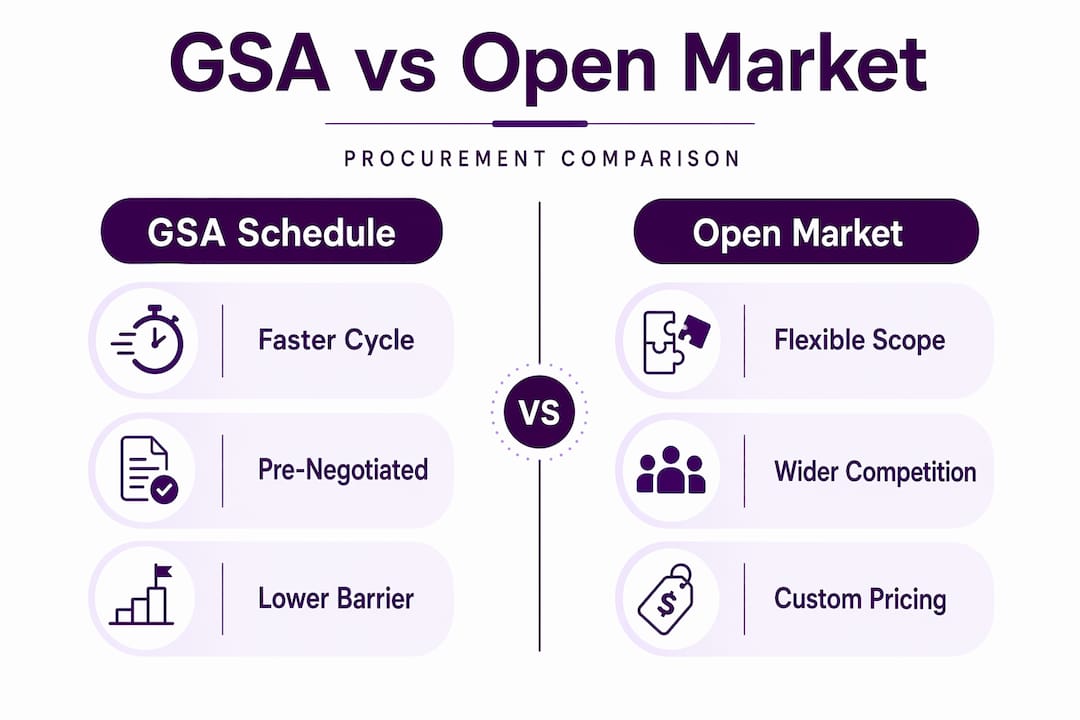
| Factor | GSA Schedule | Open market |
|---|---|---|
| Procurement speed | Days to weeks | Weeks to several months |
| Competition scope | Schedule holders only | All qualified vendors |
| Pricing pressure | Moderate, compete on value | High, often price-driven |
| Administrative burden on agency | Low | High |
| Entry requirements | Significant (2+ years history) | Low to moderate |
| Revenue predictability | Higher with BPAs | Variable |
| Contract type default | Firm-fixed-price common | Varies widely |
The speed difference is not a minor convenience. Procurement cycles shorten dramatically when an agency can skip open competition and buy from a Schedule holder directly. For agencies working against fiscal year deadlines, that speed often decides which vendor gets the call.
The competition angle also deserves real attention. In open market procurement, you compete against every vendor who responds to a solicitation. In a GSA Schedule competition, only other Schedule holders are in the running. That is a meaningfully smaller pool, and it shifts how you should position your offer.
One of the most underappreciated GSA schedule advantages is how pricing dynamics change. GSA Schedule vendors compete more on value and past performance than on pure price. Open market competitions frequently become races to the lowest bid, which compresses your margins and rewards cost-cutting over quality. A 2026 executive order further mandates that agencies prefer firm-fixed-price contracts as default, which affects pricing strategy under both methods. You need to know your true costs before committing to fixed pricing in either environment.
Using BPAs to build recurring revenue
Blanket Purchase Agreements are one of the most powerful and underutilized tools in federal contracting. A BPA is essentially a standing agreement between a vendor and a federal agency that allows the agency to make repeated purchases without issuing a new solicitation each time. They exist under both GSA Schedule and open market frameworks, and they work differently in each.
GSA Schedule BPAs
If you hold a GSA Schedule, you can establish BPAs with federal agencies that use your Schedule. These agreements can last up to five years and create a predictable, recurring revenue stream that most single-award contracts cannot match. Once an agency has a BPA with you, ordering from you is frictionless. That frictionless relationship is worth protecting and growing.
To establish a GSA Schedule BPA, you typically need a strong relationship with the contracting office, a competitive offer compared to other Schedule holders, and a clear demonstrated capability. Agencies will often run a mini-competition among Schedule holders before establishing a BPA, so your past performance and technical fit matter enormously here.
Open market BPAs
Open market BPAs operate under Simplified Acquisition Procedures and typically manage purchases under $250,000. They are more accessible to smaller or newer firms that have not yet landed a GSA Schedule. If you are early in your federal contracting journey, winning an open market BPA builds the very past performance you will need later to qualify for a Schedule.

Strategically, open market BPAs serve as stepping stones to larger federal opportunities. Treat them as investment vehicles, not just revenue. Every successful delivery under a BPA becomes a past performance reference that strengthens your GSA Schedule application and your competitive position in future procurements.
Pro Tip: When negotiating a BPA under either method, push to include language that makes you the preferred source for orders in your product or service category. Preferred source status dramatically increases call frequency.
Leveraging BPAs strategically lets you capture benefits from both sides of the GSA vs commercial purchasing debate. The recurring revenue of a Schedule BPA combined with the accessibility of open market BPAs gives you real flexibility across different agency relationships and budget levels.
Choosing the right path for your business
There is no universal answer to GSA schedules vs open market. The right choice depends on where your business is right now, what resources you can commit, and what federal buyers actually need from you.
GSA Schedules make sense when:
- Your business has at least two years of financials and demonstrable past performance.
- Your products or services map clearly to existing Schedule categories.
- You are targeting repeat agency relationships rather than one-off contracts.
- You want to reduce the time spent on proposal writing and administrative bidding.
- You plan to invest in federal sales and marketing over the long term.
Open market procurement is often the better fit when:
- Your offering is highly niche or does not align with GSA categories.
- You are newer to federal contracting and still building past performance.
- The specific opportunity you are targeting is not available through a Schedule.
- You want to test the federal market before committing to the Schedule application process.
- Speed to first contract matters more than recurring revenue stability.
The most effective long-term approach is to combine both. Use open market to win early contracts and build credibility. Use those wins to qualify for a GSA Schedule. Then layer BPAs on top of your Schedule to create the recurring revenue that makes federal contracting genuinely worth the investment. Review the full application process when you are ready to make the move toward a Schedule.
My honest take on this decision
I have seen too many small business owners treat a GSA Schedule like a magic door into federal revenue. They go through the months-long application process, get approved, and then wait. Nothing happens. They get frustrated and conclude that GSA does not work.
Here is what I have learned: GSA Schedules are not a guaranteed revenue source. Their real value comes from two things that are harder to see on a spreadsheet. First, the Schedule gives you an implied endorsement. Contracting officers prefer Schedule holders because the compliance vetting has already happened. That credibility lowers their risk, which lowers their resistance to buying from you. Second, the Schedule eliminates the friction that kills deals. When an agency wants to move fast, they call their Schedule vendors first.
What I have found actually works is treating the GSA Schedule as infrastructure, not as a lead generator. You still have to market yourself to agencies. You still have to build relationships with contracting officers. You still have to deliver consistently enough that agencies want BPAs with you specifically. The Schedule just makes all of that easier once you are doing the work.
My contrarian view on open market procurement is that it is far more valuable in the early stages than most advisors admit. Yes, it is competitive. Yes, the timelines are long. But winning an open market contract as a small business proves something that a Schedule alone cannot: that you can compete and win without a pre-vetted advantage. That proof matters when you are building relationships and asking agencies to take a chance on you.
Blend the methods. Use BPAs deliberately. Stop waiting for the phone to ring and start calling.
— Josh
Ready to pursue your GSA Schedule?
If you have read this far, you already understand more about GSA schedules vs open market than most contractors starting out. The next step is figuring out whether your business is ready for a Schedule and what that process actually looks like in practice. Gsascheduleservices.com specializes in helping small and medium-sized businesses through exactly this process. From readiness assessments to paperwork handling and pricing negotiation, the team at Gsascheduleservices takes the complexity off your plate so you can focus on winning contracts. If you want expert guidance without the administrative burden, explore your options and schedule your assessment today. You can also find practical support resources, including GSA Schedule consulting guidance to understand exactly how professional help accelerates your path to approval.
FAQ
What is the main difference between GSA Schedules and open market?
GSA Schedules are pre-negotiated contract vehicles that allow agencies to buy directly from vetted vendors without open bidding, while open market procurement requires a public solicitation where any qualified vendor can compete.
Do GSA Schedule holders automatically win more contracts?
No. A GSA Schedule is a contracting vehicle, not a sales guarantee. Schedule holders still need to actively market to agencies and compete in mini-competitions against other Schedule vendors.
How long does it take to get on a GSA Schedule?
The GSA Schedule application process typically takes four to twelve months depending on the complexity of your offering and how well prepared your documentation is before submission.
Can a small business use both GSA Schedules and open market procurement?
Yes, and many successful contractors do. Open market procurement helps build past performance early on, while a GSA Schedule supports faster, recurring revenue once your federal track record is established.
What are BPAs and why do they matter in this comparison?
Blanket Purchase Agreements are standing agreements that allow agencies to make repeated purchases from a vendor without issuing new solicitations each time. Under a GSA Schedule, BPAs can run up to five years and offer significantly more revenue stability than single-award contracts.
Recommended
- 6 Reasons GSA Schedules Appeal to Federal Buyers?
- GSA Advantage, GSA eBuy & other Marketplaces | GSA Focus Blog
- Which GSA Schedules Will Thrive Under Trump?
- Unveiling the Advantages of GSA Schedule