
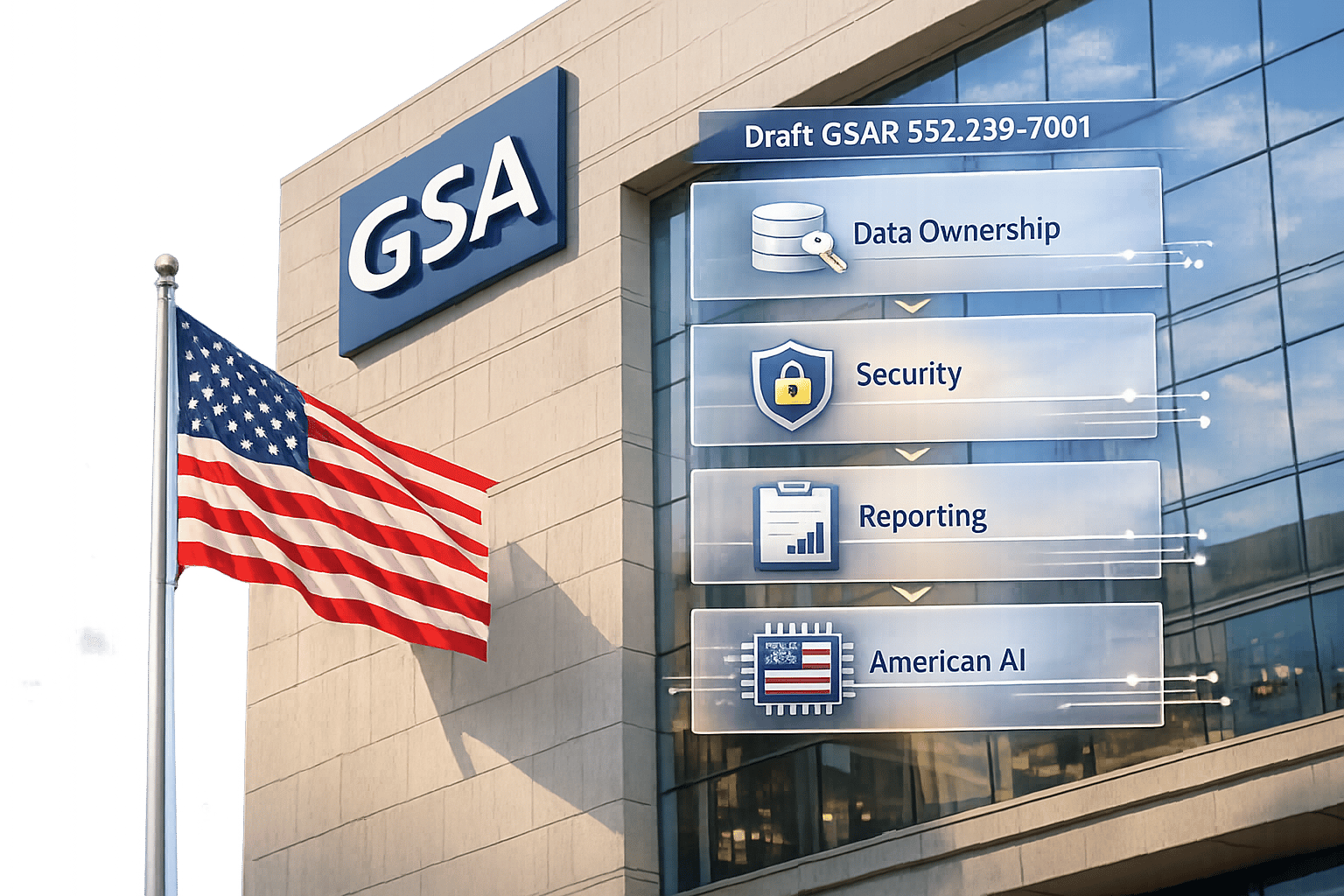
The General Services Administration (GSA) has unveiled a proposed contract clause designed to regulate the use of Artificial Intelligence (AI) systems in government contracts. Released on March 6, 2026, the draft clause, GSAR 552.239-7001, titled "Basic Safeguarding of Artificial Intelligence Systems", outlines a host of requirements aimed at standardizing AI procurement processes and ensuring compliance across federal contracts. The GSA is accepting comments on the proposal until March 20, 2026.
Overview of the Proposed Clause
The proposed clause brings significant changes to how AI systems are managed in government contracts. Key provisions include strict data ownership rules, mandatory use of "American AI Systems", stringent security measures, and comprehensive contractor responsibilities. According to the draft, the clause will apply broadly to all contracts involving "Artificial Intelligence capabilities", though the term "AI capabilities" is not clearly defined in the document.
Data Ownership and Intellectual Property Rights
A core aspect of the proposed clause is its treatment of intellectual property (IP) and data rights. Under its terms, the federal government would own all "Government Data" and any "Custom Developments" created under the contract. Contractors and their vendors would only receive a limited, revocable license to use data for the purposes of contract performance. The clause specifies that contractors are prohibited from using government-owned data to train or improve AI models for commercial purposes or other clients.
In addition, contractors must grant the government an irrevocable, royalty-free license to use their AI systems for the duration of the contract. The clause also requires contractors to assign any IP rights in "improvements" or "derivative works" developed from government data to the government.
Security Requirements and Reporting Obligations
The draft clause imposes strict security and incident reporting requirements on contractors. These include a 72-hour deadline to report any suspected or confirmed security incidents involving government data. Contractors must notify the Cybersecurity and Infrastructure Security Agency (CISA), the contracting officer, and other relevant parties, and provide daily updates until the issue is resolved. Forensic artifacts must also be preserved for at least 90 days after an incident.
Contractors are required to implement "reasonable technical, administrative, physical, and organizational safeguards" to protect government data. Safeguards include the use of "eyes off" data handling procedures, which limit human access to data, and the secure deletion of all government data upon the conclusion of the contract.
"American AI Systems" and Compliance Challenges
One notable requirement in the proposed clause is the preference for "American AI Systems", defined as systems "developed and produced in the United States." However, the draft offers no further clarification on what constitutes "produced", potentially complicating compliance for contractors using globally sourced data, open-source tools, or international talent. The clause also prohibits the use of any "foreign AI systems" or components controlled by non-US entities.
Prime contractors are held directly responsible for ensuring that their subcontractors, referred to as "Service Providers", comply with the same requirements. This includes the obligation to flow down all terms of the clause to commercial vendors, potentially requiring renegotiation of existing contracts with AI providers.
Unbiased AI Principles and Performance Standards
A unique feature of the proposed clause is its emphasis on "Unbiased AI Principles." These principles mandate that AI systems be "truthful" and prioritize "historical accuracy, scientific inquiry, and objectivity." The systems must also function as "neutral, nonpartisan tools" and avoid supporting ideological frameworks such as "Diversity, Equity, Inclusion."
The government reserves the right to independently evaluate AI systems for bias, accuracy, and compliance using its own benchmarks. Noncompliance could result in the suspension of an AI system’s use or, in extreme cases, termination of the contract. Terminations for cause could leave contractors liable for "reasonable decommissioning costs", though the draft does not specify what these costs may include.
Operational and Practical Implications
The proposed clause introduces operational challenges for contractors. The expansive government ownership requirements and restrictions on data use may disrupt the business models of commercial AI vendors. Furthermore, the demand for compliance with the "American AI Systems" standard and detailed reporting requirements could increase costs and limit technology options for contractors. Smaller companies may find it particularly difficult to meet these demands, potentially reshaping the competitive landscape of the federal AI marketplace.
The clause also emphasizes interoperability and portability, requiring that all AI systems, outputs, and custom developments use open and standard formats to avoid vendor lock-in. Contractors must provide tools to export government data in machine-readable formats and notify the government before implementing significant changes to their AI systems.
Next Steps for Stakeholders
With the public comment period closing on March 20, 2026, contractors and other stakeholders have limited time to provide feedback. Areas of concern include the lack of clarity around terms like "American AI Systems" and "AI capabilities", the broad data ownership provisions, and the feasibility of flowing down compliance requirements to subcontractors and commercial vendors.
The GSA’s proposed clause represents a landmark attempt to regulate AI procurement at the federal level. However, the extensive obligations it imposes will likely require contractors to rethink their compliance strategies and renegotiate vendor agreements. As the GSA reviews industry input, the final version of the clause will play a pivotal role in shaping the future of AI-driven government contracts.
For now, contractors must prepare for the potential impact of these regulations on their operations and relationships with commercial AI providers. With implementation possibly beginning as soon as spring 2026, the clock is ticking for stakeholders to adapt to this evolving regulatory landscape.