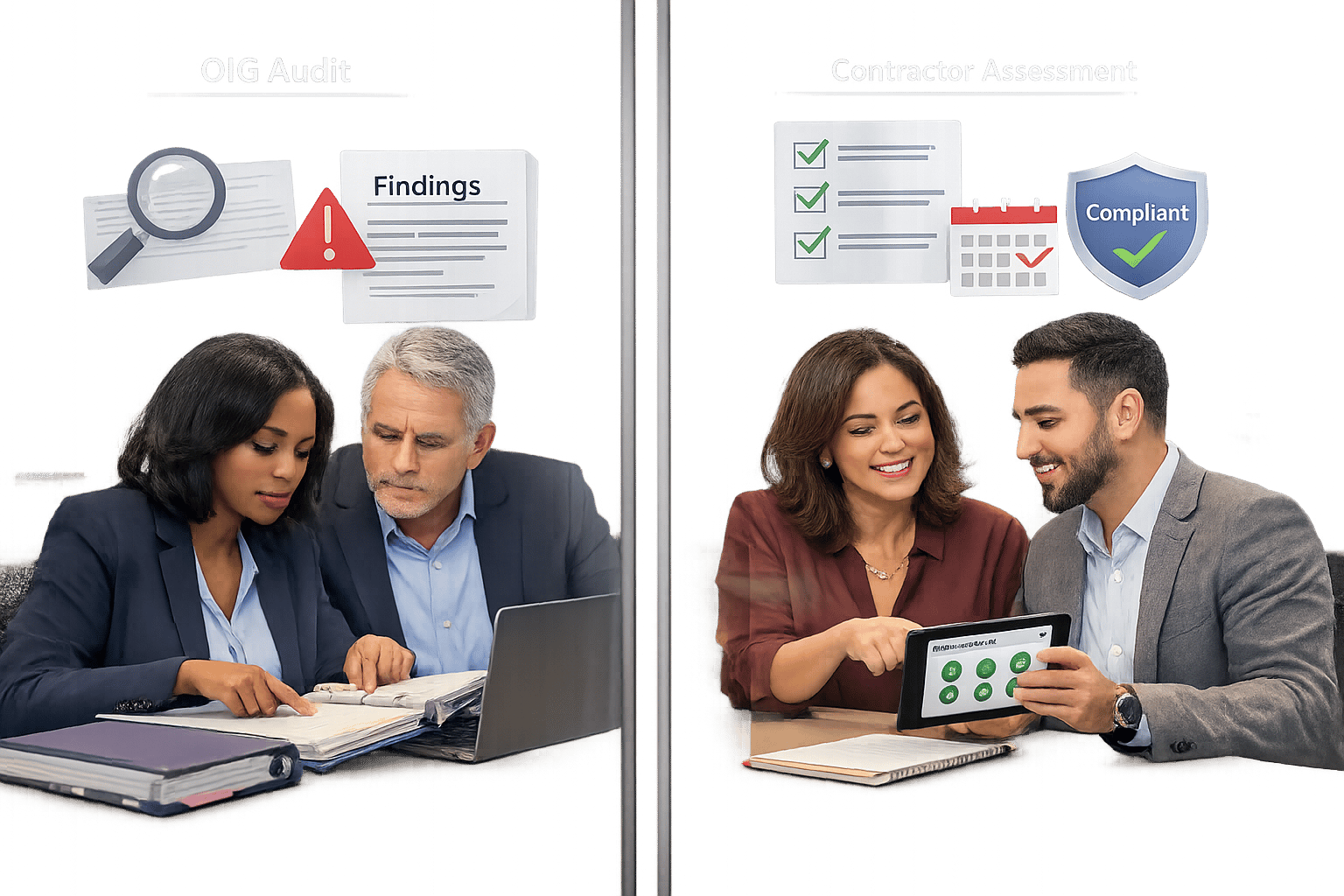
GSA Audits and Contractor Assessments (CAVs) are two distinct processes for GSA Schedule contract holders. Here’s the key difference: Audits are in-depth investigations led by the Office of Inspector General (OIG) to enforce compliance and identify violations, often with serious financial and legal consequences. Assessments, on the other hand, are supportive reviews conducted by Industrial Operations Analysts (IOAs) to ensure contractors meet basic requirements and provide guidance for improvement.
Key Takeaways:
- GSA Audits: Investigative, focused on pricing, compliance, and fraud; can result in penalties or legal action.
- Contractor Assessments: Educational, aimed at compliance checks and contractor success; less severe outcomes.
Quick Comparison:
| Feature | Contractor Assessment (CAV) | GSA Audit (OIG) |
|---|---|---|
| Purpose | Compliance review and guidance | Investigations for violations |
| Authority | Industrial Operations Analyst (IOA) | Office of Inspector General (OIG) |
| Frequency | Annual or End-of-Term | Periodic or risk-triggered |
| Tone | Collaborative and supportive | Strict and investigative |
| Outcome | Recommendations for improvement | Penalties, repayments, or legal action |
Preparation is crucial for both. Keep accurate records, monitor compliance areas like pricing and Trade Agreements Act (TAA), and conduct self-audits to avoid risks. For audits, expect a deeper dive into data and potential repercussions. For assessments, focus on understanding and adhering to contract requirements.
Pro Tip: Regular compliance reviews and expert support can help you navigate both processes and protect your contract.
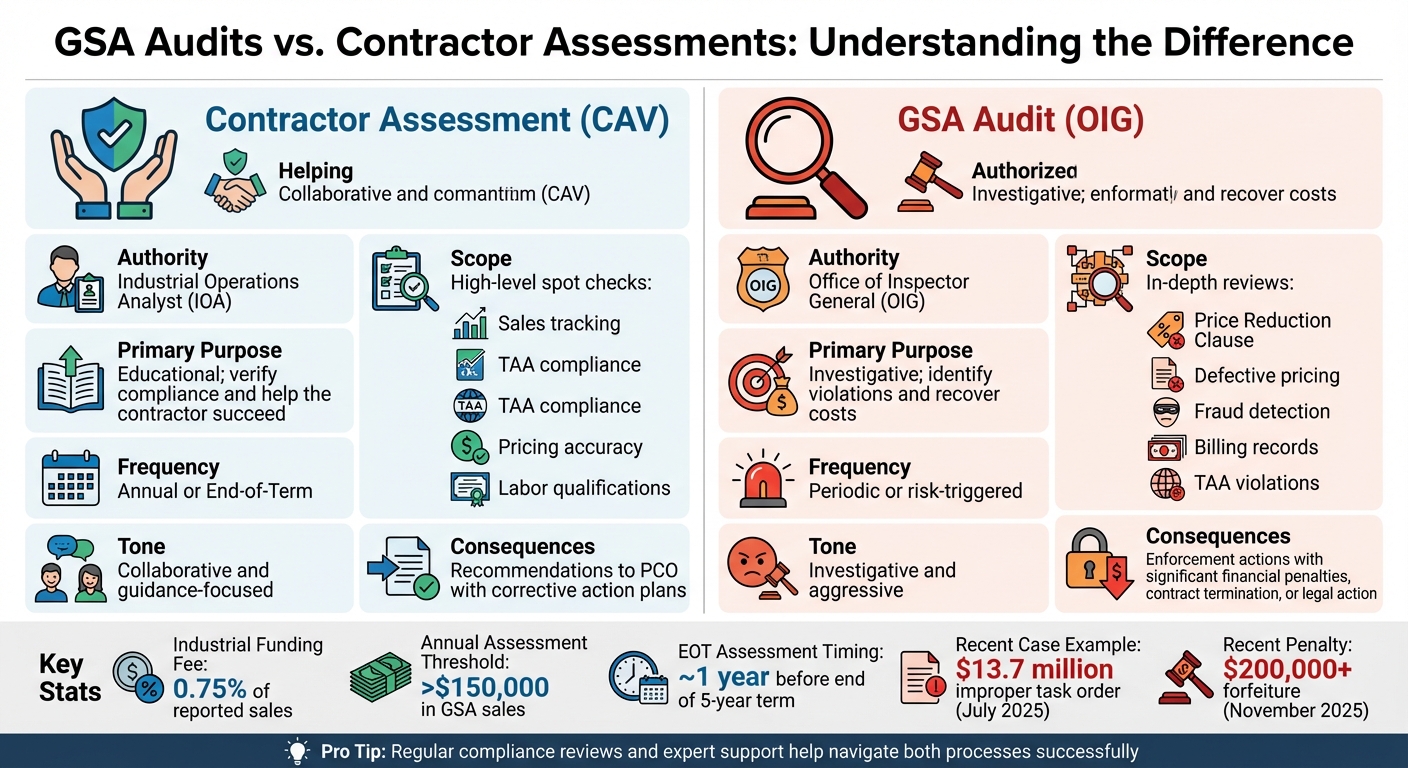
GSA Audits vs Contractor Assessments: Key Differences Comparison Chart
Key Insights for GSA Schedule Contracting
What Are GSA Audits?
A GSA audit is an investigation carried out by the Office of Inspector General (OIG), an independent body tasked with safeguarding the integrity of the General Services Administration (GSA). Unlike contractor assessments, which are more educational in nature, these audits focus on uncovering and preventing fraud, waste, and mismanagement within GSA programs.
Purpose of GSA Audits
The primary goal of GSA audits is to identify and address misconduct. This can include issues like defective pricing, violations of the Price Reductions clause, or non-compliance with the Trade Agreements Act (TAA). The Office of Audits outlines its mission as follows:
“The Office of Audits’ mission is to add value by providing timely, cost effective, professional, and useful products and services to our clients and stakeholders. This Office’s ultimate goal is to help improve GSA, while simultaneously protecting the integrity of its operations”.
GSA audits are categorized into two types:
- Pre-award audits: These occur before contracts are finalized. The aim is to help GSA officials negotiate fair and reasonable pricing by reviewing Multiple Award Schedule (MAS) proposals and analyzing cost or pricing data.
- Post-award audits: These take place after the contract is active. They focus on ensuring the government gets what it paid for by reviewing billing records, verifying compliance with the Industrial Funding Fee (currently 0.75% of reported sales), and identifying defective pricing.
Who Conducts GSA Audits and What They Cover
The Office of Inspector General oversees GSA audits. Within the OIG, the Office of Audits handles evaluative reviews, while the Office of Investigations addresses criminal and civil fraud cases. OIG officials have unrestricted access to all GSA and contractor records, reports, and materials tied to agency programs.
These audits cover a broad range of areas, including:
- Transaction data and pricing records
- IT systems and financial statements
- Billing records and compliance with cost-reimbursable contracts
- Contractor adherence to Basis of Award obligations
For example, in July 2025, an OIG audit revealed that the GSA Office of Administrative Services had improperly awarded a task order worth $13.7 million, highlighting the depth and importance of these investigations.
What Happens When You Fail an Audit
Failing a GSA audit can lead to serious repercussions. These include mandatory repayments, retroactive price reductions, contract termination, and even referrals to the Department of Justice (DOJ) or Suspension and Debarment officials.
Recent cases underscore the high stakes. In December 2025, a senior manager at a Virginia-based contractor faced charges of government fraud, wire fraud, and obstructing federal audits after providing false information about a cloud-based platform’s security. Similarly, in January 2026, a GSA contracting officer’s representative pleaded guilty to a bribery conspiracy involving construction companies. In November 2025, San Diego Powder & Protective Coatings and its hiring manager admitted to hiring undocumented workers, resulting in a forfeiture of over $200,000.
Beyond legal penalties, failing an audit can tarnish your record with unsatisfactory past performance reports, making it difficult to secure future government contracts. These audits are not casual reviews – they are rigorous investigations with serious consequences. This sharp contrast with contractor assessments sets the stage for understanding the role of Contractor Assistance Visits (CAVs).
What Are Contractor Assessment Visits (CAVs)?
Contractor Assessment Visits (CAVs) are compliance reviews aimed at ensuring GSA Multiple Award Schedule (MAS) contract holders meet their obligations while also providing guidance for improvement. Unlike GSA audits, which are investigative, CAVs focus on education and support. As the GSA Vendor Support Center explains:
“The purpose of the assessment is to help you succeed as a contractor. During the assessment, the IOA will verify that you are in compliance with some of the critical clauses of your contract as well as ensure you have an understanding of your responsibilities and opportunities.”
Although these visits are not classified as audits, they fall under the authority of GSAR Clause 552.215-71, which governs audit procedures. The key difference lies in their purpose – CAVs are designed to build collaboration rather than enforce penalties.
Purpose of Contractor Assessments
The main goal of CAVs is twofold: to confirm compliance and to offer contractors the tools and knowledge needed to perform better. These visits aim to foster a positive relationship between contractors and the GSA.
After the visit, contractors receive a Contractor Assessment Report (CAR), sometimes called a “Scorecard.” This report outlines the contractor’s compliance status and includes recommendations for improvement. Typically, contractors can expect the report within 7 to 14 days after the visit wraps up.
Who Conducts Contractor Assessments?
Industrial Operations Analysts (IOAs) are responsible for conducting CAVs. While IOAs do not have the authority to impose penalties, they can recommend actions to the Procurement Contracting Officer (PCO). The PCO may then request corrective measures or, in extreme cases, cancel a contract.
During the assessment, IOAs review critical compliance areas such as sales tracking systems, adherence to the Trade Agreements Act, pricing accuracy, and monitoring of the Basis of Award. They also evaluate broader aspects like timely deliveries, accurate GSA Advantage! listings, and payment terms. To make the process more efficient, most assessments now take place virtually via teleconference rather than on-site.
Annual vs. End-of-Term Assessments
CAVs are divided into two types, each with specific goals and timing.
- Annual Assessments: These are brief “spot checks” conducted for contractors with over $150,000 in GSA sales. They focus on key compliance areas like sales reporting, pricing, Trade Agreements Act compliance, and labor qualifications.
- End-of-Term (EOT) Assessments: These are more thorough reviews that occur about a year before the end of a five-year contract option period. In addition to the areas covered in annual assessments, EOT reviews also evaluate contract scope, e-verify requirements, Basis of Award compliance, and the accuracy of GSA Advantage!® catalogs.
| Feature | Annual Assessment | End-of-Term (EOT) Assessment |
|---|---|---|
| Frequency | Once per year (for high-sales contractors) | Every five years (at the end of the term) |
| Depth | Limited “spot check” | Comprehensive full review |
| Primary Focus | Sales tracking, pricing, TAA, labor quals | Annual items + contract scope, BOA, e-verify |
| Sales Threshold | >$150,000 | All contractors nearing end of term |
Proper preparation for these assessments is essential, as they can serve as a precursor to formal audit procedures. While CAVs are mainly educational, serious compliance issues may be referred to the GSA Office of Inspector General (OIG) for further investigation. This referral process highlights the preventive approach of CAVs, contrasting with the more reactive nature of GSA audits.
Key Differences Between GSA Audits and Contractor Assessments
Audits and assessments serve distinct purposes: audits focus on investigation and enforcement, while assessments emphasize education and guidance. These differences shape not only how each is conducted but also the outcomes they produce.
Comparison Table: GSA Audits vs. Contractor Assessments
| Feature | Contractor Assessment (CAV) | GSA Audit (OIG) |
|---|---|---|
| Authority | Industrial Operations Analyst (IOA) | Office of Inspector General (OIG) |
| Primary Purpose | Educational; verify compliance and help the contractor succeed | Investigative; identify violations and recover costs |
| Frequency | Annual or End-of-Term | Periodic or triggered by specific risks |
| Tone | Collaborative and guidance-focused | Investigative and aggressive |
| Scope | High-level spot checks (e.g., sales, TAA, pricing) | In-depth reviews (e.g., Price Reduction Clause, labor qualifications) |
| Consequences | Recommendations to the Procurement Contracting Officer (PCO) with corrective action plans | Enforcement actions, often with significant financial penalties |
Investigative vs. Educational Approach
The tone and intent of these processes couldn’t be more different. According to the GSA Vendor Support Center, contractor assessments are designed to be a helpful resource: “The IOA can be a valuable educational resource, helping answer any questions you have about your contract and can direct you to appropriate resources.”
Audits, however, take a stricter path.
What Happens After Each Process
The outcomes of these processes differ just as much as their approaches. Contractor assessments wrap up with a Contractor Assessment Report (CAR), which highlights compliance status and offers recommendations for improvement. If issues arise, the IOA suggests corrective actions to the PCO to address them.
OIG audits, on the other hand, lead to formal reports that often result in penalties, price adjustments, or even legal action. Auditors tend to zero in on complex areas like the Price Reduction Clause (PRC), ensuring the government receives pricing comparable to or better than that offered to commercial customers. For example, identifying a single unqualified employee could prompt auditors to review all orders involving that individual, potentially spanning years.
It’s important to note that past successful assessments don’t shield contractors from future audits. Each process functions independently, making it essential to align your compliance strategy with the specific demands of both audits and assessments.
How to Prepare for GSA Audits and Contractor Assessments
Preparation isn’t just helpful – it’s essential. Whether you’re gearing up for a routine contractor assessment or a full-scale GSA OIG audit, staying organized and proactive reduces compliance risks significantly. The secret? Treat compliance as an ongoing priority, not a last-minute task.
Getting ready for these evaluations boils down to consistent monitoring, detailed documentation, and expert guidance when necessary.
Key Compliance Areas to Watch
Auditors and assessors focus on specific compliance areas, so it’s smart to prioritize these in your strategy. For example:
- MAS Contract Sales and IFF Payments: Keep meticulous records of all MAS contract sales and ensure the 0.75% Industrial Funding Fee (IFF) is paid on time. Even if sales are reported quarterly, monthly updates are crucial.
- Trade Agreements Act (TAA) Compliance: Products sold to the government must be made or substantially transformed in the U.S. or a TAA-approved country. Regularly auditing product origins is a must to avoid compliance issues.
- Labor Qualifications for Service Contracts: An Industrial Operations Analyst (IOA) will review labor records during a Contractor Assessment to confirm compliance with contract clauses. Up-to-date resumes for all personnel working under GSA orders are essential to demonstrate qualifications align with contract requirements.
- Transactional Data Reporting (TDR): If your contract includes eligible Special Item Numbers (SINs), you’ll need to provide detailed transactional data for GSA to analyze buying trends. For contractors not using TDR, the IFF must be paid within 30 days of the quarter’s end.
Best Practices for Documentation and Recordkeeping
Good recordkeeping isn’t just about staying organized – it’s your first line of defense during audits. Well-maintained records allow you to identify potential risks, explain discrepancies, and address issues before GSA reviewers step in.
Here’s what you should focus on:
- Pricing and Sales Documentation: Maintain detailed records to verify accurate pricing and proper sales classification.
- Service Contract Records: Keep resumes for all GSA project staff in a centralized, accessible location to confirm compliance with labor category qualifications.
- Commercial Catalogs and Price Lists: Store these documents properly to support Economic Price Adjustment (EPA) requests.
Before an official review, conduct a self-audit to spot and fix any compliance gaps. The Contractor Assessment Reference Guide, provided by the MAS Program Management Office, offers valuable insights into what to expect and how to prepare for both OIG audits and MAS assessments.
By keeping your records in order, you not only protect your compliance but also make the preparation process far smoother.
How GSA Focus Can Assist
Sometimes, having an expert in your corner makes all the difference. GSA Focus specializes in helping businesses navigate both assessments and audits with confidence. Their team provides tailored guidance to ensure you understand GSA’s specific requests during a Contractor Assessment Visit (CAV). They’ll help you gather and organize the required documentation and prepare your team to handle questions effectively.
GSA Focus also offers virtual support during assessments, acting as a liaison between your business and the assessors. Their document preparation services and compliance expertise make the entire process less daunting.
With a 98% success rate, GSA Focus is a trusted partner for small businesses, helping them maintain the records, compliance protocols, and confidence needed to handle both routine assessments and in-depth audits successfully.
Conclusion
Grasping the difference between GSA audits and contractor assessments is essential for safeguarding your federal contracting business. This distinction highlights the importance of staying ahead with compliance efforts.
As GSA steps up the frequency and depth of its audits, contractors must treat compliance as a top priority. Whether you’re dealing with a routine review or a comprehensive audit, being prepared can make all the difference. Keeping your records well-organized, staying vigilant on key compliance areas like the Price Reduction Clause and Trade Agreements Act, and performing regular self-audits are crucial steps to mitigate risks.
Preparation is your best defense. This includes strong document management systems, consistent self-auditing, and proactive compliance checks. These measures not only protect you from penalties but also build a solid foundation for success in federal contracting. For many small businesses, having expert guidance can make all the difference. GSA Focus offers the expertise, documentation support, and compliance strategies contractors need to confidently handle both assessments and audits. With a 98% success rate, they empower businesses to maintain the standards required to thrive in federal contracting.
Stay prepared, stay compliant, and don’t hesitate to seek professional help when navigating GSA requirements. Your federal contract – and your business’s future – depend on it.
FAQs
Can a CAV lead to an OIG audit?
Yes, a Contractor Assistance Visit (CAV) can potentially result in an Office of Inspector General (OIG) audit. While the primary goal of a CAV is to conduct a compliance review led by GSA Industrial Operations Analysts, it often involves a close examination of documents and sampling of sales data. If the review uncovers serious issues or irregularities, it could prompt further scrutiny, including an OIG audit. This aligns with GSA’s growing focus on ensuring adherence to compliance procedures.
What records should I keep year-round to be ready?
To get ready for GSA audits or contractor assessments, it’s crucial to keep your records well-organized throughout the year. This includes contracts, invoices, delivery documents, sales data, certifications, and correspondence. Generally, most records should be retained for at least three years after the final payment, but some, like GSA SmartPay records, need to be kept for up to six years.
Make sure to use secure digital and physical backups to protect your data. Regularly reviewing your records can help you stay compliant and prepared for any assessments.
What should I do first if I get an audit notice?
If you get an audit notice, the first step is to get all your paperwork in order. This includes key documents like your contract, any modifications, sales reports, invoices, and pricing lists. Take time to do an internal review to double-check that everything is accurate and nothing is missing. Make sure you understand the specific areas the audit will focus on, such as pricing or sales reporting, and get your team ready to address those topics. It’s also a good idea to maintain a positive working relationship with the GSA Industrial Operations Analyst (IOA), as this can make the process go more smoothly.
Related Blog Posts
- How to Track GSA Contract Compliance
- Top 5 Compliance Issues in GSA Contracts
- Common GSA Audit Issues and How to Avoid Them
- GSA Audit Compliance Strategies: What Works Best