

If your Authorized Negotiator hasn’t completed the Readiness Assessment and Pathways to Success training, you’re not ready to submit, period. Do that first. The most common early blocker isn’t strategy or pricing, it’s a mismatched SAM.gov record or missing financial statements, both fixable in days if you catch them now.
TL;DR:
- Ensuring SAM.gov data matches your offer details exactly is critical, as even a single discrepancy can cause immediate rejection.
- Two years of audited or unaudited financial statements are required, with explanations needed for any negative equity or losses.
- Past performance must be relevant and directly linked to your proposed SINs, with references prepared to be reachable and briefed.
- Completing the required training and assessments within 12 months prior to submission is essential for eligibility.
- Internal review of pricing disclosures against actual invoices and verifying all templates are current can prevent most common rejection reasons.
Table of Contents
- The GSA Readiness Checklist Every Small Business Should Run First
- What Administrative Prerequisites Do You Need Before Applying?
- How Do You Prove Financial Responsibility and Past Performance?
- What Goes Into the Technical and Pricing Volumes?
- What Actually Gets an eOffer Rejected?
- Should You Apply Alone or Bring In Help?
- The Mistake That Kills Otherwise Solid GSA Offers
- When It Makes Sense to Bring In GSA Schedule Support
- Where to Find the Official Forms and Tools
- Sources
- FAQ
The GSA Readiness Checklist Every Small Business Should Run First
Think of this as the pre-flight check contracting officers wish every offeror ran before hitting submit. Miss one item and your offer stalls, or gets returned outright.
- Training and assessment: Complete Pathways to Success and the Readiness Assessment within the year before you submit, both acknowledged in eOffer by your Authorized Negotiator.
- SAM.gov accuracy: Your Unique Entity Identifier (UEI), legal business name, and representations and certifications must match exactly across SAM.gov and your offer.
- Two years of financials: Balance sheet and income statement for the last two years, or documented Springboard exception evidence if you’re a qualifying startup.
- Past performance: Narratives and reachable references tied directly to the Special Item Numbers (SINs) you’re proposing.
- Required templates: Price proposal template, Commercial Sales Practices (CSP) or Transactional Data Reporting (TDR) disclosure, Product/Pricing Questionnaire (PPQ), and letters of supply if you’re a reseller.
- Pricing strategy set: You know whether you’re pursuing CSP or TDR, and your pricing supports Trade Agreements Act (TAA) compliance if you sell products.
- Authorized Negotiator ready: This must be a current employee, not a contracted consultant, with a digital certificate and signing authority in eOffer.
Check every box and you’re in strong shape. Miss two or three, and you’re looking at weeks of delay before you even reach a contracting officer’s desk.
What Administrative Prerequisites Do You Need Before Applying?
Before you write a single word of your technical narrative, get the paperwork foundation solid. This is the boring part, and it’s also where most offers quietly die.
Start with SAM.gov. Pull your current record and compare it line by line against what you plan to submit in eOffer, your legal name, UEI, and physical address all need to match exactly. A single discrepancy here is one of the fastest ways to get an offer returned before a reviewer even reads your pricing.
Your Authorized Negotiator has to be a bona fide employee with signing authority and a digital certificate for eOffer, and that person is the one who must complete the Readiness Assessment personally. Pathways to Success runs roughly three to four hours and both the training and assessment need completion within the 12 months before you submit.
Run a quick internal audit before moving forward:
- Confirm SAM.gov data matches your intended offer exactly.
- Verify your Authorized Negotiator’s certificate is active and unexpired.
- Pull GSA’s new offeror checklist and check off every administrative item line by line.
How Do You Prove Financial Responsibility and Past Performance?
GSA wants two years of financial statements, a balance sheet and income statement, audited if you have them, unaudited if you don’t. Contracting officers use this to gauge whether you can actually perform on a federal contract at volume, a standard rooted in FAR 9.104-1’s financial responsibility criteria.
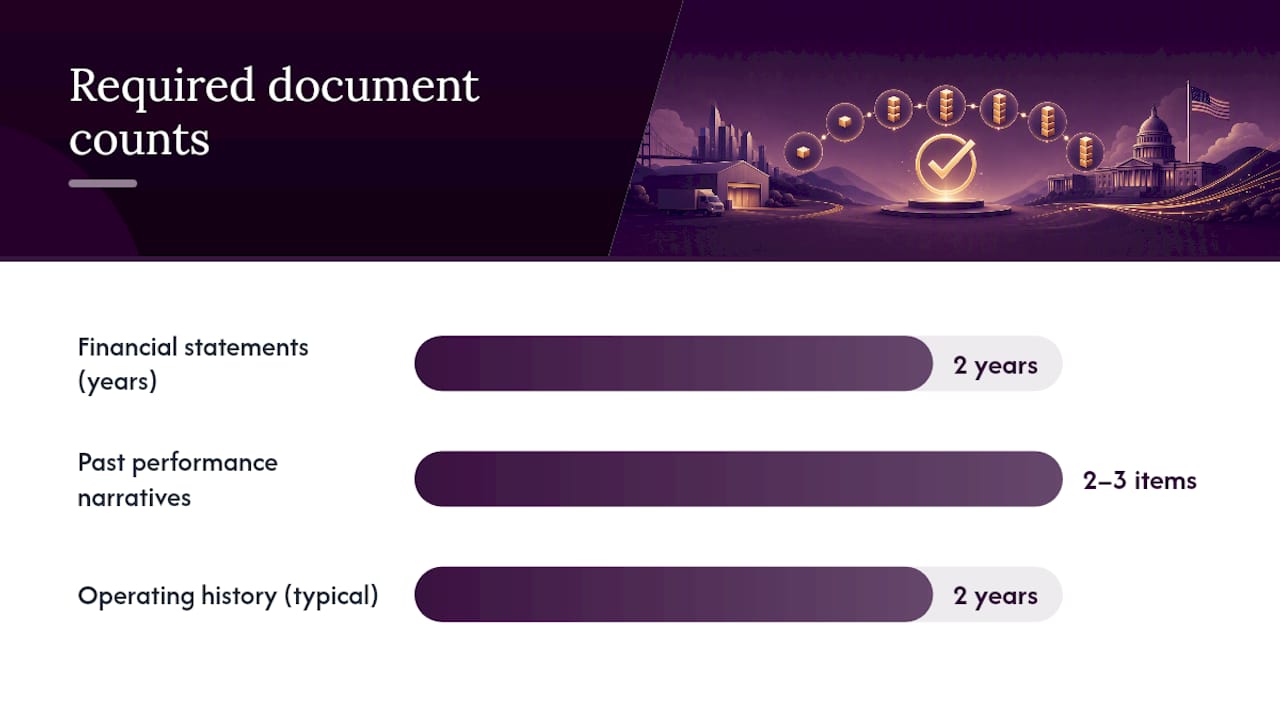
If your financials show negative equity or a loss year, don’t hide it. Attach a short narrative explaining what happened (a one-time expense, a leadership transition, a bad debt write-off) and back it with supporting documentation like tax returns or a CPA letter. Reviewers are far more comfortable with an explained dip than an unexplained one.
Past performance works the same way: relevance beats volume. GSA needs to see that your prior contracts map to the SINs you’re proposing now, not just that you’ve done business before.
- Gather two to three strong past performance narratives tied to your proposed SINs.
- Collect Past Performance Questionnaires (PPQs) or verify references are reachable and briefed on what to expect.
- If you’re a startup without two years of history, document your Springboard exception eligibility with whatever alternative evidence GSA accepts for your category.
What Goes Into the Technical and Pricing Volumes?
Your offer splits into three volumes, administrative, technical, and pricing, and the technical volume is where most narrative gets written. Expect character-limited fields (often capped around 10,000 characters per section) covering quality control procedures, corporate experience, and staffing approach, so tighten your language before you paste anything in.
Pricing is where the real preparation debt shows up. If you’re pursuing CSP, your Commercial Sales Practices disclosures need to line up with your actual invoices, a mismatch between what you claim you charge and what your books show is a classic reason for return. If you’re on TDR instead, you’re reporting transactional sales data post-award rather than disclosing commercial pricing upfront, which changes how a contracting officer evaluates your price proposal.
- Download the correct price proposal template for your SIN from GSA’s required templates page.
- Reconcile every listed price against actual invoices before you submit, not after a clarification request arrives.
- If you sell products, confirm TAA compliance and secure letters of supply from manufacturers to document country-of-origin eligibility.
What Actually Gets an eOffer Rejected?
eOffer is a binding submission. Every narrative field you type and every document you upload becomes part of the official contract record, so resist the urge to work around portal limits by uploading a PDF instead of filling in the required field correctly. Reviewers read what’s in the portal fields first.
Most returned offers fail for a small, predictable set of reasons:
- SAM.gov mismatches between your registration and your offer details.
- Inconsistent pricing evidence, where CSP disclosures don’t match your invoices or commercial price lists.
- Incomplete or wrong templates, especially outdated price proposal formats pulled from the wrong SIN.
- Weak past performance, references that can’t be reached or don’t map to proposed SINs.
Contracting officers evaluate for completeness, responsibility, scope conformity, and pricing fairness, roughly in that order. A clean, complete offer with modest pricing beats an ambitious offer full of gaps every time. Realistically, budget several weeks to a few months from submission through negotiation, longer if clarification cycles drag. Once negotiations wrap, you’ll submit a final proposal revision before award.
Should You Apply Alone or Bring In Help?
Fix things in order: SAM.gov and financials first, since those stop review cold if they’re wrong. Past performance and pricing evidence come next, they take longer to assemble but rarely block an initial read.
Whether to handle the offer yourself comes down to three questions. How much internal staff time can you actually dedicate over the next two to three months? How urgent is your timeline, are you chasing a specific opportunity or building long-term access? And how much regulatory risk are you comfortable absorbing if a first submission gets returned?
A consultant typically handles the readiness assessment, full document preparation, SIN mapping, pricing strategy, and the eOffer submission itself. Before engaging anyone, have these ready:
- Two years of financial statements
- Past performance references and any existing PPQs
- SAM.gov login access
- A rough list of the products or services you want on your Schedule
The Mistake That Kills Otherwise Solid GSA Offers
The single most avoidable rejection I see traces back to sloppy internal review, not bad strategy. A business submits a strong technical narrative, then gets bounced because their CSP disclosure lists prices their actual invoices don’t support. Another does everything right except their SAM.gov legal name has a stray “LLC” that their offer doesn’t.
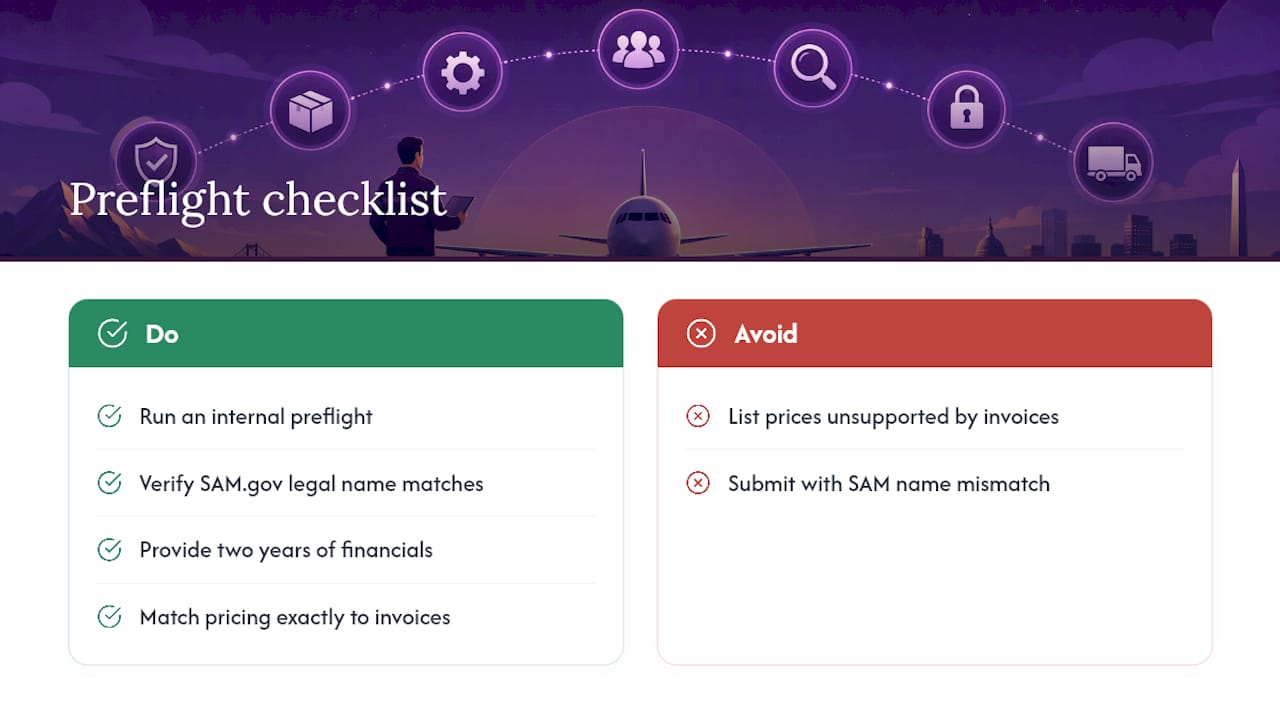
Neither mistake reflects a weak business. Both reflect a missing final check.
Run an internal preflight that mirrors what a contracting officer will look at: SAM match, two years of financials, past performance mapped to your SINs, and pricing that matches your invoices dollar for dollar. Businesses that do this before hitting submit consistently move faster through review, not because GSA gives them a break, but because reviewers have nothing to send back.
— Josh
When It Makes Sense to Bring In GSA Schedule Support
If you’ve read this far and you’re staring at a stack of financial statements wondering whether your CSP disclosure actually matches your invoices, that instinct to double check is the right one. Consultants can run readiness assessments, prepare and reconcile required documents, map your offerings to the right SINs, and handle the eOffer submission itself to help prevent return over mismatches.
If your internal team is stretched thin, your timeline is tight, or you’ve already had an offer bounced once, that’s your signal to stop troubleshooting alone. Start with a discovery session and get a straight diagnostic on exactly where your business stands before you submit anything.
Where to Find the Official Forms and Tools
Pull these directly from GSA before you start: the Readiness Assessment confirms baseline eligibility, Pathways to Success covers required training, and the roadmap page links every required template and the new offeror checklist. Our own guide to the GSA contract process walks through the steps in order.
FAQ
What Is a GSA Readiness Checklist?
It’s a self-evaluation list covering the prerequisites GSA reviewers check first, including SAM.gov accuracy, Pathways to Success training, two years of financial statements, and past performance evidence tied to your proposed SINs.
How Long Does the Pathways to Success Training Take?
The training runs roughly three to four hours, and both it and the Readiness Assessment must be completed within the 12 months before you submit your offer.
Can a Startup Without Two Years of Financials Apply?
Yes, through the Springboard exception, but you’ll need to document alternative evidence of your ability to perform since standard financial history isn’t available.
What’s the Most Common Reason GSA Offers Get Returned?
SAM.gov mismatches and inconsistent CSP pricing evidence against actual invoices account for a large share of returned offers, both fixable with a careful internal review before submission.
Should I Hire a Consultant or Apply on My Own?
It depends on your internal bandwidth, timeline urgency, and risk tolerance. Some consultants handle readiness assessments, document preparation, and eOffer submission for businesses that want to avoid a preventable rejection.
Recommended
- (Infographic) 25 Reasons GSA Contracts are Rejected
- GSA eOffer process guide: Steps to secure your schedule contract
- An Essential Checklist to Maintain Your GSA Schedule Contract
- What Happens If Your GSA Schedule Proposal Gets Rejected? 4 Points You Should Know