
Most U.S. SaaS companies with two years of trading history can qualify for a GSA Schedule under the Cloud SIN or Software License SIN, opening federal agencies as a sales channel. The immediate next step is confirming an active SAM.gov registration with your Unique Entity ID, then completing GSA’s Pathways to Success training and a readiness assessment before your team touches the eOffer portal.
TL;DR:
- Most SaaS companies need at least two years of financial history and scalable support infrastructure to qualify for a GSA Schedule.
- The application process involves registering in SAM.gov, completing Pathways to Success training, and submitting a detailed proposal through the eOffer portal.
- The Cloud SIN (518210C) is the primary category for SaaS, but some vendors also file under the Software License SIN (511210) for license-based models.
- FedRAMP authorization is not mandatory but is highly valued by agencies handling sensitive data, and early planning can accelerate sales.
- Partnering with a specialist firm can significantly reduce application time, help navigate compliance hurdles, and improve chances of approval.
Table of Contents
- What Is GSA for SaaS, and Who Actually Qualifies?
- How Do You Apply for a GSA Schedule as a SaaS Company?
- Which GSA SIN Fits Your SaaS Product?
- Does Your SaaS Need FedRAMP to Sell to Federal Agencies?
- What Happens After You Win a GSA Schedule Award?
- Three SaaS-Specific Mistakes I See Constantly
- How Gsascheduleservices Gets Your SaaS Schedule Awarded Faster
- Sources
- FAQ
What Is GSA for SaaS, and Who Actually Qualifies?
“GSA for SaaS” refers to getting your software listed on the General Services Administration’s Multiple Award Schedule (MAS), the federal government’s largest procurement vehicle for buying commercial products and services. Once you’re on it, any federal agency, from the Department of Veterans Affairs to a small field office of the Forest Service, can buy your platform without running a separate competitive bid. That’s the entire point of the Schedule: it pre-negotiates price and terms so purchases move faster.
Not every SaaS company should chase this on day one. A quick self-check saves months of wasted effort:
- Two years of financial history. GSA typically wants two years of corporate financial statements showing you can perform a federal contract. Startups under two years old can sometimes qualify through the SBA’s Mentor-Protégé arrangement or by showing strong financial backing, but it’s the exception, not the rule.
- Support infrastructure that scales. Federal buyers expect defined SLAs, a real support desk, and the operational capacity to onboard a 5,000-user agency deployment without falling over.
- Enough expected volume to justify the overhead. A Schedule brings ongoing reporting obligations. If you’re not expecting meaningful federal revenue within 18 to 24 months, the compliance burden may outweigh the benefit.
- Direct application vs. an authorized reseller. Smaller vendors sometimes route through an Authorized Cooperative Hosting reseller or teaming partner to skip upfront compliance costs, trading a revenue share and slower GSA eLibrary visibility for lower risk.
Pro Tip: If you’re unsure whether your revenue history clears the bar, run the numbers against GSA’s Financial Responsibility standards before you invest in Pathways to Success training. It’s a five-minute gut check that can save you a wasted quarter.
How Do You Apply for a GSA Schedule as a SaaS Company?
GSA’s own Roadmap to get a MAS contract lays out a defined sequence, and skipping steps is the single most common cause of stalled applications. Here’s how that sequence plays out for a SaaS vendor specifically.
- Register in SAM.gov and secure a UEI. Your Unique Entity Identifier and an active System for Award Management record are non-negotiable prerequisites. If your SAM registration lapses mid-application, GSA halts review until you fix it.
- Complete Pathways to Success training. The Pathways to Success guide requires your authorized negotiator, usually a founder, COO, or contracts lead, to finish this training before submitting anything.
- Run the Readiness Assessment. This self-evaluation, built into Pathways to Success, forces you to confirm you meet the financial, past-performance, and operational bars before GSA will even look at your offer.
- Read the current MAS solicitation and pick your SINs. Use GSA eLibrary to confirm which Special Item Numbers match your product, not just what sounds closest.
- Assemble your proposal package. This is where most SaaS teams underestimate the lift.
- Submit through eOffer. GSA’s electronic offer portal is where the package actually gets filed and tracked.
- Respond to contracting officer clarifications. Expect at least one round of questions; three or four rounds is common for a first-time offeror.
Your proposal package typically needs:
- A commercial pricelist mapped to your chosen SINs
- Commercial Sales Practices (CSP) disclosures, or a Transactional Data Reporting (TDR) election if you go that route instead
- Two years of financial statements
- Past performance references, ideally including any prior government or large-enterprise clients
- A completed SF1449 offer form
- Technical proposal narratives addressing each SIN’s specific requirements
Realistic timeline: Roadmap to get a MAS contract | GSA doesn’t publish a fixed number of weeks, but industry practitioner estimates put award at several months from a serious start, with in-house teams logging substantial staff hours and specialist consultants charging varying fees depending on complexity. The variable that moves that timeline more than any other is how clean your CSP disclosures are on the first submission.
Which GSA SIN Fits Your SaaS Product?
Two Special Item Numbers cover most SaaS offerings, and picking the wrong one is, according to GSA’s own guidance, the single most common fatal mistake offerors make.
- Cloud SIN (518210C). This is home base for most modern SaaS platforms. GSA’s Cloud SIN guidance centralizes IaaS, PaaS, and SaaS offerings under one category, and it’s where FedRAMP expectations get evaluated most closely.
- Software License SIN (511210). Better fit for term or perpetual license models bundled with maintenance, rather than a pure subscription delivered entirely over the web.
A meaningful share of SaaS companies end up filing under both SINs when their product bundles hosted software with a licensed on-premises component, and GSA’s contracting officers generally accept multi-SIN offers when the technical narrative justifies it.
Pricing preparation is where offers stall. GSA evaluates “price reasonableness” against your CSP, meaning your GSA price needs a defensible relationship to what you charge your best commercial customers. A 2024 GSA update now allows upfront payment structures for SaaS licenses, easing a cash-flow barrier that used to push smaller vendors toward reseller arrangements just to get paid on a normal schedule.
Common errors to avoid: disclosing a “most favored customer” discount you can’t document, quoting a GSA price above what any commercial customer actually pays, and electing TDR without understanding the quarterly reporting obligation it carries going forward.
Does Your SaaS Need FedRAMP to Sell to Federal Agencies?
FedRAMP authorization isn’t a blanket requirement to get on the Schedule, but it heavily influences whether agencies with sensitive data will actually buy from you. GSA’s Cloud SIN guidance treats FedRAMP status as a strong signal in cloud procurement decisions, even where it isn’t strictly mandated by the solicitation.
- Build a System Security Plan (SSP) and Plan of Action and Milestones (POA&M) early, even before you pursue full authorization.
- List your product on the FedRAMP Marketplace once you begin the process, so agencies can find your authorization status.
- Consider partnering with a FedRAMP-authorized reseller or hosting your product on an authorized cloud infrastructure provider to sell sooner, then pursue full authorization after your first agency contracts.
Pro Tip: Don’t let a FedRAMP gap stop you from applying for the Schedule itself. Many SaaS vendors win their first task orders from smaller offices or civilian agencies with lighter security requirements, then use that revenue to fund the authorization process.
What Happens After You Win a GSA Schedule Award?
Winning the contract is the beginning of the sales cycle, not the end of the paperwork.
- Publish your catalog on GSA Advantage and eLibrary. Write your product descriptions the way a contracting officer searches, with plain-language capability terms, not marketing copy.
- Work eBuy actively. Federal buyers post RFQs here, and a capability statement pitched at the right SIN wins task orders that never show up anywhere else.
- Build targeted outreach to agency IT and procurement offices most likely to need your platform.
- Stay audit-ready. Track sales against your Schedule pricing, file modifications when your commercial pricing changes, and hit minimum sales thresholds to keep the contract active through option years.
Neglect that last step and your Schedule goes dormant, which defeats the entire investment you just made.
Three SaaS-Specific Mistakes I See Constantly
Reconciling your commercial invoices with your CSP before submission catches most pricing red flags early, yet teams routinely skip it and pay for that skip with extra clarification rounds. Misclassifying features under the wrong SIN, treating a hosted platform as a straight software license, is the second recurring error. And the one nobody talks about: winning the Schedule, then treating it as a trophy instead of a sales channel that needs active management, so it sits dormant until GSA flags it for cancellation.
— Josh
How Gsascheduleservices Gets Your SaaS Schedule Awarded Faster
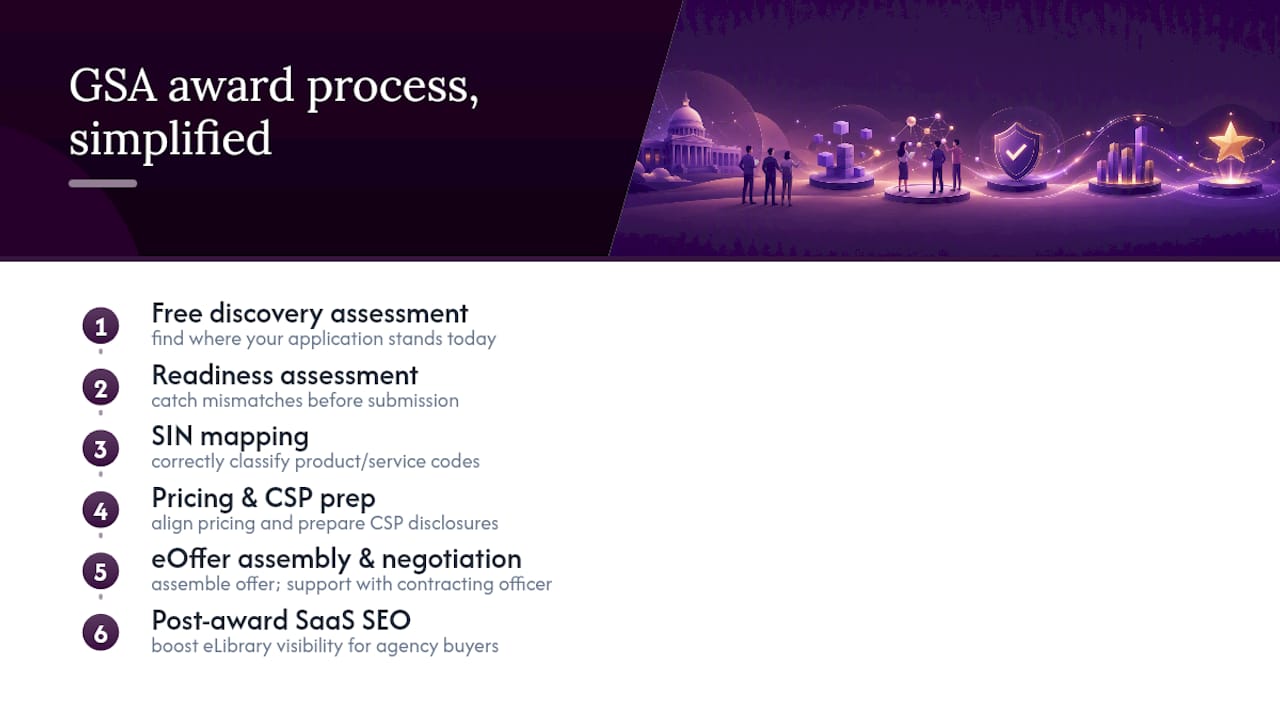
Gsascheduleservices exists for exactly the SaaS executives who read this far and thought, “I don’t have 300 hours to spend on CSP disclosures.” Our team handles the full sequence: readiness assessment, SIN mapping, pricing and CSP preparation, eOffer assembly, and direct negotiation support with your contracting officer, so the parts of the process that trip up first-time offerors (mismatched pricing, missing past performance evidence, misclassified SINs) get caught before submission instead of after.
Hiring specialized help makes the most sense when your internal team lacks bandwidth to own a 6 to 12 month process on top of running the business, or when a first DIY attempt has already stalled in clarification rounds. Once you’re awarded, staying visible matters just as much as winning; pairing your GSA listing with SaaS-specific SEO helps agency buyers actually find your eLibrary listing.
Start with a free discovery assessment to find out where your application stands today.
Sources
Before you start, pull GSA’s Pathways to Success PDF, the Cloud SIN guidance, and GSA’s new-offer checklist for templates you’ll need at submission.
- Roadmap to get a MAS contract | GSA
FAQ
Can a small SaaS startup get a GSA Schedule?
Yes, if the company can show two years of financial history and operational capacity to support federal customers; startups under two years sometimes qualify through SBA mentor-protégé arrangements or a reseller route.
How long does it take to get a GSA Schedule for SaaS?
Most SaaS applicants reach award within several months from a serious start, assuming clean CSP disclosures and a correctly chosen SIN on the first submission.
Is FedRAMP required to get on the GSA Schedule?
No, FedRAMP isn’t a strict Schedule requirement, but it heavily influences which agencies will actually buy, especially for cloud SIN offerings involving sensitive data.
How much does it cost to get a GSA Schedule?
In-house teams typically spend substantial staff hours on the process, while specialized consultants may charge a sizable fee depending on complexity.
Should I hire a consultant or apply myself?
DIY works if you have dedicated staff time and prior federal contracting experience; most SaaS executives without that bandwidth use a specialist like Gsascheduleservices to avoid the clarification-round delays that stall first-time offers.
Recommended
- Schedule Contract Guide: How to Get a GSA Schedule Award
- How much Does a GSA Contract Cost in 2020?
- An Essential Checklist to Maintain Your GSA Schedule Contract
- How to Obtain a GSA Schedule Number in 6 Steps