

The Federal Acquisition Regulation (FAR) is the primary rulebook governing how the U.S. federal government buys goods and services. Codified in Title 48, Chapter 1 of the Code of Federal Regulations, it applies to all executive agencies and covers everything from identifying an agency’s need to administering a signed contract. If you want to sell to the federal government, this is the document that controls how that relationship works.
Here is what FAR covers at a glance:
- Who it governs: All executive branch agencies and the contractors working with them
- What it regulates: The full acquisition process, from need identification through contract closeout
- Its core goal: Standardize procurement so every contractor competes on a level playing field
- What it does not cover: Grants, most subcontracts, and certain other transactions are excluded from FAR coverage
- Where to find it: Publicly available at acquisition.gov, free of charge
FAR is not light reading. It spans 53 parts and touches nearly every aspect of federal procurement. But understanding its basics puts you ahead of most new contractors, and that is exactly what this guide covers.
Table of Contents
- Why FAR matters for anyone entering government contracting
- How the FAR is organized
- Key concepts you need to understand in FAR
- What DFARS is and how agency supplements work
- Common challenges beginners face with FAR
- How Gsascheduleservices helps new contractors navigate FAR
- What the federal procurement process actually looks like
- Key FAR clauses and terms explained simply
- Basic compliance requirements and pitfalls to avoid
- Where to learn more about FAR
- Key Takeaways
- FAQ
Why FAR matters for anyone entering government contracting
FAR is not bureaucratic red tape for its own sake. It exists because the federal government spends hundreds of billions of dollars annually on contracts, and without a uniform framework, that spending would be vulnerable to favoritism, waste, and legal challenge.
FAR’s guiding principles center on four outcomes: satisfying the customer (the agency), minimizing costs to taxpayers, maintaining business integrity, and fulfilling public policy objectives like supporting small businesses and domestic manufacturing. Every clause you encounter in a government contract traces back to one of those goals.
For contractors, FAR matters for a more practical reason: non-compliance can get your contract terminated, your company suspended, or your bid disqualified. Agencies are legally required to follow FAR, and they expect contractors to know it too. Understanding federal acquisition basics is not optional once you are in the game.
FAR also promotes competition. Agencies generally cannot sole-source a contract without justification, which means the market stays open. That is good news for new entrants who can compete on price and capability rather than relationships alone.
How the FAR is organized
FAR’s structure follows a logical hierarchy, though it can feel overwhelming at first. The regulation is divided into subchapters, parts, subparts, sections, and subsections. Parts 1 through 53 each cover a distinct aspect of acquisition, with Parts 52 and 53 serving a special function: they contain the standard contract clauses and forms that get incorporated into actual contracts.
| FAR Part(s) | Focus Area |
|---|---|
| Parts 1–4 | General policies, definitions, administrative matters |
| Parts 5–11 | Publicizing contracts, competition, acquisition planning |
| Parts 13–17 | Simplified acquisition, sealed bidding, negotiation |
| Parts 19–25 | Socioeconomic programs (small business, labor standards) |
| Parts 27–39 | Patents, bonds, taxes, utilities, transportation |
| Parts 41–50 | Utilities, research, foreign acquisitions, cost principles |
| Part 52 | Contract clauses (the ones that appear in your contract) |
| Part 53 | Standard forms and templates |
Agency-specific supplements follow FAR as Chapter 2 and beyond in Title 48 CFR. So when you see “DFARS” or “GSAM,” those are supplements that sit on top of FAR, not replacements for it.
Pro Tip: When you look up a FAR clause number like 52.212-4, the first two digits (52) tell you it lives in Part 52, and the rest identifies the specific clause. Learning this numbering system makes research much faster.
Key concepts you need to understand in FAR
FAR defines “acquisition” broadly: it means acquiring supplies or services using appropriated funds, starting from when an agency identifies a need and running all the way through contract performance and closeout. That scope matters because FAR rules apply throughout that entire lifecycle, not just at the point of award.
Several foundational concepts show up constantly:
- Acquisition Team: FAR treats government contracting officers and contractors as a team working toward the government’s best interest. Contractors are active participants, not passive vendors.
- Contract types: Fixed-price, cost-reimbursement, time-and-materials, and indefinite-delivery contracts each carry different risk profiles and compliance requirements.
- Competition requirements: Agencies must generally use full and open competition. Exceptions exist but require written justification.
- Contract clauses: Standard clauses from Part 52 flow into contracts automatically based on contract type and dollar value. You are bound by them whether or not you negotiated them.
- Sound business judgment: FAR explicitly permits the acquisition team to exercise judgment when the regulation is silent, as long as the action is lawful and in the government’s best interest.
One point that trips up beginners: the signed contract is the legally binding document, not FAR itself. Courts can interpret FAR clauses into a contract even if they were accidentally omitted. That means you cannot rely on a missing clause as a defense.
What DFARS is and how agency supplements work
The Defense Federal Acquisition Regulation Supplement, or DFARS, is the Department of Defense’s addition to FAR. Codified in Title 48, Chapter 2 of the CFR, DFARS applies exclusively to DoD contracts and adds requirements that go beyond what FAR mandates.
Key DFARS additions include:
- Cybersecurity requirements: DFARS 252.204-7012 requires contractors handling controlled unclassified information to meet NIST SP 800-171 standards. This is a major compliance burden many small businesses underestimate.
- Cost accounting standards: Larger DoD contracts may require compliance with Cost Accounting Standards (CAS), which govern how contractors allocate costs.
- Specialty metals and domestic sourcing: DFARS restricts the use of certain foreign-made components in defense products.
- Unique identification: DoD requires item unique identification (IUID) marking on many deliverables.
Other agencies have their own supplements too. The GSA has the GSAM (General Services Acquisition Manual), NASA has the NFS, and the Department of Health and Human Services has the HHSAR. Each one layers additional requirements on top of FAR. FAR is not a static manual; you need to understand the full hierarchy of authority for the specific agency you are contracting with.
Common challenges beginners face with FAR
The single biggest complaint from new contractors is volume. FAR is long, dense, and written in regulatory language that does not read like plain English. That is not an accident; it is a legal document. But it creates real problems for small businesses trying to figure out what applies to them.
Common stumbling blocks include:
- Figuring out which parts apply: Not every FAR clause applies to every contract. Applicability depends on contract type, dollar value, and agency. Beginners often read FAR cover to cover when they should be reading the specific clauses in their solicitation.
- Missing agency supplements: Many contractors focus on FAR and miss DFARS or other supplements entirely, then get surprised during an audit.
- Misreading compliance thresholds: FAR uses dollar thresholds to trigger different requirements. The micro-purchase threshold, simplified acquisition threshold, and others determine which rules kick in.
- Ignoring flow-down clauses: Prime contractors must pass certain FAR clauses down to subcontractors. Missing this creates liability.
The good news: the government is actively working to fix the readability problem. The Revolutionary FAR Overhaul (RFO) initiative aims to rewrite FAR in plain language, making it more accessible for newcomers and experienced practitioners alike. That work is ongoing, but it signals that even the government acknowledges the current version is hard to use.
Pro Tip: When you receive a solicitation, go straight to Section I (Contract Clauses) and Section L/M (Instructions and Evaluation Criteria). Those sections tell you exactly which FAR and supplement clauses apply to that specific contract, saving you hours of guesswork.
How Gsascheduleservices helps new contractors navigate FAR
Understanding FAR on paper is one thing. Applying it correctly on a live contract is another. Gsascheduleservices works specifically with small and medium-sized businesses to bridge that gap, handling the parts of the process that trip up most newcomers.
Core services include:
- Readiness assessments: Evaluating whether your business meets the baseline requirements before you invest time in a full application
- Paperwork handling: Managing the documentation burden so you are not learning compliance requirements from scratch
- Negotiation support: Helping you understand what terms are standard, what is negotiable, and where to push back
- Marketing strategy: Positioning your GSA Schedule contract to actually generate revenue, not just sit on a shelf
Getting a GSA Schedule contract is one of the most reliable ways for a small business to access federal procurement opportunities. The challenge is that most businesses do not know what they do not know about FAR compliance. Having expert guidance from the start prevents costly mistakes that can take months to correct.
The federal procurement process involves layers of regulation that interact in ways that are not obvious from reading any single document. Gsascheduleservices’s value is in knowing where those interactions create risk and how to stay on the right side of them.
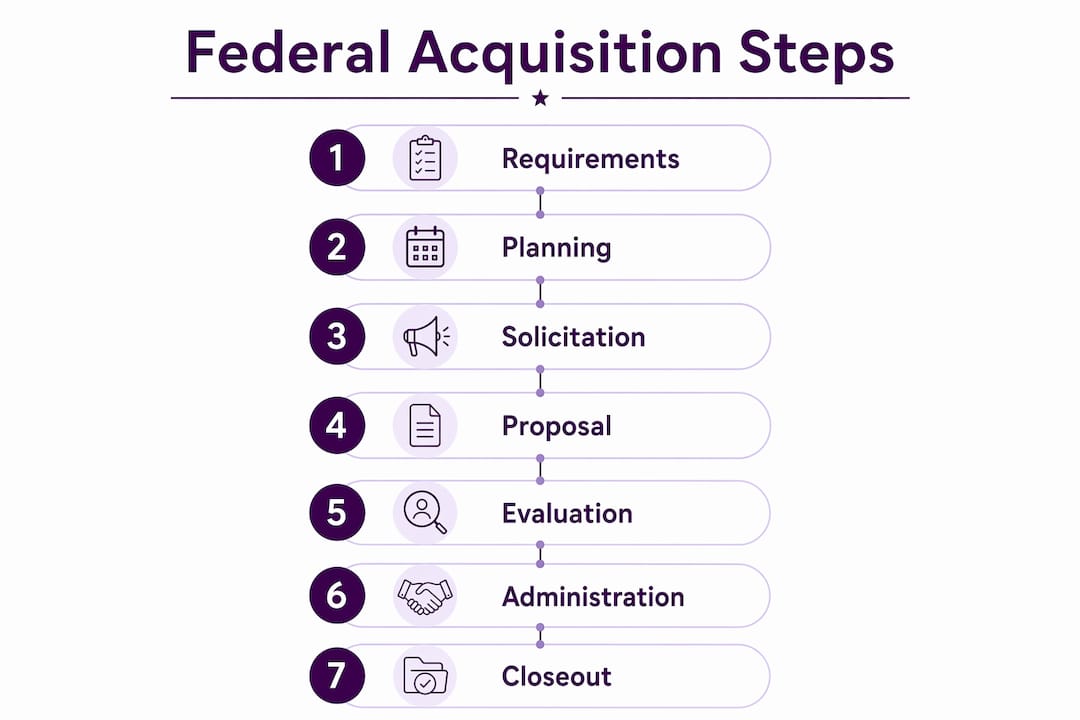
What the federal procurement process actually looks like
Federal procurement follows a defined sequence, and knowing the steps helps you understand where FAR rules apply most heavily.
Step 1: Requirements definition. The agency identifies what it needs and documents requirements. FAR rules on market research and acquisition planning apply here.
Step 2: Acquisition planning. The contracting officer develops a plan covering contract type, competition strategy, and timeline. This is where decisions about simplified acquisition procedures or full competition get made.
Step 3: Solicitation. The agency publishes a Request for Proposal (RFP), Request for Quotation (RFQ), or Invitation for Bid (IFB) on SAM.gov. The solicitation incorporates applicable FAR and supplement clauses.

Step 4: Proposal or bid submission. Contractors respond according to the solicitation’s instructions. FAR Part 15 governs negotiated procurements; Part 14 covers sealed bidding.
Step 5: Evaluation and award. The agency evaluates responses against stated criteria and awards the contract. FAR requires the process to be documented and defensible.
Step 6: Contract administration. Both parties perform their obligations. The contracting officer’s representative (COR) monitors performance. FAR Part 42 covers administration requirements.
Step 7: Closeout. Once performance is complete, the contract is formally closed. Final invoices, audits, and documentation requirements apply. Checking out a federal procurement training guide can help you prepare for each stage.
Key FAR clauses and terms explained simply
Part 52 contains hundreds of clauses, but a handful appear in nearly every federal contract. Here are the ones you will encounter most:
FAR 52.212-4 (Contract Terms and Conditions for Commercial Items): The standard clause for commercial item contracts. It covers inspection, acceptance, payment terms, and disputes. Most small business contracts use this.
FAR 52.222-26 (Equal Opportunity): Prohibits employment discrimination. Required in contracts above $10,000.
FAR 52.204-10 (Reporting Executive Compensation): Requires disclosure of top executive pay for contracts above certain thresholds. Tied to the Federal Funding Accountability and Transparency Act.
FAR 52.232-33 (Payment by Electronic Funds Transfer): The government pays by EFT. Your banking information must be current in SAM.gov or you will not get paid.
FAR 52.215-2 (Audit and Records): Gives the government the right to audit your books on cost-reimbursement contracts. This clause has teeth.
A few terms that come up constantly: Contracting Officer (CO) is the only person with legal authority to bind the government. Contracting Officer’s Representative (COR) monitors performance but cannot change contract terms. Solicitation is the document requesting offers. Award is the signed contract. Knowing these distinctions prevents a lot of confusion on your first contract.
Basic compliance requirements and pitfalls to avoid
Compliance under FAR is not a one-time checkbox. It runs through the life of the contract, and the most common failures are process failures, not intentional violations.

Register and maintain SAM.gov. System for Award Management registration is mandatory before award and must be renewed annually. A lapsed registration can delay payment or disqualify you from award.
Understand your representations and certifications. When you register in SAM.gov, you certify compliance with dozens of FAR requirements. False certifications carry serious legal consequences under the False Claims Act.
Track your subcontracting obligations. If your contract includes a subcontracting plan, you must report progress. Agencies take these commitments seriously.
Document everything. FAR requires contractors to maintain records supporting invoices, cost claims, and performance. “We did the work” is not enough without documentation.
The most avoidable pitfall is assuming that what worked on a commercial contract works on a federal one. Agency-specific supplements like DFARS can significantly alter compliance requirements in ways that catch contractors off guard, often not until an audit surfaces the gap. Read your contract’s clause list before you start performance, not after.
Where to learn more about FAR
The best resources are free and authoritative:
- acquisition.gov: The official home of FAR, DFARS, and all agency supplements. Searchable and updated in real time.
- SAM.gov: Where you register, find solicitations, and manage your entity profile.
- DAU (Defense Acquisition University): Offers free online courses on FAR, contracting basics, and acquisition management. Open to industry, not just government employees.
- GSA’s eBuy and MAS resources: Specific to GSA Schedule holders, covering how to market and respond to task orders.
- Villanova University’s professional studies program: Offers structured courses on federal acquisition for contractors and government personnel.
For practical guidance on getting your first federal contract, Gsascheduleservices publishes resources specifically aimed at small businesses working through the process for the first time. The learning curve is real, but it flattens quickly once you understand the structure.
Key Takeaways
The FAR is the single most important document in federal contracting, and understanding its structure, key clauses, and compliance requirements is the foundation of any successful government contracting program.
| Point | Details |
|---|---|
| FAR’s legal home | Codified in Title 48, Chapter 1 of the CFR, covering all executive agency acquisitions. |
| Supplements matter | DFARS and other agency supplements add requirements on top of FAR; read both for your specific contract. |
| Contract is binding | The signed contract is the legal authority; courts can read FAR clauses in even if omitted. |
| RFO is coming | The Revolutionary FAR Overhaul aims to rewrite FAR in plain language for easier use. |
| SAM.gov is mandatory | Registration must stay current; a lapsed registration can delay payment or disqualify your bid. |
FAQ
What are the Federal Acquisition Regulations?
The Federal Acquisition Regulations (FAR) are the primary set of rules governing how U.S. federal executive agencies purchase goods and services, codified in Title 48, Chapter 1 of the Code of Federal Regulations.
What are the guiding principles of the Federal Acquisition Regulation?
FAR’s guiding principles, outlined in FAR 1.102, focus on satisfying the customer agency, minimizing costs, maintaining business integrity, and fulfilling public policy objectives like competition and small business support.
What are the key DFARS requirements?
DFARS adds DoD-specific requirements on top of FAR, most notably cybersecurity standards under DFARS 252.204-7012 (NIST SP 800-171 compliance), cost accounting standards, and domestic sourcing restrictions for specialty metals.
Does FAR apply to all federal government purchases?
FAR applies to most executive agency acquisitions using appropriated funds, but grants, most subcontracts, and certain other transactions are explicitly excluded from its coverage.
What is the Revolutionary FAR Overhaul?
The Revolutionary FAR Overhaul (RFO) is a government initiative to rewrite FAR in plain language, making it clearer and more accessible for both new and experienced contractors.
Recommended
- Federal Procurement Guidelines Simplified
- Federal Procurement Training Essentials Guide
- What is federal procurement? A small business owner’s guide
- GSA Procurement Guide: Streamline Your Buying