

A capability statement is a one-page, buyer-focused PDF that answers what you do, who you’ve done it for, and how to reach you. Build a single master version covering your core competencies, past performance, and company identifiers, then cut targeted copies for each agency or solicitation you chase. A set of core sections carry the whole document, and the tailoring step is what separates a statement that gets read from one that gets filed and forgotten.
TL;DR:
- Tailor your master capability statement template to match specific agency language and include relevant compliance frameworks or certifications upfront.
- Ensure past performance entries are outcome-focused, measurable, and listed with real dollar values, project scope, and timely results to build credibility.
- Verify all identifiers, including UEI, CAGE code, and NAICS, match SAM.gov records precisely to avoid rejection or disqualification.
- Keep the document to one page with clear headings, concise bullets, and accessible formatting to improve readability and searchability.
- Seek outside review when expanding to multiple SINs or contract vehicles to ensure clarity, differentiation, and alignment with buyer expectations.
Table of Contents
- What Goes Into a Capability Statement Example
- Annotated Examples You Can Adapt
- Turning One Master Template Into Targeted Versions
- Writing Past Performance That Actually Gets Believed
- Formatting Rules That Keep Your Statement From Getting Ignored
- Quick One-Page Template Skeleton
- What a Reviewer Actually Looks For
- Get Your Capability Statement Reviewed Before You Send It
- Where to Find the Official Templates
- Sources
- FAQ
What Goes Into a Capability Statement Example
Federal buyers expect the same six core sections no matter which agency they work for, and skipping one is the fastest way to look like an amateur to a contracting officer who reviews dozens of these a week.
- Header and one-line positioning. Company name, logo, and a single sentence stating what you do and for whom.
- Core competencies. Several bullets written in action-noun language that mirrors your NAICS codes and DSBS profile, not internal jargon.
- Past performance. A few entries with dollar value, timeline, and a measurable outcome for each.
- Differentiators. Verifiable credentials, clearances, certifications, or contract vehicles a competitor can’t casually claim.
- Company data block. Your UEI, CAGE code, primary NAICS, and any SBA socio-economic designations.
- Contact line. A named point of contact with a direct phone number and email, not a generic info@ address.
That data block matters more than most owners assume. A contracting officer verifying your UEI, CAGE, and NAICS codes against SAM.gov will bounce a statement with mismatched identifiers straight to the bottom of the pile, so double-check every field before you send anything out.
Annotated Examples You Can Adapt
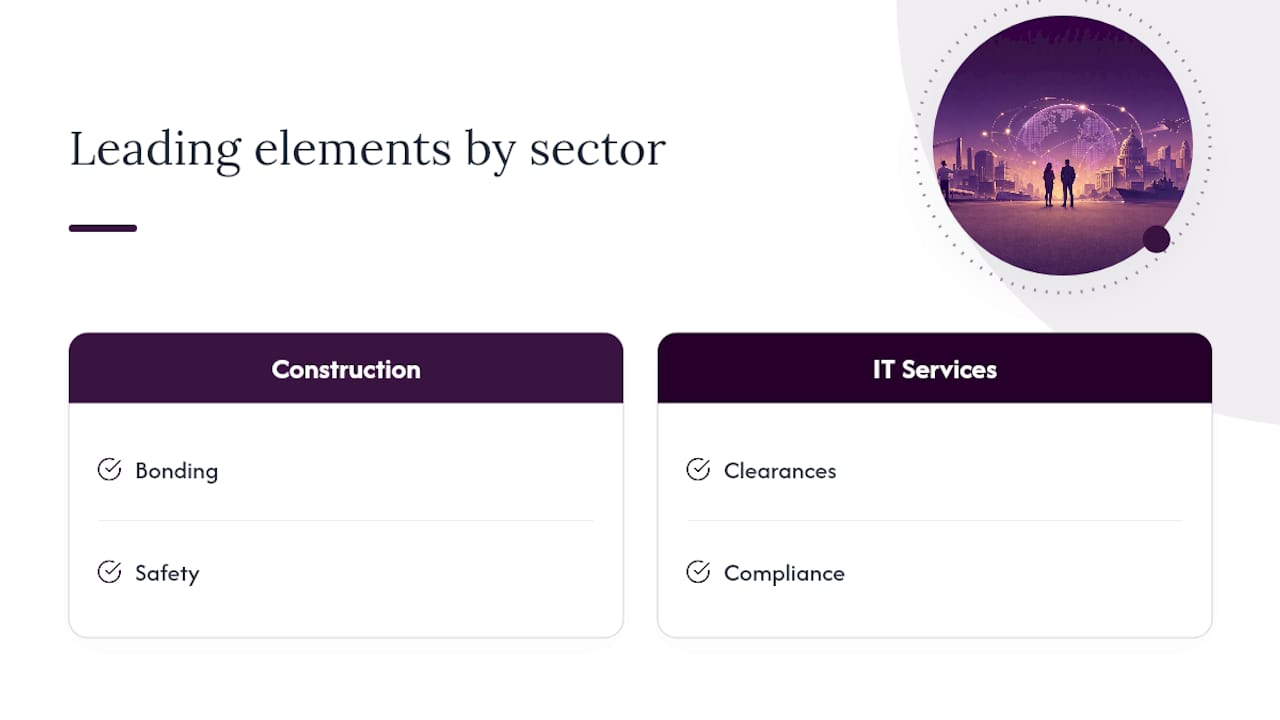
Templates recommended by industry sources vary by sector because construction firms lead with bonding and safety while IT firms lead with clearances and compliance. Which evidence goes first depends entirely on what your buyer cares about most.
1. IT Services Example
An IT capability statement built for a Department of Veterans Affairs modernization contract should put FedRAMP authorization or CMMC Level 2 status directly under the header, not buried in a paragraph. Map each competency bullet to a specific NAICS code (541512, 541519) so an automated search actually surfaces your document.

Adaptation notes: Swap the compliance framework named at the top for whichever one the solicitation cites; list cloud platforms by name only if you hold a current authorization; drop generic phrases like “IT solutions” for exact service names buyers search for.
2. Construction Example
A construction example leads with bonding capacity, EMR (Experience Modification Rate), typical project size range, and an on-time delivery percentage.

Adaptation notes: Update EMR annually since it changes with your insurance renewal; adjust project size ranges to match the specific solicitation’s scope; cite your bonding company by name if it’s a recognized surety.
3. Professional Services Example
Consulting and professional services statements need measurable outcomes tied to a client role, not just a list of skills.
Adaptation notes: Always clarify whether you served as prime or sub; quantify the outcome even if it’s an estimate; name the client type (agency, prime contractor) without violating any nondisclosure terms.
4. Targeted Agency Example
This isn’t a new document, it’s your master template with vocabulary and evidence order swapped to match a specific agency’s language, pulled straight from the solicitation or the agency’s strategic plan.
Pro Tip: Search the solicitation for the exact phrase the agency uses to describe the work (not your own industry term for it), then use that phrase in your top competency bullet. Contracting officers scan for their own language, not yours.
Turning One Master Template Into Targeted Versions
Federal guidance consistently points to the same workflow: keep a master template and produce targeted versions rather than rewriting from scratch every time. Here’s how to make that fast instead of tedious.
- Build the master first. Lock in your identifiers, full competency list, and every past-performance entry you might ever use, even ones you’ll trim for specific versions.
- Pick several competencies suitable for the solicitation or agency mission. Choose the ones that map most directly to the solicitation or agency mission, and cut the rest for this version only.
- Swap past-performance entries. Lead with the project most similar in size, scope, or agency type to the one you’re targeting.
- Update differentiators last. A clearance or vehicle relevant to one buyer may be irrelevant noise to another.
- Check the 10-minute rule. Vocabulary and order swaps take ten minutes; adding a brand-new past-performance entry needs a real review first.
Pull buyer language from the agency’s DSBS profile, the solicitation text itself, or its published strategic documents. Those three sources tell you more about what the buyer wants to hear than any generic template ever will.
Writing Past Performance That Actually Gets Believed
The strongest capability statements list past-performance entries with real metrics attached, not vague claims about being “experienced” or “trusted.”
- Format: client or agency name, scope of work, dollar value, contract period, and outcome, all in one line.
- Strong metric examples: percent cost savings, schedule improvement in days or weeks, SLA adherence rate.
- No federal contracts yet? Use commercial or subcontract work, mapped to the same NAICS code you’re targeting, with the same outcome-focused format.
Guidance from established templates recommends three to five entries and four to six competency bullets, tailored for relevance rather than padded to fill space. A vague line like “successfully managed multiple projects” tells a buyer nothing. “Managed a $1.4M facilities contract for a regional VA hospital, delivered two weeks ahead of schedule” tells them everything they need in one breath, and you can borrow that same structure when picking performance metrics for your own past work.
Formatting Rules That Keep Your Statement From Getting Ignored
Default to one page. Two pages only earn their place when the technical detail genuinely can’t compress further, and even then, most reviewers still expect page one to stand alone.
- Export as a text-searchable PDF, not a scanned image or flattened graphic.
- Keep the file under 1 MB and name it with a version convention like
Company_Capability_Statement_2026.pdf. - Use 11 to 12 point fonts with genuine contrast, and add basic accessibility tagging where your software allows it.
- Attach it to a two-to-three sentence email that names the specific opportunity or point of contact, never a blank attachment with no context.
That searchable PDF requirement isn’t a formatting preference, it’s functional: a searchable file preserves keyword findability so a contracting officer can actually search inside it once it’s logged into an acquisition file. A locked image file just disappears from that search entirely. Before you send anything, run it against this list of common reasons GSA submissions get rejected so a formatting slip doesn’t sink a document you spent real time building.
Quick One-Page Template Skeleton
Paste this skeleton into Word or Google Docs and fill in each prompt.
- Header: logo, legal company name, one-line positioning statement.
- Identifiers block: UEI, CAGE code, primary NAICS, active certifications.
- Competencies block: four short bullets in the buyer’s own language.
- Past performance block: three lines, each with client, dollar value, outcome.
- Bottom section: differentiators, contract vehicles, contact line.
| Field | What Goes Here |
|---|---|
| Positioning line | One sentence: what you do, for whom |
| Competencies | 4 bullets, buyer language |
| Past performance | 3 lines: client, $ value, outcome |
| Contact | Name, direct phone, direct email |
What a Reviewer Actually Looks For
Recommendations point to an outside review because an objective reader spots unclear positioning or cluttered layout faster than the person who wrote it ever will. A consultant working outreach doesn’t read your statement once, they use it as the anchor for a whole sequence of calls and emails, pulling the sharpest differentiator into the subject line and the strongest past-performance line into the opening paragraph.
You probably need outside help once your GSA Schedule spans several SINs, your contract vehicles get complicated enough that a generalist can’t summarize them in one sentence, or you’ve rewritten your differentiators three times without landing on one that actually distinguishes you. Those are the readiness signals worth taking seriously, not a vague sense that “it could be better.”
— Josh
Get Your Capability Statement Reviewed Before You Send It
Gsascheduleservices reviews and rebuilds capability statements as part of its GSA Schedule application and compliance support, so you’re not guessing whether your one-pager actually matches what buyers search for. A typical engagement covers a full edit of your master document, targeted versions for the agencies or solicitations you’re pursuing, and outreach templates built around the differentiators that actually hold up under a contracting officer’s scrutiny. The result is a document that matches live SAM.gov data, mirrors solicitation language back to the buyer, and gets you into more discovery calls instead of more silence. If your last few attempts went nowhere, start with a discovery call and get a second set of eyes on it before your next submission.
Where to Find the Official Templates
- HHS capability statement guidance and sample
- SBA 8(a) capability statement brand guide
- SAM.gov guidance for identifiers and NAICS verification
Sources
- Hhs
- 8(a) Capabilities Statement | U.S. Small Business Administration
- Federal capability statement template | BesaGov
FAQ
What is a capability statement example?
It’s a completed one-page document showing how a real business fills the six core sections, header, competencies, past performance, differentiators, company data, and contact, using its own NAICS codes and actual project outcomes instead of placeholder text.
What does a good capability statement look like for an individual or small firm?
A strong solo or small-firm version skips generic buzzwords and leads with one sharp positioning line, three to five past-performance entries with real dollar values, and a company data block with a verified UEI and CAGE code.
Is there a free template for a capability statement?
Yes. The SBA offers a free 8(a) capability statement brand guide and template, and HHS.gov publishes its own downloadable sample alongside detailed writing guidance.
Can you give an example of a core competency for a capability statement?
A well-written competency reads as an action phrase tied to buyer language, such as “Network Infrastructure Design and Cybersecurity Compliance” rather than a vague label like “IT services,” and it should map to one of your listed NAICS codes.
How many past-performance examples should I include?
Most federal guidance recommends three to five entries, each with a client name, dollar value, timeline, and measurable outcome, trimmed to whatever is most relevant to the opportunity you’re targeting.
Recommended
- Government Contract Opportunities 2026: SME Guide
- Best Fedmarket.com Alternatives for Government Contractors 2026
- (Infographic) 25 Reasons GSA Contracts are Rejected
- SAM.gov Portal Guide – Your Gov Contract Hub