
Agency procurement forecasts are early-warning planning documents that federal agencies publish to tell vendors what they intend to buy before a solicitation ever posts. They carry no guarantee the purchase will happen, but they hand you the one thing a live RFP never does: lead time. The core sources every U.S. procurement team should track are the GSA Forecast of Contracting Opportunities (FCO), the Acquisition, the DHS Acquisition Planning Forecast System (APFS), and SAM.gov, which is where the resulting solicitation eventually lands.
The immediate action is simple:
- Set filters for your NAICS codes and expected award date on each forecast tool.
- Flag any entry with an estimated value and timeline that matches your capacity.
- Contact the listed point of contact early, before the formal solicitation appears.
Key Takeaways
Agency procurement forecasts work best when treated as validated leads, not guaranteed opportunities, and paired with award-history research and early POC outreach.
| Point | Details |
|---|---|
| Forecasts are non-binding | Treat every entry as a planning signal; agencies can revise or cancel forecasted purchases at any time. |
| Screen by NAICS first | Verify exact NAICS fit before dollar value or title, since forecast titles are often generic. |
| Validate with award history | Cross-check entries against USAspending and SAM.gov to spot incumbents and recompetes early. |
| Monitor live, not static | Re-pull forecast filters weekly since entries on APFS, FCO, and agency portals change frequently. |
| Get readiness support | Gsascheduleservices helps firms prepare compliance documents and pricing so forecast leads convert faster. |
Table of Contents
- What Agency Procurement Forecasts Actually Tell You
- Where to Find Agency Procurement Forecasts
- How Do You Turn a Forecast Entry Into a Pursued Lead?
- How to Score and Prioritize Forecast Leads
- Build a Capture Checklist Before the RFP Posts
- Comparing Forecasts With Other Market Intelligence Tools
- Legal and Compliance Considerations for Using Forecasts
- Real-World Examples of Forecasts Driving Capture Wins
- How Josh Uses Forecasts to Accelerate Capture
- Let GSAScheduleServices Turn Forecasts Into Contract Wins
- Sources
- FAQ
What Agency Procurement Forecasts Actually Tell You
A forecast record is not a contract notice. It’s a snapshot of an agency’s acquisition plan, and treating it as anything more than that is the fastest way to waste a business development quarter chasing a purchase that never materializes. Federal procurement forecasts are planning documents for information purposes only, and agencies routinely revise or cancel entries as budgets shift or requirements change.
That non-binding status doesn’t make forecasts less valuable. It changes how you should use them. Here’s what to screen first in any forecast record:
- NAICS code — the title of a forecast entry is often generic or reused from a prior award; the NAICS code tells you whether it genuinely fits your registered capabilities in SAM.
- Estimated value and award date — these set your urgency. An entry with a high estimated value and an award date six months out deserves a different response than a smaller entry due soon.
- Acquisition strategy and set-aside status — this tells you whether the work is reserved for small business, 8(a), HUBZone, or SDVOSB firms, or open to full and open competition, and which contract vehicle the agency plans to use.
- Place of performance and point of contact — the POC field is your entry point for early questions; place of performance affects teaming and travel cost assumptions.
- Award history references — many forecast tools link back to the incumbent or prior award, which tells you whether you’re pursuing new work or a recompete.
Where to Find Agency Procurement Forecasts
Start at the governmentwide level and narrow down. The Acquisition links out to individual agency forecast pages, making it the fastest way to see which agencies publish forecasts at all before you go hunting agency by agency.
From there:
- GSA’s Forecast of Contracting Opportunities (FCO) is a nationwide dashboard with standardized fields, NAICS, estimated award date, acquisition strategy, set-aside status, and POC, and you don’t need to register to search it.
- Acquisition Gateway hosts a related forecast tool that connects vendors to standardized forecast data across agencies, useful when you’re tracking multiple GSA-adjacent buying offices at once.
- DHS APFS covers anticipated DHS contract actions above the simplified acquisition threshold, and it specifically focuses on actions over $350,000, so smaller DHS buys won’t show up there.
- Agency-specific portals (VA, DOT, DoD components) often carry richer filters than the governmentwide tools. If your pipeline concentrates in one agency, monitor its own forecast page directly rather than relying solely on the hub.
Every one of these tools gets revised. A forecast you pulled last month may already be stale.
How Do You Turn a Forecast Entry Into a Pursued Lead?
Finding a forecast entry is the easy part. Converting it into a live pursuit takes a repeatable process, and the firms that win consistently are the ones who run this same sequence every time rather than reacting ad hoc.
- Filter and monitor. Set standing searches by NAICS code, estimated award date, place of performance, and set-aside flag across FCO, APFS, and any agency-specific tool relevant to your pipeline.
- Validate with award history. Cross-check the entry against USAspending and SAM.gov to see who held the incumbent contract, at what value, and for how long. This tells you whether you’re facing an entrenched incumbent or a genuinely open recompete.
- Score the lead. Rank it on fit, dollar value, timing against your bandwidth, and competitive risk. Not every forecast entry deserves capture resources.
- Engage early. Send the listed POC a short capabilities statement, loop in the agency’s small-business specialist if one is named, and ask specific questions about anticipated evaluation criteria or vehicle type rather than generic “please add us to your list” outreach.
- Watch for downstream signals. Sources-sought notices, RFIs, industry days, and draft RFPs typically follow a forecast entry by weeks or months. Each one is a chance to refine your capture position before the real deadline hits.
Pro Tip: Build one standing calendar reminder to re-pull your forecast filters every Monday. Practitioner guidance consistently points out that forecast entries change often enough that a snapshot from a month ago can already be misleading.
The strongest firms treat forecasts as leads to be validated, not opportunities to be assumed. NAICS filtering narrows the list; award history tells you if it’s worth the effort.
How to Score and Prioritize Forecast Leads
Not every matching NAICS code deserves a place in your pipeline. A working scoring framework keeps your team from spreading capture hours across ten mediocre leads instead of three strong ones.
Start with the basics: is your SAM registration current and does your NAICS alignment actually match the entry, not just the agency’s general subject area? Then layer in the set-aside signal. An entry marked 8(a) or HUBZone sorts differently than one marked full and open, and the VA’s forecast tool, for example, lets you filter directly by socioeconomic category and dollar range, which is worth mimicking even on tools that lack that filter.
Contract vehicle matters just as much as dollar value. An order under an existing GSA schedule moves faster and rewards firms already on that schedule, while an IDIQ recompete often means a longer proposal cycle against a smaller pool of pre-qualified bidders.
Score each lead on four axes:
- Fit — does the requirement match your core capability, not an adjacent one you’d have to stretch for?
- Value — is the estimated dollar range worth the capture investment?
- Timing — does the award date align with your team’s current bandwidth?
- Risk — is there a strong incumbent, and do you have a realistic path to displace or team with them?
Build a Capture Checklist Before the RFP Posts
The gap between agencies that forecast well and vendors that capitalize on it comes down to preparation. By the time a solicitation posts, the firms with the best shot already did their homework weeks earlier.
Keep a capture sheet per lead that tracks incumbent name, contracting POC, NAICS code, estimated value, and expected timing in one place. Pair it with:
- A tailored one-page capability statement matched to the specific requirement, not a generic company overview.
- Past-performance highlights relevant to the exact NAICS and agency, ideally with a named reference.
- A preliminary pricing posture appropriate to the anticipated vehicle, whether that’s a GSA schedule task order or an open-market IDIQ.
- Compliance readiness: current SAM registration, up-to-date representations and certifications, and proof of required insurance.
Pro Tip: Assign one owner per lead and update your capture sheet weekly rather than monthly. Forecast entries shift often enough that a stale sheet gives your team false confidence about timing.
Comparing Forecasts With Other Market Intelligence Tools
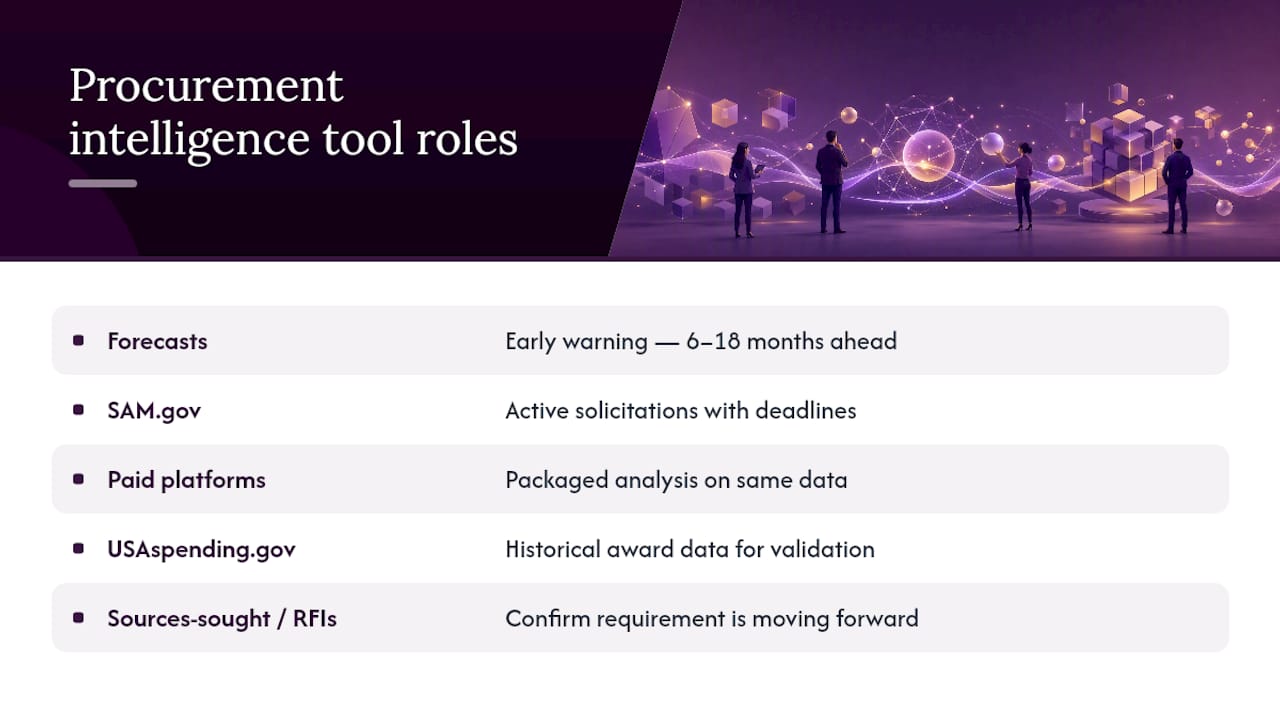
Forecasts sit in a different category than most procurement market intelligence tools, and confusing the two leads teams to misallocate research time. SAM.gov tells you what’s actively open for bid right now, with a hard deadline and a defined evaluation process. Forecasts tell you what’s coming, often six to eighteen months before that.
Paid market intelligence platforms and industry newsletters add analysis, incumbent tracking, and spending trend charts layered on top of raw government data, which can be useful for long-range strategic planning. But they’re frequently built on the same underlying forecast and award data available for free through APFS, GSA FCO, and Acquisition.gov, just packaged with dashboards and alerts.
USAspending.gov fills a different gap entirely: it shows historical award data, not future plans, which is exactly what you need to validate a forecast entry rather than discover one. Sources-sought notices and RFIs, meanwhile, sit between forecasts and solicitations chronologically. They confirm an agency is actively moving toward a buy that a forecast only hinted at.
None of these tools replaces the others. A forecast entry without award-history validation is a guess. Award history without a forecast gives you no forward visibility at all. The strongest procurement intelligence process layers forecasts for early warning, award data for validation, and sources-sought or RFI activity for confirmation that a requirement is actually moving toward the street.
Legal and Compliance Considerations for Using Forecasts
Forecasts exist because of a statutory push for transparency, not as a courtesy. The visibility requirement traces back to legislation aimed at giving small businesses earlier notice of upcoming federal work, which is why agencies like DHS are required to publish forecast data through systems like APFS rather than leaving it to discretion.
That legal backing comes with a limit worth restating clearly: a forecast entry does not commit the government to buy anything. Building a business case, a hiring plan, or a subcontracting commitment around a forecast entry that later gets pulled or delayed is a real risk, and it happens more often than most first-time bidders expect.
Compliance readiness matters just as much as legal awareness. Before you invest capture hours in a forecasted lead, confirm your SAM.gov registration is active and your representations and certifications are current. If the entry carries a set-aside designation, make sure your firm’s certification (8(a), HUBZone, SDVOSB, or small business) is verified and not pending renewal. An expired certification discovered after you’ve built a proposal around a set-aside opportunity is an entirely avoidable failure.
Data currency is its own compliance issue. Downloaded PDFs or cached forecast exports go stale fast, and acting on an outdated dollar range or award date can misalign your pricing or staffing plan before you’ve even seen the real solicitation.
Real-World Examples of Forecasts Driving Capture Wins
The pattern behind successful forecast-driven wins looks remarkably consistent across agencies and business sizes. A small IT services firm tracking the VA’s forecast tool, for instance, can filter directly by SDVOSB status and dollar range, giving it a shortlist of entries worth pursuing months before VA posts anything on SAM.gov. That lead time is the entire advantage: it’s the difference between drafting a capabilities statement calmly in March and scrambling to assemble one in the same week a 30-day RFP drops.

Firms that treat DHS’s APFS listings seriously get a similar edge. Because APFS only covers anticipated contract actions above $350,000, every entry represents a meaningful pursuit, not a small purchase order not worth the capture investment. A vendor that spots a matching NAICS entry there, pulls the incumbent’s award history, and reaches out to the listed contracting office before the formal RFP appears typically enters the eventual competition with a warmer relationship and a sharper proposal than a firm responding cold.
The common thread isn’t luck or size. It’s discipline: filtering by NAICS, validating with award history, and making contact early enough that the agency already recognizes your name when the solicitation finally posts.
How Josh Uses Forecasts to Accelerate Capture
Our team runs a standing weekly sweep of GSA FCO, APFS, and Acquisition.gov filtered by client NAICS codes, then cross-checks any promising entry against award history before recommending it to a client’s pipeline. Early POC outreach and a pre-built capabilities statement routinely cut proposal turnaround time once the real RFP lands, because the groundwork is already done. Forecasts reward the teams willing to do the unglamorous work months in advance.
— Josh
Let GSAScheduleServices Turn Forecasts Into Contract Wins
Spotting a promising forecast entry is one thing. Having the compliance documentation, pricing posture, and GSA schedule already in place to respond fast is another. Gsascheduleservices exists for that gap: we handle the readiness assessment, full documentation prep, NAICS and SIN code mapping, pricing support, and negotiation work that most small business teams don’t have the bandwidth to run in parallel with actual client delivery.
If your team has been bookmarking forecast entries but hasn’t converted one into a signed contract yet, the missing piece is usually readiness, not opportunity. We help small and mid-sized businesses get GSA schedule ready and stay compliant so early outreach on a forecast lead turns into an actual submitted, competitive response. Start with a discovery consultation to see where your readiness gaps sit before the next forecast entry turns into an RFP with a 30-day clock.
Sources
- Home | Acquisition Planning Forecast System
- DOJ forecast of contracting opportunities
- Find opportunities | GSA
- Acquisition
- How to use agency procurement forecasts to find contracts before the RFP | GovUnpacked
FAQ
What Are Agency Procurement Forecasts?
They’re planning documents federal agencies publish to show anticipated future purchases, including estimated value, timing, and NAICS code, but they don’t guarantee the government will make the purchase.
Is SAM.gov the Same as a Procurement Forecast Tool?
No. SAM.gov posts live, active solicitations with deadlines, while forecasts show anticipated purchases months before a solicitation appears there.
How Far in Advance Do Forecasts Typically Post?
Forecast lead time varies by agency, but entries commonly appear months ahead of the actual solicitation, giving vendors time to validate the lead and prepare capture materials.
Does the DHS Forecast Cover All DHS Purchases?
No. The DHS APFS specifically covers anticipated contract actions above the $350,000 simplified acquisition threshold, so smaller purchases won’t appear there.
Can Gsascheduleservices Help Me Act on a Forecast Lead?
Yes. Gsascheduleservices helps small and mid-sized businesses get GSA schedule ready, prepare documentation, and build pricing posture so a promising forecast entry can turn into a submitted response.
Recommended
- 2023 Federal Government Procurement Forecast Outlook
- 2023 Federal Government Procurement Forecast
- Federal Government Procurement Forecast 2023 Guide
- Discover Your Comprehensive List of Government Contracts