

GSA contract administration comes down to five recurring duties: accepting Mass Modifications on time, filing quarterly sales reports and remitting the Industrial Funding Fee, processing eMod requests correctly, keeping your GSA Advantage!/SIP price list current and preparing for Industrial Operations Analyst (IOA) reviews. Miss any one of them and GSA can freeze your pricelist, block new modifications, or flag you for a Contractor Assessment Report finding. Your Procurement Contracting Officer, Administrative Contracting Officer, and IOA are the three people to know by name, and the two items that need attention first are outstanding Mass Mods and the next quarterly sales report deadline.
TL;DR:
- Accept all Mass Modifications promptly to prevent approval blocks or price list freezes and ensure ongoing modification eligibility.
- File quarterly sales reports and remit the Industrial Funding Fee on time, even with zero sales, to avoid suspension of your GSA Advantage! listing.
- Keep your price list current and compliant, updating within 30 days of approved catalog changes or recertify SIP uploads biennially to maintain contract validity.
- Build an organized contract file and shared calendar to track deadlines, revisions, and correspondence, reducing errors caused by overlooked due dates.
- Maintain direct communication with your Contracting Officer and Administrative Contracting Officer, and document all interactions for efficient dispute resolution.
Table of Contents
- Top Ongoing GSA Contract Management Responsibilities
- Your Monthly, Quarterly, and Annual GSA Compliance Checklist
- How to Handle Mass Modifications Without Getting Stuck
- Sales Reporting, IFF Payments, and Pricing Records
- Getting Ready for IOA Visits and Contractor Assessments
- Tools and Official Resources Worth Bookmarking
- What Does a Contracting Officer’s Representative Actually Do?
- Communicating With GSA Contracting Officials the Right Way
- Resolving Contract Administration Disputes and Problems
- Deadlines That Keep Your Contract in Good Standing
- What to Expect From a GSA Audit or Review
- The Gap Between Knowing the Rules and Actually Following Them
- How Gsascheduleservices Handles GSA Contract Administration for You
- Sources
- FAQ
Top Ongoing GSA Contract Management Responsibilities
Running a Multiple Award Schedule (MAS) contract is less like signing a one-time deal and more like maintaining a piece of equipment. Skip the maintenance and it breaks down, usually at the worst possible moment, like right before a big order comes in.
Here’s what actually needs your attention on a recurring basis:
- Mass Mod acceptance. GSA issues Mass Modifications to update terms across every contract on a schedule. Leaving one unsigned doesn’t just sit there quietly. It gets bundled into the next Mass Mod and blocks approval of other modification requests, you might need, like adding a new item or updating pricing.
- Quarterly sales reports and IFF remittance. Every quarter, you report sales and pay the Industrial Funding Fee, even in a quarter with zero sales.
- Price list and terms and conditions upkeep. Your GSA Advantage! listing has to match your current, approved terms at all times.
- eMod submissions. Administrative and substantive modifications both route through the eMod system, and each type has its own document requirements.
- Subcontracting plan reporting. If your contract requires one, reports are due on a fixed schedule, not whenever you get around to it.
- Authorized negotiator and access management. Your FAS ID credentials and multifactor authentication setup need to stay current, especially if staff turnover hits the person who used to handle this.
None of these are complicated on their own. The trouble starts when three or four of them pile up at once because nobody owned the calendar.
Your Monthly, Quarterly, and Annual GSA Compliance Checklist
Treat contract administration like payroll: predictable, recurring, and bad news when it’s late. Here’s a workable rhythm.
Monthly:
- Check the Mass Mod portal for anything pending your signature.
- Review order inquiries and confirm response windows are being met, particularly the requirement to respond to orders from agencies outside the executive branch within 5 working days of receipt.
- Scan your GSA Advantage! listing for pricing or item description mismatches.
Quarterly (due January 30, April 30, July 30, and October 30):
4. Pull your sales data and file through the FAS Sales Reporting Portal at 72a.gsa.gov, remitting the IFF with the same submission.
5. If you had zero sales, report zeros. Silence is treated as noncompliance, not as “nothing to report.”
6. Reconcile whichever accounting method you use (cash or accrual) against your internal books so numbers match year over year.
As needed:
7. When a modification changes your catalog contents, upload the revised price list through SIP within 30 days of approval.
8. Gather supporting documents (cost proposals, technical narratives, signed forms) before starting any substantive eMod.
Annual or biennial:
9. Recertify or refresh your SIP upload at least every two years to avoid catalog removal.
10. Confirm subcontracting plan reports, if applicable, are filed on schedule.
Pro Tip: Build one shared calendar with the four IFF due dates and a recurring monthly reminder to check the Mass Mod portal. Most compliance failures aren’t complicated mistakes. They’re a date nobody wrote down.
Keep a single contract file (award document, every SF30 modification, price lists, quarterly sales exports, eMod confirmations) so you’re never scrambling to reconstruct history when GSA asks a question.
How to Handle Mass Modifications Without Getting Stuck
A Mass Mod is GSA’s way of pushing a policy, clause, or pricing update across an entire schedule at once, and it lands in your Mass Mod portal account with a PIN you use to review and accept it. This isn’t optional paperwork you can let sit.
- Know the difference between mod types. Administrative mods (adding a socioeconomic certification, updating a point of contact) usually need minimal attachments. Substantive mods (adding SINs, changing pricing structure) require supporting documentation and often IOA review.
- Check status directly. The Mass Mod portal shows exactly what’s pending your signature and what’s already been accepted.
If you’ve inherited a contract from a previous administrator, checking Mass Mod status is the first thing to verify. Our modification guide walks through the eMod submission process in more detail.
Sales Reporting, IFF Payments, and Pricing Records
Every MAS holder reports sales and remits the Industrial Funding Fee through the Sales Reporting Portal at 72a.gsa.gov, on a fixed quarterly cycle: January 30, April 30, July 30, and October 30.
Pick one accounting method (cash or accrual) and stick with it. Switching methods between quarters creates reconciliation headaches and looks inconsistent during a review. If you had no sales in a quarter, you still file, entering zeros rather than skipping the report.
The consequences for skipping a deadline are concrete: late or missing reports can lead to a frozen or removed price list on GSA Advantage!, and unresolved issues can result in blocked orders until you’re back in compliance. Pricing itself stays tied to your contract’s Economic Price Adjustment clause and FAR 552.243-72, so any rate increase has to route through a proper modification, not a quiet catalog edit.
Getting Ready for IOA Visits and Contractor Assessments
Your Industrial Operations Analyst runs Contractor Assistance Visits at least twice over a five-year contract cycle, and the findings become your Contractor Assessment Report. Think of the IOA less as an auditor hunting for violations and more as a case reviewer checking whether your paperwork matches your practice.
They typically review:
- Sales reporting accuracy and timeliness
- Whether you’re selling within your approved scope and SINs
- Pricing compliance, including Trade Agreements Act (TAA) and Basis of Award (BOA) tracking
- General administrative recordkeeping
Pro Tip: Build your contract file before the IOA ever calls. Award document, every modification, current price lists, four quarters of sales exports, and copies of correspondence. Contractors who show up organized routinely close out their CAR faster than those digging through email threads mid-visit.
Most CAR findings trace back to gaps in these same four areas: incomplete sales history, scope creep, stale pricing, or missing records. When a finding does show up, work the remediation path with your Administrative Contracting Officer rather than treating it as a dead end. It rarely is.
Tools and Official Resources Worth Bookmarking
Skip the guesswork and go straight to the source. Bookmark the Vendor Support Center, eMod, the Mass Mod portal, SIP, GSA Advantage!, and the Sales Reporting Portal.
Keep the MAS Modification Guide and MAS CAR Guide handy as reference documents, along with the VSC’s “Steps to Success” guide. Internally, a simple contract file template and a shared calendar for reminders go a long way. Our checklist for maintaining a GSA Schedule covers the internal side in more detail.
What Does a Contracting Officer’s Representative Actually Do?
A Contracting Officer’s Representative (COR) is the government’s eyes and ears on contract performance, appointed by the Contracting Officer to monitor whether a contractor is delivering what was promised. On a GSA Schedule contract, you won’t always have a COR the way a traditional task-order contract does, but if you’re performing work under a specific order, a COR may be assigned to that order to track deliverables, inspect quality, and confirm invoices match completed work.
The COR isn’t authorized to change your contract terms, direct new scope, or approve cost increases. Only the Contracting Officer holds that authority. What a COR can do is document performance, flag problems early, and recommend action to the Contracting Officer.

For a contractor, this means the COR is often your most frequent point of contact on active task orders, even though they aren’t the person who signs modifications. Confusing the two roles is a common and avoidable mistake: if a COR asks for something outside their authority, like a price change, it needs to go to the Contracting Officer to be valid.
Understanding this distinction matters practically. If a COR verbally approves extra work or a change in deliverables, that approval means nothing contractually unless it’s ratified by the Contracting Officer. Contractors who proceed on a COR’s informal go-ahead sometimes end up doing unpaid work. Get anything that affects scope, price, or terms in writing from the Contracting Officer, not just acknowledged by the COR.
Communicating With GSA Contracting Officials the Right Way
Most friction with GSA officials comes down to poor timing or vague requests, not disagreements over policy. A few habits fix most of it.
Lead with specifics, not generalities. Instead of “I have a question about my contract,” write “I need to confirm the required attachments for a SIN addition modification on contract number [X].” Contracting officials handle dozens of contracts. A specific, well-framed question gets a faster, more useful answer than an open-ended one.
Use the right channel for the right issue. The VSC help desk handles system access problems, portal errors, and login issues, not questions about contract interpretation. Route substantive compliance or modification questions to your PCO or ACO directly.
Put requests in writing. Phone calls are fine for quick clarifications, but anything involving a deadline, a modification, or a compliance question should have a written trail, email at minimum. If a CO gives verbal guidance that matters to your contract, follow up with a confirming email summarizing what was discussed.
Respect response times, but follow up. Contracting officials manage large portfolios. If you haven’t heard back on something time-sensitive within a reasonable window, a polite follow-up is appropriate. Silence usually means the request got buried, not that it was rejected.
Know who to escalate to. If your PCO is unresponsive on something urgent, your ACO is often the appropriate next contact, since administrative matters frequently fall under their authority rather than the PCO’s.
Resolving Contract Administration Disputes and Problems
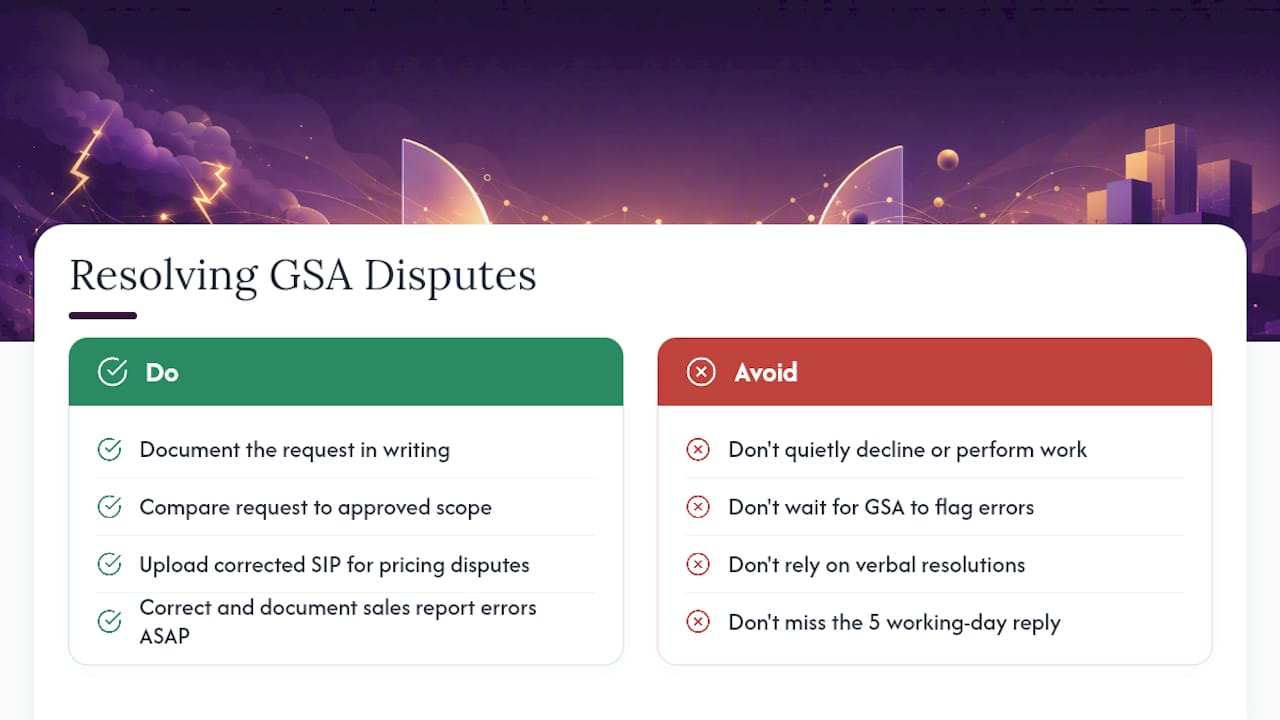
Most GSA contract disputes start small: a delayed sales report, a pricelist that doesn’t match an approved modification, an order a contractor believes falls outside contract scope. Left alone, small issues compound into CAR findings or blocked modifications.
Scope disagreements are among the most common. If an ordering agency requests something you believe falls outside your approved SINs, the fix isn’t to quietly decline or quietly perform it anyway. Document the request, compare it against your approved scope in writing, and communicate the mismatch to the ordering activity and your Contracting Officer. Orders outside the executive branch that you decide to reject must be communicated back to the ordering activity within five working days.
Pricing disputes often trace back to a pricelist that fell out of sync with an approved Economic Price Adjustment modification. The remedy is almost always a corrected SIP upload, not a negotiation.
Late or inaccurate sales reports create their own category of dispute, usually surfacing during an IOA review rather than in real time. If you catch an error after filing, correct it as soon as possible and document the correction rather than waiting for GSA to flag it first.
For anything that escalates beyond a quick email exchange, put your position in writing, reference the specific contract clause or guidance document involved, and request a written response. Verbal resolutions are hard to enforce later. When in doubt, your ACO is generally the right first stop for administrative disputes, while your PCO handles matters tied to contract terms and modifications.
Deadlines That Keep Your Contract in Good Standing
Missing a single deadline rarely sinks a GSA contract. Missing the same one twice, or missing several at once, is what triggers real consequences.
The fixed points on the calendar are the quarterly sales report and IFF remittance dates: January 30, April 30, July 30, and October 30. These don’t move, and they apply whether or not you had sales that quarter.
Beyond those four dates, your deadlines are event-driven rather than calendar-driven. A price list update tied to an approved modification needs to be uploaded through SIP within 30 days of approval. Orders from agencies outside the executive branch that you intend to decline need a response within five working days. Subcontracting plan reports, where required, follow whatever schedule is written into your specific plan, so that date lives in your contract file, not in a universal GSA calendar.
The two-year mark matters too. If your SIP catalog upload goes stale without recertification, GSA can freeze or remove your pricelist entirely, which effectively takes you off GSA Advantage! until it’s fixed.
None of these deadlines are hidden. They’re published in the modification guide, the CAR guide, and the VSC’s own reference materials. The businesses that miss them aren’t missing information. They’re missing a system for tracking it, which is really the whole problem contract administration exists to solve.
What to Expect From a GSA Audit or Review
An IOA-led Contractor Assistance Visit is the most common form of review you’ll face, happening at least twice across a five-year MAS contract cycle. It isn’t an adversarial audit in the way a tax audit might feel. It’s closer to a structured check-in against your own paperwork.
During a CAV, expect the IOA to review sales reporting accuracy, confirm you’re operating within your approved SINs and scope, check pricing compliance including TAA and Basis of Award tracking, and look at general administrative recordkeeping like modification history and price list currency.
Preparation is straightforward if you’ve kept a running contract file. Have your award document, every signed modification, current and past price lists, sales report exports for at least the last several quarters, and any relevant correspondence with your Contracting Officer organized and accessible before the visit. Contractors who scramble during a CAV are usually the ones who never built this file in the first place, not the ones with genuinely complicated compliance problems.
If the review surfaces a finding, it becomes part of your CAR, and remediation typically runs through your ACO. Most findings, whether they involve a stale pricelist, a sales reporting gap, or a scope question, have a defined correction path. Treat the finding as a to-do item with a deadline, not as a crisis, and close it out in writing so there’s a paper trail showing the issue was resolved.
The Gap Between Knowing the Rules and Actually Following Them
Most contractors who get in trouble with GSA didn’t skip reading the modification guide. They read it, understood it, and then let the routine slip three months later when someone got busy. That’s the real failure mode in contract administration: not ignorance, but drift.
The fix isn’t more knowledge. It’s a system that doesn’t depend on someone remembering. A shared calendar with the four IFF dates. One person clearly responsible for checking the Mass Mod portal. A contract file that exists before an IOA ever asks for it.
If you bring in outside help for any of this, treat that help as an extension of your team, not a replacement for oversight. Keep your own access to the Vendor Support Center, eMod, and Mass Mod portals. You’re the one who stays legally responsible for the contract, no matter who’s handling the paperwork day to day.
— Josh
How Gsascheduleservices Handles GSA Contract Administration for You
Reading a modification guide is one thing. Tracking Mass Mod deadlines, quarterly IFF filings, and SIP uploads across a busy operating calendar is another, and it’s the part most small and medium businesses underestimate until something gets missed.
Specialized providers handle the recurring mechanics of GSA contract management, including readiness assessments, eMod handling, price list and SIP maintenance, and sales-report setup, so quarterly filings and Mass Mod acceptance stop competing with the rest of your workload. If you’re already stretched thin running the business itself, managed support closes the gap that in-house effort tends to leave open, particularly around deadline tracking and documentation.
If your team is spending more time chasing compliance paperwork than closing federal sales, book a discovery call to see what ongoing support could look like for your contract.
Sources
FAQ
Where can I find GSA contracts to bid on?
Federal buyers search for and place orders against GSA Schedule holders through GSA Advantage! and the buy platform, both accessible once you hold an awarded MAS contract.
Which companies provide GSA contract support?
Firms that help small and medium businesses with GSA Schedule applications and ongoing administration include specialized consulting providers like Gsascheduleservices, which focuses on readiness assessments, documentation, and managed contract maintenance.
Who is the largest federal contractor?
The federal government’s largest contractors are typically major defense and aerospace firms, but the vast majority of individual MAS Schedule holders are small and medium businesses using their contracts to access smaller, recurring government purchases.
What are GSA government contracts?
GSA government contracts, formally called Multiple Award Schedule contracts, are pre-negotiated agreements that let any federal agency purchase a contractor’s goods or services at agreed pricing without running a separate competitive bid each time.
How often do I need to report sales on my GSA contract?
Sales reports and Industrial Funding Fee payments are due quarterly, on January 30, April 30, July 30, and October 30, even in quarters with no sales.
Recommended
- Busting the Myths Around GSA Contracts for Small Business
- Government procurement strategies that help SMBs win GSA bids
- How Small Businesses Can Get Started With A GSA Contract? 5 Steps!
- How to Grow a Small Business Through a GSA Schedule