

The authoritative text for every clause on your GSA Multiple Award Schedule contract lives in two places: GSA eLibrary’s Contracts Online tool, which shows the exact clauses on your award, and GSAM Part 552, which holds the full legal text. Once you’ve confirmed which clauses apply, three key compliance deadlines demand immediate attention: quarterly sales reporting and Industrial Funding Fee payments, price reduction triggers, and catalog updates after a Mass Modification.
TL;DR:
- Most GSA schedule clauses are updated through Mass Modifications, making ongoing monitoring essential for compliance.
- Contractors must track quarterly sales reports, Industrial Funding Fee payments, and catalog updates within tight 15- to 30-day windows.
- The most common compliance issues stem from treating clause obligations as one-time tasks instead of continuous operational processes.
- Knowing key clauses like 552.238-80 and 552.238-81 helps prevent audit risks related to sales reporting and price reductions.
- Using GSA eLibrary, GSAM Part 552, and a dedicated contract management system ensures accurate clause application and timely updates.
Table of Contents
- How Do You Find Your Exact GSA Contract Clauses?
- Which GSAR Clauses Actually Drive Your Compliance Work?
- What Deadlines Come With These Clauses?
- How Are Clauses Incorporated Into Your Contract?
- How Do You Use the 552.301 Applicability Matrix?
- Your Post-Award Compliance Checklist
- What Do Contractors Get Wrong Most Often?
- Get Help Managing Clause Compliance After Award
- Where to Verify Clause Text and Deadlines
- Sources
- FAQ
How Do You Find Your Exact GSA Contract Clauses?
Every MAS award pulls its clauses from a specific set of documents, and guessing which version applies is how contractors end up out of compliance without realizing it.
Start with GSA eLibrary’s Contracts Online feature. Search by your contract number or company name, and the system generates a view showing every clause incorporated into your specific award, including any exceptions you negotiated during the offer stage. This matters because two contractors on the same Special Item Number (SIN) can carry different clause sets if one took an exception the other didn’t. The Contracts Online view for a sample contract shows exactly how this looks in practice, listing standard clauses alongside noted deviations.
For the actual legal language behind a clause number, go to GSAM Part 552, which houses the full text of every GSAR provision and clause GSA uses or has modified from the Federal Acquisition Regulation.
A few more steps worth building into your process:
- Cross-check the base MAS solicitation and your category attachment on beta.SAM.gov, since solicitation-specific clauses sometimes differ from the general schedule.
- Note the clause’s effective date. GSA revises clauses periodically, and an older award may still operate under a prior version until a Mass Mod updates it.
- Check for alternates. A clause number followed by “Alternate I” or similar means the standard text has been swapped for different terms.
Which GSAR Clauses Actually Drive Your Compliance Work?
Most MAS contractors deal with a small handful of clauses that generate nearly all of their ongoing compliance work. Knowing what each one demands, in plain terms, saves you from digging through GSAM every time a question comes up.
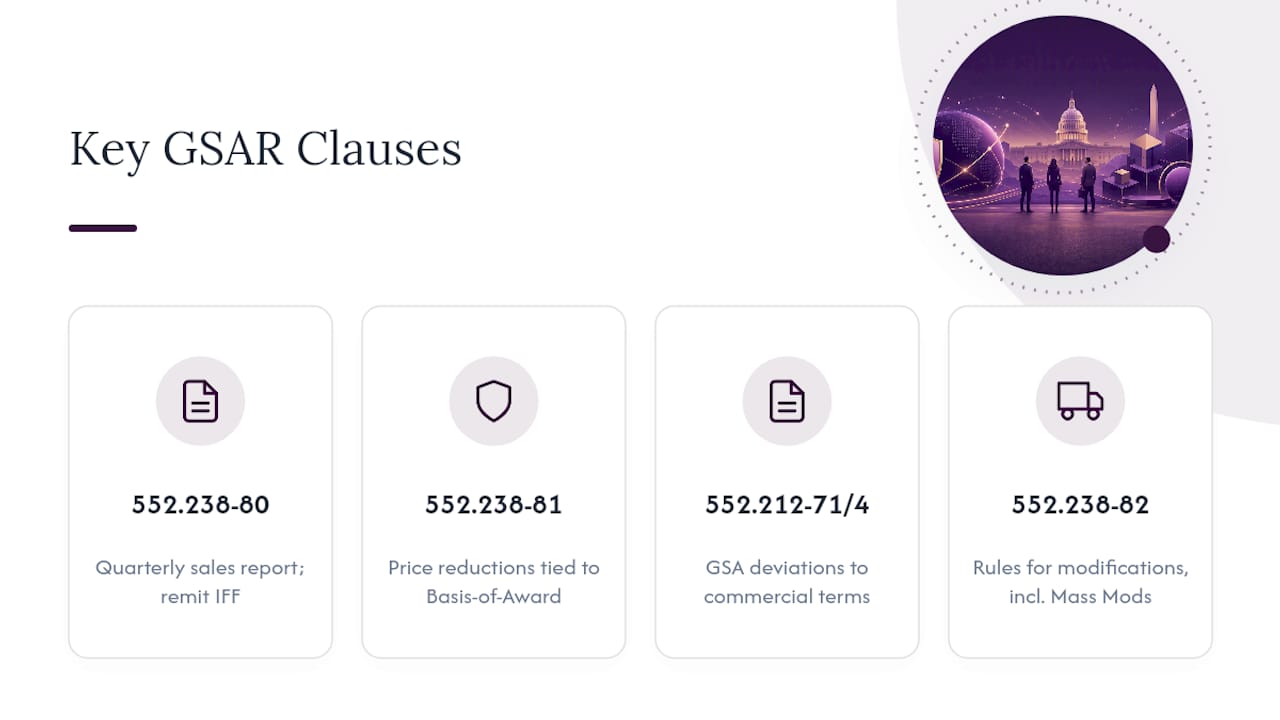
552.238-80, Industrial Funding Fee and Sales Reporting. This clause requires you to report all sales made under your contract and remit the Industrial Funding Fee (IFF) based on that total. It’s the clause behind your quarterly reporting obligation, and it’s the one auditors check first.
552.238-81, Price Reductions Clause (PRC). This is arguably the trickiest clause on the schedule. It ties your GSA pricing to your commercial pricing practices for a specific class of customer, called your Basis of Award customer. If you cut prices for that customer category outside the GSA relationship, you may owe GSA an equivalent price reduction. Keeping documentation of every discount decision is the only way to prove you didn’t trigger it.
552.212-71 and 552.212-4. These carry GSA-specific deviations from standard FAR commercial-item terms, and they’re where GSA’s modified language on inspection, acceptance, and other commercial terms actually lives.
552.238-82, Modifications (Multiple Award Schedule). This governs how bilateral and unilateral modifications get processed, including Mass Mods.
552.238-88 ties into GSA Advantage! catalog requirements, meaning your online catalog must reflect current, accurate pricing at all times.
A few other clauses show up regularly across MAS contracts: 552.238-83 covers GSA’s right to examine your records, 552.238-85 addresses billing and invoicing responsibilities, and various clauses reference identity verification and E-Verify requirements for certain labor categories.
Pro Tip: Print or save your Contracts Online clause report the day you’re awarded. Clause sets can shift after Mass Mods, and having a dated baseline makes it easy to spot exactly what changed.
What Deadlines Come With These Clauses?
Clauses don’t just describe obligations. They come attached to calendars, and missing one is often what turns a minor paperwork gap into an audit finding.
- Quarterly sales reporting and IFF payment. GSA guidance sets a standard window of 30 days after each reporting quarter closes. If you’re on the Transactional Data Reporting (TDR) pilot instead of standard reporting, your cadence and required data fields differ, so confirm which reporting structure your contract actually uses.
- CAGE code or business structure changes. Notify your Contracting Officer within 30 days of any change to your CAGE code, ownership, or legal structure.
- Price reduction and modification triggers. Certain PRC-related disclosures and modification requests carry tighter windows, typically between 15 and 30 days depending on the specific action.
- Post-Mass Mod catalog sync. Once a Mass Mod hits your contract, GSA Advantage! listings and pricing need to reflect the change quickly, and delays here are one of the most common compliance gaps GSA flags during reviews.
The GSA MAS contractor compliance checklist lays these timeframes out clause by clause, and it’s worth keeping a copy pinned somewhere your contracts team actually looks.
How Are Clauses Incorporated Into Your Contract?
Clauses reach your contract two ways: by direct inclusion in your solicitation package, or “incorporated by reference,” meaning the clause number is cited but the full text lives in GSAM rather than being reprinted in your contract document. Both carry equal legal weight.
Reading the clause correctly means checking the prescription language in GSAM Subpart 552.3, which tells you when a clause applies and whether an alternate version replaces the standard text for your contract type. Experts note that the specific terms in your signed solicitation and category attachment always override a general checklist, so if something looks inconsistent, the signed document wins.
Mass Modifications add another layer. GSA issues these to update pricing structures, add clauses, or revise terms across large groups of contracts at once, and tracking Mass Mod notices is the only way to know your obligations have shifted before an audit tells you.
How Do You Use the 552.301 Applicability Matrix?
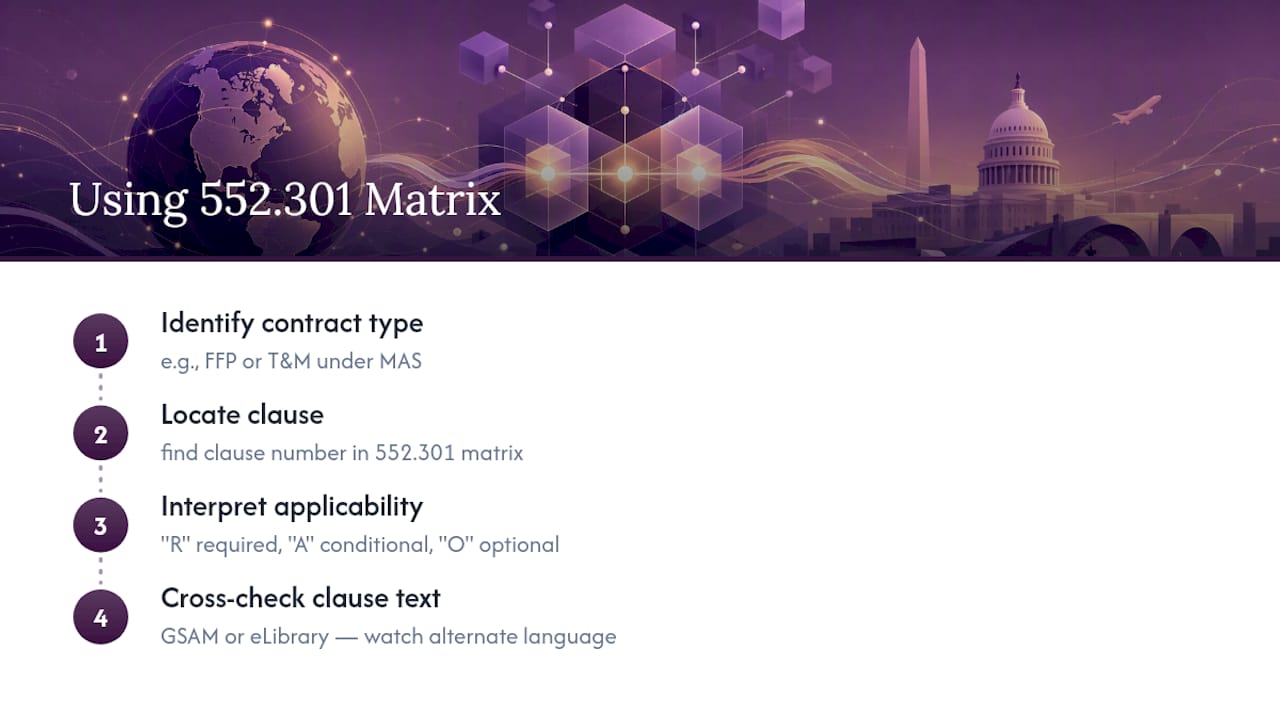
GSAM’s matrix at 552.301 is the tool that settles arguments about whether a clause actually applies to your specific contract type and SIN.
Start by identifying your contract type, most commonly Firm-Fixed-Price (FFP) or Time-and-Materials (T&M) under the MAS program. Then locate the clause number in the matrix and read its applicability code: “R” for required, “A” for applicable under certain conditions, “O” for optional. Once you’ve confirmed applicability, cross-check the actual clause text in GSAM or your eLibrary contract view to catch any alternate language.
The most common mistake is assuming a clause applies universally just because it’s common across the schedule. A negotiated exception or an alternate clause version can quietly change your obligation, so always confirm at the contract level, not the category level.
Your Post-Award Compliance Checklist
Getting the order right matters almost as much as completing each step.
- Pull your clause list. Locate your contract’s specific clauses through eLibrary and Contracts Online, noting any exceptions taken during negotiation.
- Build your reporting calendar. Set recurring 30-day entries for IFF and sales reporting, and add reminders for GSA Advantage! updates after any modification.
- Document every price decision. Keep records tied to your Basis of Award customer category so you can demonstrate PRC compliance if questioned.
- Maintain an audit-ready file. Sales logs, Commercial Sales Practices (CSP) documentation, modification notices, and Contracting Officer correspondence should live in one place, not scattered across inboxes.
- Escalate ambiguity early. If a deviation or Mass Mod language is unclear, get a contract specialist or counsel involved before you act rather than after.
Pro Tip: Assign one person ownership of catalog updates after a Mass Mod. When responsibility is diffuse, the 30-day window slips more often than anyone expects.
The essential GSA Schedule maintenance checklist breaks these steps down further if you want a working document to hand to your team.
What Do Contractors Get Wrong Most Often?
The pattern shows up again and again: contractors treat clause compliance as a one-time onboarding task instead of an ongoing operational habit. The Price Reductions Clause causes the most damage because it’s invisible until someone runs a commercial discount without checking it against the Basis of Award customer. A pre-approval workflow for commercial pricing decisions catches this before it becomes a disclosure problem.
Catalog sync after Mass Mods is the second recurring failure. GSA issues these on its own timeline, not yours, and a 30-day update window disappears fast when nobody owns the task. Subscribe to Mass Mod notices directly, centralize your sales reporting in one system, and automate your calendar reminders rather than relying on memory. If a deviation looks unusual or an audit request lands on your desk, bring in a contract specialist before responding. Guessing on a formal inquiry rarely ends well.
— Josh
Get Help Managing Clause Compliance After Award
Reading clause text is one thing. Building the internal systems to track IFF deadlines, catalog updates, and PRC exposure across every quarter is another, and it’s where most in-house teams run out of bandwidth. A consulting service can work directly with MAS contractors on the compliance side of the schedule, not just the application: reviewing specific clause sets and exceptions, managing eMod and catalog updates after Mass Mods, and setting up sales and IFF reporting systems that do not depend on someone remembering a due date.
Contractors typically bring in this kind of support to cut audit risk and free their own staff from chasing paperwork instead of selling. If your reporting calendar feels more like guesswork than a system, start with a discovery call and walk through where your current process has gaps.
Where to Verify Clause Text and Deadlines
For primary sources, bookmark these: GSAM Part 552 for full clause and prescription text, GSA eLibrary and Contracts Online for your contract’s specific clause list, and the GSA MAS Contractor Compliance Checklist for deadline specifics. A curated list of official GSA links rounds out the set if you need a single bookmark folder.
Sources
FAQ
Where Can I Find My GSA Contract Clauses?
Use GSA eLibrary’s Contracts Online tool to see clauses specific to your award, and check GSAM Part 552 for the full legal text behind any clause number.
Do GSA Contract Clauses Apply to the Federal Government Too?
GSA contract clauses set obligations for the contractor and establish the terms federal agencies rely on when placing orders. Government ordering activities operate under the same contract terms when they buy through your schedule.
What Are the Different Types of GSA Contract Clauses?
Clauses generally fall into categories covering pricing and sales reporting (like 552.238-80 and 552.238-81), modifications and catalog maintenance, recordkeeping and examination of records, and general commercial terms adapted from the Federal Acquisition Regulation.
What Are the Requirements for a GSA Schedule Contract?
Beyond initial eligibility and pricing requirements, MAS contractors must maintain accurate sales reporting, pay the Industrial Funding Fee on schedule, keep GSA Advantage! catalog listings current, and respond to Mass Modifications within required windows. Some consulting services help contractors build systems for exactly these ongoing obligations.
How Often Do GSA Contract Clauses Change?
GSA updates clauses periodically through Mass Modifications, which can add new terms or revise existing ones across large groups of contracts. Monitoring Mass Mod notices is the only reliable way to catch these changes before they affect your compliance status.
Recommended
- An Essential Checklist to Maintain Your GSA Schedule Contract
- Performance Metrics for GSA Contracts: 2026 Guide
- A 3 Steps Guide to the GSA Contract Acquisition Process
- GSA Compliance: Don’t Get Lost