

A contractor team arrangement (CTA) is, per FAR Subpart 9.6, a setup where two or more companies form a partnership or joint venture to pursue a prime contract together, or where a potential prime lines up one or more firms to act as subcontractors on a specific government program. Form one when a solicitation demands combined technical capabilities, past performance, or capacity that no single firm on the team can supply alone.
TL;DR:
- A contractor team arrangement (CTA) must be disclosed to the contracting officer before proposal submission to avoid misclassification as an undisclosed subcontracting scheme.
- Each team member must hold an active GSA Schedule contract, operate independently, and separately invoice and pay fees, even within a CTA.
- The prime remains fully responsible for contract performance, regardless of internal agreements, and the arrangement must never violate antitrust laws.
- Proper formation requires screening all partners for exclusions, conducting early conflicts of interest checks, and drafting a detailed written agreement before award.
- Outside consulting can help with readiness assessments, documentation, and compliance checks, saving time and reducing audit risks.
Table of Contents
- What Does FAR Subpart 9.6 Actually Require?
- How Are GSA MAS CTAs Different From FAR Teaming?
- When Does a CTA Actually Make Sense?
- How Do You Form a Compliant Contractor Team Arrangement?
- What Belongs in the Agreement Itself?
- Who Is Liable, and How Do You Manage the Risk?
- When Should You Bring in Outside Help?
- How Gsascheduleservices Supports Your Next Contractor Team Arrangement
- Where to Verify the Rules Yourself
- Sources
- FAQ
What Does FAR Subpart 9.6 Actually Require?
FAR 9.601 defines a CTA as either a joint venture/partnership pursuing a prime award, or a prime agreeing to subcontract portions of the work to named team members. The government will recognize the arrangement’s validity, but only if it’s disclosed to the contracting officer, and 9.602 through 9.604 spell out the ground rules that follow from that recognition.
A few things matter more than the rest:
- The prime remains fully responsible for contract performance no matter what the private team agreement says internally.
- Nothing in Subpart 9.6 authorizes an arrangement that violates antitrust law.
- Disclosure timing counts. Waiting until after award to reveal a teaming relationship invites scrutiny you don’t want.
- The full text lives at FAR 9.601, and it’s worth reading before you draft anything.
Skip the disclosure step and you’re not just risking a protest. You’re risking the contracting officer treating your “team” as an undisclosed subcontracting scheme, which is a different, worse conversation.
How Are GSA MAS CTAs Different From FAR Teaming?
FAR 9.6 covers teaming generally, but GSA’s Multiple Award Schedule program layers its own rules on top for Schedule holders. A MAS CTA lets several MAS contractors combine capabilities to deliver one total solution, and critically, it does not create a new legal entity. Each member keeps its own Schedule contract, invoices for its own portion, and answers for its own piece of the work.
Two structural choices shape everything else:
- Order-level CTA: formed for a single task or delivery order, the most common approach for one-off requirements.
- Contract-level CTA: incorporated into the MAS contract itself, useful when the same partners expect to team repeatedly.
A few practical mechanics follow from that distinction. Every member must hold an active Schedule, invoicing can run through the lead or separately per member, and each contractor still tracks its own sales and pays its own Industrial Funding Fee (IFF), regardless of who submits the paperwork.
When Does a CTA Actually Make Sense?
Not every gap in capability calls for a formal team. CTAs earn their complexity in specific situations:
- Complex R&D or systems integration work spanning multiple technical disciplines.
- Task orders or BPAs that require a combined solution no single Schedule holder can deliver.
- Past performance or capacity shortfalls where one firm’s track record alone won’t win the evaluation.
- Situations calling for speed. A CTA forms faster than a joint venture because there’s no new entity to stand up.
The trade off runs the other way too. If the relationship is genuinely long term, or if liability needs to sit inside one legal wrapper, a joint venture might serve you better. If one firm clearly leads and the rest are support labor with no real stake in past performance credit, a straightforward prime/sub relationship is simpler and avoids CTA disclosure overhead entirely.
How Do You Form a Compliant Contractor Team Arrangement?
Forming a CTA is not complicated, but the sequence matters, and skipping a step is exactly what shows up in audit findings later.
- Screen every partner, not just the lead. Check SAM.gov exclusions status for each member, not only the company signing as prime. Map each partner’s capabilities and past performance references against the solicitation’s actual evaluation factors.
- Run an organizational conflicts of interest (OCI) check early. Undisclosed or unmitigated OCI can get a team disqualified outright under conflicts of interest rules, so surface it before you draft, not after a competitor protests.
- Draft the written agreement before it takes effect. Vague verbal understandings do not satisfy a contracting officer’s disclosure expectations, and they don’t hold up if a partner walks mid performance.
- Determine who signs and when. Authorized representatives from every member firm need to sign, and the agreement should be finalized before proposal submission, not scrambled together after an award notice.
- Submit at the right level for MAS. Decide whether this is an order-level CTA tied to one solicitation or a contract-level CTA incorporated into the Schedule contract itself, then follow the applicable clause references in your solicitation.
- Loop in the contracting officer. Disclose the arrangement as part of the proposal, and confirm the ordering activity hasn’t prohibited CTAs for that specific requirement.
Pro Tip: Build your OCI screening and SAM checks into the same due diligence memo you use for capability mapping. Auditors consistently find that teams document capability fit carefully but skip the compliance checks on non-lead partners entirely.
What Belongs in the Agreement Itself?
A CTA that reads like a handshake dressed up in legal language will not survive scrutiny, and it will not protect you if a partner underperforms. GSA’s own guidance on MAS teaming points to a specific set of elements worth treating as non-negotiable.
- Full identification of every party, including contract or Schedule numbers.
- Defined roles: who is lead, who is member, and what each is responsible for delivering.
- A statement of work detailed enough that a third party could tell who owns which deliverable.
- Invoicing and payment allocation, spelled out by percentage or fixed scope, not left to later negotiation.
- Duration and termination triggers, including what happens if the underlying contract or order ends early.
- A replacement procedure if a member needs to exit, including contracting officer notification steps.
- Confidentiality terms and any exclusivity limitations on pursuing other teams for the same opportunity.
- Signature blocks for authorized representatives of every firm.
Avoid “good-faith negotiation” placeholder language wherever you can. An agreement built on vague future promises is harder to enforce and can read to a contracting officer as an arrangement that isn’t actually finalized. If the relationship is genuinely likely to convert into a formal subcontract after award, say so directly rather than leaving the transition ambiguous.
| Clause | Why it matters |
|---|---|
| Party identification | Confirms Schedule numbers and legal entity names match SAM records |
| Roles and SOW | Prevents disputes over who owed which deliverable |
| Invoicing allocation | Determines IFF reporting and payment timing per member |
| Duration/termination | Sets clear exit conditions instead of open-ended commitment |
| Replacement procedure | Keeps performance gaps from stalling the order |
Who Is Liable, and How Do You Manage the Risk?
The prime carries full responsibility for performance regardless of what the internal team agreement allocates, a limitation FAR 9.604 makes explicit. That single fact should shape every internal risk decision you make, because private agreements about who does what don’t shift government liability.
The GSAIG audit on CTA administration found a recurring pattern: exclusions checks performed on the lead firm but skipped for other members, missing written team agreements, and inconsistent tracking across contracting offices. That’s a government-side administrative gap, but it’s also a warning for teams that assume someone else is checking compliance.
Build these habits into every CTA you run:
- Screen every member against SAM exclusions, not just the lead, and keep dated documentation of each check.
- Disclose and mitigate OCI in writing, with the mitigation plan attached to the proposal file.
- Decide invoicing structure explicitly. Routing everything through the lead can obscure individual sales reporting and IFF obligations for other members.
- Keep a shared record of correspondence with the contracting officer so no team member is guessing at the current status.
When Should You Bring in Outside Help?
Some CTAs are simple enough to handle in house: two firms, clear roles, low OCI exposure. Others aren’t. Multi-prime arrangements with three or more Schedule holders, high OCI risk from prior contract relationships, or a first-time contract-level CTA are exactly where an outside set of eyes earns its cost.
Specialized consulting services handle the pieces that trip teams up most: readiness assessments before committing to a team structure, drafting the actual CTA documentation, running SAM and OCI checks across every member, and packaging the proposal so the contracting officer sees a clean, disclosed arrangement instead of a compliance question mark.
— Josh
How Gsascheduleservices Supports Your Next Contractor Team Arrangement
Most firms lose time on CTAs not because the concept is hard, but because the paperwork, disclosure timing, and cross-member compliance checks eat weeks they don’t have before a proposal deadline. Experienced consultants handle that groundwork directly: document review against solicitation requirements, a gap list showing exactly what’s missing before submission, and a realistic timeline so you’re not guessing whether you’ll make the deadline.
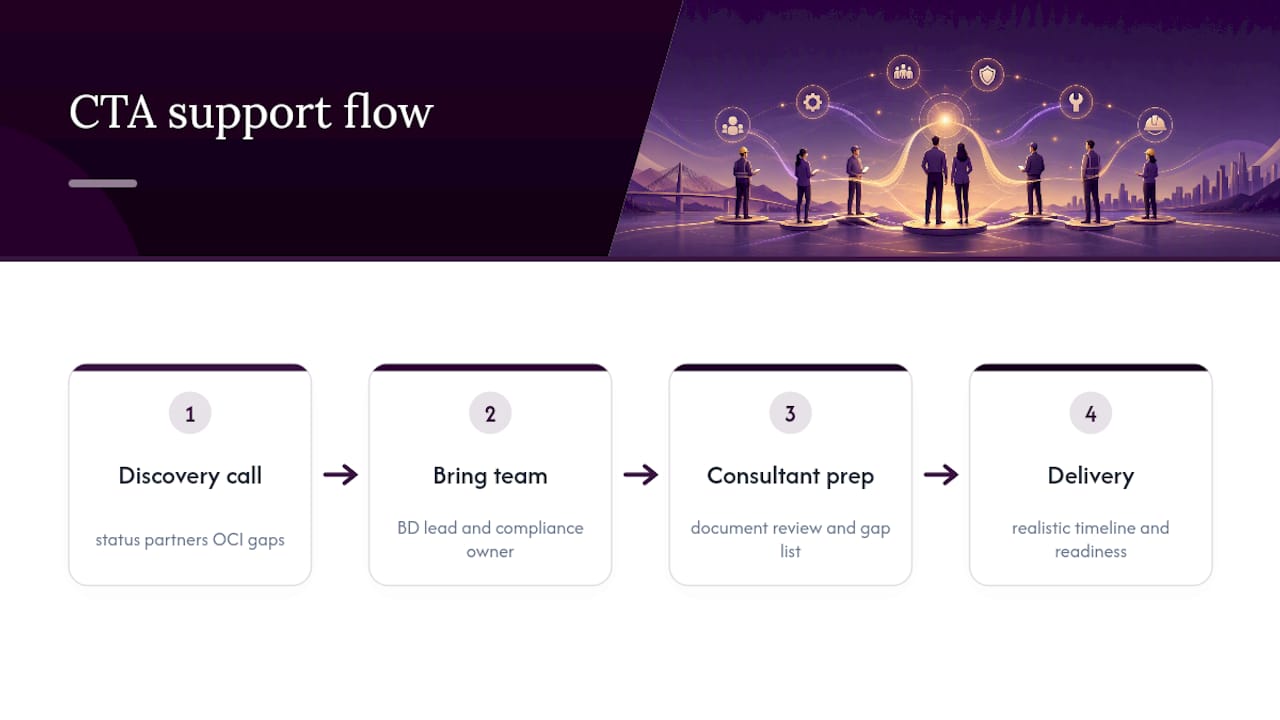
A discovery call typically covers your current Schedule status, the partners you’re considering, and where OCI or capability gaps might sink the proposal. Bring your business development lead and whoever owns compliance on your side. From there, schedule a discovery call and get a clear read on what your CTA needs before you draft a single clause.
Where to Verify the Rules Yourself
- FAR Subpart 9.6: the core definition, policy, and prime responsibility rules for contractor team arrangements.
- GSA’s MAS CTA guidance: roles, order-level versus contract-level structures, and recommended agreement elements.
- GSAIG audit report: documented administration weaknesses across CTA use governmentwide.
Sources
- Acquisition
- Partner with other MAS contractors | GSA
- Audit of Contractor Team Arrangement Use (GSA Inspector General)
FAQ
What Is a Contractor Team Arrangement in Federal Contracting?
A CTA is a FAR-recognized setup where two or more firms partner to jointly pursue a prime contract or where a prime lines up named subcontractors for a specific government program, formalized in writing and disclosed to the contracting officer.
Is a Teaming Agreement Legally Binding?
Yes, once properly executed with clear terms on scope, payment, and duration. A written agreement without vague “good-faith negotiation” placeholders holds up far better than an informal understanding if a dispute arises.
What Is the Rule of Two in Government Contracting?
That phrase most often refers to small business set-aside rules requiring contracting officers to reserve procurements for small businesses when two or more qualified small firms are likely to bid, a separate concept from CTA formation itself.
Can You Give an Example of a Teaming Agreement?
A typical example pairs a firm with strong past performance in a technical area with a partner that holds a needed certification or capacity, structured as an order-level MAS CTA with the first firm as lead and clearly divided invoicing responsibilities.
Do Both Firms Need a GSA Schedule for a MAS CTA?
Yes. Every member participating in a MAS contractor team arrangement must hold an active GSA Schedule contract, since each firm invoices and reports sales under its own contract number.
Recommended
- An Essential Checklist to Maintain Your GSA Schedule Contract
- Prevent Yourself from GSA Contract Cancellation
- Avoid GSA Contract Cancellation