

A subcontracting plan is required whenever a negotiated contract or task order (including options) is expected to exceed the FAR threshold and subcontracting opportunities exist. If you hit that trigger, your first three moves are: confirm the contract’s total value with options, pick between an individual or commercial plan based on your reporting needs, and pull the GSA model subcontracting plan as your starting draft.
TL;DR:
- Most contractors should consider switching to a commercial subcontracting plan to reduce reporting burdens, especially if they have multiple contracts or awards from the same agency.
- Accurate goal setting requires projecting subcontracting dollars, not just percentages, and documenting outreach methods and recordkeeping to demonstrate good faith efforts.
- Failing to adapt plan language from templates and ensuring all goals and responsible officials are clearly defined can cause rejection and delays in approval.
- Submission and reporting are continuous, with annual or semiannual reports needing thorough source lists, outreach logs, and consistent evaluation records to avoid breach and damages.
- Seeking specialized assistance can improve the quality of a subcontracting plan, especially when managing complex NAICS codes or limited internal compliance resources.
Table of Contents
- What a GSA Subcontracting Plan Actually Requires
- Who Has to Submit One, and When
- Individual, Commercial, or Master Plan: Picking the Right One
- Building Goals That Survive Negotiation
- Reporting Without Getting Burned by Liquidated Damages
- A Working Checklist to Build Your Plan
- Where Plans Get Rejected, and How to Fix It Before Submission
- Why the Narrative Matters More Than People Assume
- Get Help Preparing or Negotiating Your Plan
- Sources
- FAQ
What a GSA Subcontracting Plan Actually Requires
A subcontracting plan is a contract deliverable, not a formality attached to your proposal. FAR Subpart 19.7 and clause 52.219-9 require large contractors on qualifying awards to submit a plan that spells out how much small business subcontracting they expect and how they will get there. Fail to submit an acceptable plan before award, and the contracting officer can hold up negotiations or decline to award the contract at all.
The plan is a documented commitment, backed by specifics the CO can verify:
- Written percentage goals tied to actual subcontracting dollars, not vague intentions
- A narrative explaining your outreach methods and how you identify small business sources
- Recordkeeping procedures that prove the goals are being pursued, not just written down
- Assurances that you’ll flow the same requirements down to subcontractors above the threshold
Who Has to Submit One, and When
The threshold that triggers a plan applies to negotiated and sealed bid acquisitions above the dollar amount set in FAR 19.702, with a separate, higher threshold for construction contracts. Small businesses themselves are exempt. So are contracts for personal services and work performed entirely outside the United States and its outlying areas.
A few nuances trip up otherwise careful contract teams:
- Multiple NAICS codes on one contract can each carry different size standards, which changes whether the plan requirement even applies
- A modification that increases contract value past the threshold can trigger a plan requirement that didn’t exist at award
- Task orders under a multiple-award vehicle sometimes require their own plan even when the base contract already has one
If you’re unsure whether your NAICS mix pushes you over the line, review your contract eligibility criteria before you assume you’re exempt.
Individual, Commercial, or Master Plan: Picking the Right One
Three plan types cover almost every GSA contractor, and the choice affects your reporting workload for the life of the contract.
- Individual Subcontracting Plan. Tied to a single contract, with goals specific to that award. You file a semiannual Individual Subcontract Report (ISR) through eSRS for each contract carrying its own plan.
- Commercial Subcontracting Plan. Covers your entire company for a full fiscal year across all commercial-item sales, GSA and otherwise. You file one annual Summary Subcontract Report (SSR) instead of a separate ISR per contract.
- Master Subcontracting Plan. A standing plan pre-approved by one agency that you attach to multiple individual contracts, useful if you win repeat awards from the same agency but still need contract-specific numbers.
For most GSA Schedule holders selling commercial products or services, the commercial plan cuts reporting labor substantially since one SSR replaces a stack of individual reports. Individual plans still make sense when a single contract is large enough, or unusual enough, that the CO wants dedicated visibility into that award alone.
Building Goals That Survive Negotiation
FAR 19.704 lays out exactly what a compliant plan contains, and skipping any piece is the fastest way to get sent back for revisions. Your checklist:
- Separate percentage goals for small business, veteran-owned, service-disabled veteran-owned, HUBZone, small disadvantaged, and women-owned small business categories, each calculated against total planned subcontracting dollars
- A dollar and percentage breakdown for the base period and each option year
- A description of the methods you used to develop each goal
- Outreach and solicitation procedures, plus how you’ll track subcontractor performance
- Assurances your subcontracts above the threshold will flow down the same plan requirements
The denominator matters as much as the numerator. Your goals get calculated against total subcontract dollars, not total contract value, and commercial plans have specific rules for how indirect costs get allocated across that base. A CO will sometimes ask you to translate percentages into projected contract dollars to sanity-check the math.
Pro Tip: Don’t lowball your goals to make them easy to hit. FAR guidance expects goals that reflect a genuine good faith effort, and a CO who sees numbers that look padded down will ask you to justify them, which slows negotiation instead of speeding it up.
Reporting Without Getting Burned by Liquidated Damages
Once your plan is in place, the paperwork doesn’t stop at award. Commercial plans require one annual SSR; individual plans require an ISR every six months. Both get filed through eSRS, and missing a deadline creates exactly the kind of compliance gap a Procurement Center Representative will flag on review.
What COs and reviewers actually check when they audit your good faith effort:
- Source lists showing you identified qualified small business subcontractors, not just used the same three vendors again
- Outreach logs documenting solicitations sent and responses received
- Records showing how you evaluated competing offers, including why a small business bid wasn’t selected when that happened
- Evidence your subcontractor selection criteria were applied consistently across the contract
Falling short on any of this isn’t just a paperwork problem. FAR 19.702 treats a failure to make a good faith effort as a material breach, and that can trigger liquidated damages written directly into your contract.
A Working Checklist to Build Your Plan
Most delays in getting a plan approved come from teams starting the narrative before they’ve nailed down the numbers. Work in this order instead:
- Total your projected subcontracting dollars across the base period and every option year, and sort out which costs count as indirect under commercial plan rules
- Set category-specific goals against that total, then write the narrative explaining the outreach methods that produced each number
- Name a company official responsible for plan compliance, since COs expect a named point of contact, not a department
- Gather evidence of your outreach channels: the Dynamic Small Business Search (DSBS), SUB-Net postings, and any mentor-protégé relationships you maintain
- Map out your eSRS submission schedule against your contract’s reporting cycle so the first ISR or SSR isn’t a scramble
Pro Tip: Build your outreach documentation as you go, not retroactively. A CO reviewing your plan six months from now will trust a dated log of SUB-Net postings a lot more than a summary you reconstruct from memory the week before your report is due. Reviewing how government procurement strategies work for sourcing helps make this step faster.
Where Plans Get Rejected, and How to Fix It Before Submission
The same handful of mistakes account for most rework requests. Recognize them early and you’ll skip a negotiation cycle entirely.
- Lifting language straight from the GSA model plan without adapting it to your actual supply chain reads as generic to a reviewer who has seen the template a hundred times
- Percentages that don’t add back up to your stated total subcontracting dollars, usually from someone updating one number and forgetting to update the rest
- No named responsible official and no documented outreach trail, which is precisely what triggers a “good faith effort” finding
- Sticking with an individual plan out of habit when a commercial plan would cut your reporting burden and better reflect company-wide progress
If your team is stretched thin on compliance bandwidth, that administrative load is worth weighing seriously against a switch to a commercial plan.
Why the Narrative Matters More Than People Assume
Most contractors treat the subcontracting plan as a numbers exercise: hit a percentage, file the paperwork, move on. That’s backwards. GSA’s own guidance frames the plan as a small business story, and contracting officers read it that way. Two contractors can submit identical goals, and the one with a specific, documented outreach narrative gets through negotiation faster because the CO isn’t left guessing whether the numbers are real.
The businesses that struggle aren’t usually the ones with weak goals. They’re the ones with no evidence trail behind the goals they set. Assign a responsible official, name your outreach channels, and log every solicitation as it happens rather than reconstructing it later. Do that consistently, and you’ll spend far less time in revision cycles than a competitor who treated the narrative as an afterthought.
— Josh
Get Help Preparing or Negotiating Your Plan
Building a subcontracting plan that survives CO negotiation on the first pass takes more than filling in a template. Specialized consultants can assist small and medium businesses with documentation, goal calculations, and negotiation preparation to make a subcontracting plan defensible, including readiness assessments, outreach recordkeeping setups, and eSRS reporting structure. That support matters most when you’re juggling multiple NAICS codes, a complex award, or simply don’t have the internal bandwidth to build the narrative alongside your regular contract work.
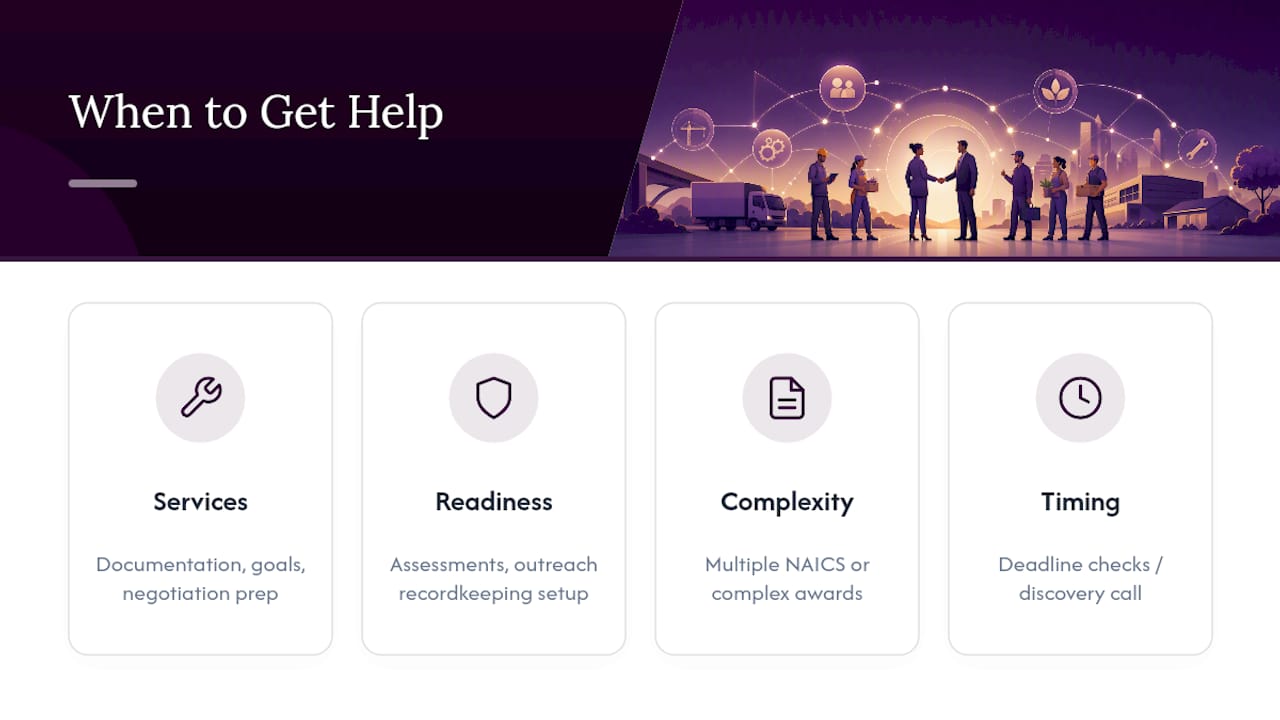
If you’re staring at a subcontracting plan deadline and want a second set of eyes before you submit, start a discovery call with our team and walk through your specific contract situation.
Sources
- Acquisition
- Subcontracting for Prime Contractors – Vendor Support Center
- GSA model subcontracting plan format (attachment) – SmartPay/GSA
FAQ
What Is a Subcontracting Plan?
It’s a required contract document, governed by FAR 52.219-9, where a prime contractor sets specific percentage goals for subcontracting with small business categories and describes the outreach methods used to meet them.
What Are the Limitations on Subcontracting in Federal Contracts?
Limitations vary by contract type, but generally a contractor must perform a minimum share of the work itself and cannot pass through federal contract requirements without meeting the subcontracting plan’s documented goals and good faith effort standards.
What Are the Three Types of Subcontracting Plans?
Individual plans cover a single contract with semiannual ISR reporting, commercial plans cover your whole company annually through one SSR, and master plans are agency-approved standing plans attached to multiple contracts.
Can You Subcontract on Government Contracts?
Yes. Subcontracting is standard practice, and large contractors above the FAR threshold are actually required to have a plan for including small businesses in that subcontracting work.
When Should I Use a Commercial Plan Instead of an Individual Plan?
Choose a commercial plan if you sell commercial items across multiple contracts, since one annual SSR replaces separate reports for each award and generally cuts administrative work.
Recommended
- Busting the Myths Around GSA Contracts for Small Business
- 5 Useful Roles of a GSA Schedule for Small Business
- How to Grow a Small Business Through a GSA Schedule
- How Small Businesses Can Get Started With A GSA Contract? 5 Steps!