

An Economic Price Adjustment lets a GSA Schedule holder raise or lower contract pricing under a method both sides agreed to at award. Clause 552.238-120 governs how that works for Federal Supply Schedule and Multiple Award Schedule contracts, and any adjustment still has to be fair and reasonable to the government. If your costs have jumped and you’re staring at your GSA rate sheet wondering how to fix it, the move is simple: use the EPA method already written into your contract and file a modification request with your FSS Contracting Officer.
TL;DR:
- Your contract’s specific EPA mechanism—fixed rate, index-based, established commercial prices, or unforeseeable market change—dictates how you can request price adjustments.
- Proper documentation, including a complete Tab A and clear index calculations with sources and dates, is essential to avoid rejection and ensure the process proceeds smoothly.
- Processing times vary from 7 to 10 days for administrative changes to over 30 days for substantive EPA requests, influenced by paperwork completeness and CO workload.
- Most rejections stem from incomplete or inconsistent Tab A submissions, weak market evidence, bundled modification requests, or missing catalog updates.
- Complex cases or previous rejections benefit from professional assistance to prepare and negotiate your EPA modification efficiently.
Table of Contents
- How GSA Escalation Rates Actually Work Under EPA
- Filing an EPA Request: The Modification Workflow
- What Documentation Proves Your Adjustment Is Fair and Reasonable
- How Long Escalation Approval Actually Takes
- Why Most Escalation Requests Get Rejected or Delayed
- A Consultant’s Checklist for Escalation Requests
- Get Help Filing Your Next EPA Modification
- Sources
- FAQ
How GSA Escalation Rates Actually Work Under EPA
Every GSA Schedule contract picks one EPA mechanism at award, and that choice determines exactly how you’re allowed to ask for a price increase later. GSA’s own guidance on economic price adjustment mechanisms walks through four options, and picking the wrong one for your business model is a common early mistake.
- Fixed escalation rate. A set percentage, often applied annually on the contract’s anniversary date, sometimes with a cap over the life of the contract. Simple to administer, but it can leave you underwater if real costs outpace the fixed number.
- Market index (index-based EPA). Tied to a published index such as the Bureau of Labor Statistics Employment Cost Index. The index you name in your contract matters enormously. An index that tracks unrelated labor categories won’t justify your specific cost increase to a reviewer.
- Established commercial pricing. Your GSA prices move with your commercial price list (CPL) or catalog. This works well if you already sell the same labor categories or products commercially at prices that shift regularly outside government channels.
- Unforeseeable significant market changes. A catch-all for events nobody priced in at award, like a sudden materials shortage or a wage spike driven by regional labor scarcity. It requires stronger, more specific evidence than the other three.
Clause 552.238-120 and GSAM Subpart 538.2 both lay out these categories, along with a short list of items that don’t qualify for EPA treatment at all. Know which mechanism you signed up for before you draft anything.
Filing an EPA Request: The Modification Workflow
An escalation isn’t automatic. It’s a contract modification, and GSA processes it through the Price Proposal Template, commonly called the PPT.
- Build Tab A first. Tab A requires the entire universe of your current offerings, not just the line items you want to raise. Reviewers check this against your last approved contract, and gaps here are a leading cause of rejection.
- Select the right tab for your mechanism. Fixed and index-based EPAs typically route through a dedicated EPA tab; other pricing changes may use Tab B. The MAS modification guide specifies exactly which tab applies to which request type.
- Submit through your FSS Contracting Officer. The CO can accept the request as filed, reject it, accept it partially, or negotiate a different number before approval.
- Wait for the effective date. Under 552.238-120, an approved adjustment applies only to orders issued on or after the modification’s effective date. Orders already in the pipeline keep the old pricing.
Pro Tip: Never bundle an EPA request with unrelated modification types (a new SIN addition, for example) in the same submission. Combined mods create combined review delays, and one incomplete section can stall the whole package. For a closer look at the mechanics, see how to modify your GSA Schedule contract.
What Documentation Proves Your Adjustment Is Fair and Reasonable
GSA’s Contracting Officers aren’t rubber-stamping escalation requests. Guidance tied to the Federal Register’s Schedule EPA rulemaking is explicit that EPA exists to keep pricing current, not to hand contractors an automatic windfall, and COs can demand evidence before approving anything.
What that means in practice:
- A complete Tab A. Submit the full universe of your offerings every time, formatted exactly as the MAS modification guide requires. A mismatch with your last approved contract is one of the fastest ways to trigger a rejection.
- Index math with sources and dates. If you’re using an index-based mechanism, show your calculation step by step and cite the exact index and reporting period you pulled from.
- Effective dates for commercial pricing. If your EPA rides on your CPL or catalog, include the dates those commercial prices actually changed.
- Fully burdened rates. Every proposed price must include the Industrial Funding Fee and any other cost factor your contract specifies, and you’ll need to update your I-FSS-600 catalog data within the required window after the mod completes.
Reviewing “fair and reasonable” standards before you file can save a resubmission cycle. GSA Focus’s breakdown of what “fair and reasonable” means for GSA contractors is worth reading alongside your own math.
How Long Escalation Approval Actually Takes
Processing time depends heavily on modification type and how clean your paperwork is.
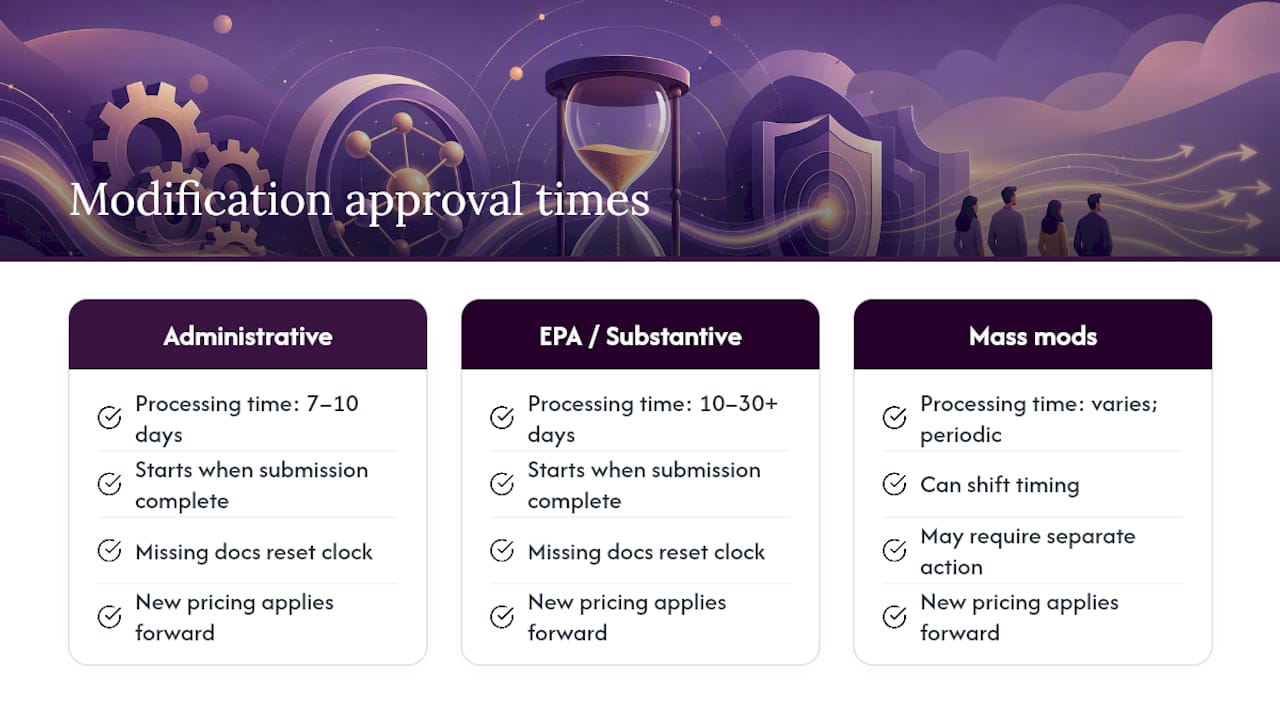
Administrative modifications often clear in 7 to 10 days, while EPA and other substantive changes typically run 10 to 30 days or longer depending on your Contracting Officer’s workload and whether your documentation arrives complete the first time, according to GSA’s own modification guidance.
That timeline only starts once your submission is complete. A missing Tab A field or an unformatted attachment resets the clock. Once approved, the new pricing applies to orders issued on or after the effective date, not retroactively, so any order already placed under old pricing stays there. Contractors should also watch for mass modifications GSA issues periodically, including transitions tied to Transactional Data Reporting, since those can shift timing or require you to take separate action on your own EPA clause acceptance.
Why Most Escalation Requests Get Rejected or Delayed
The rejections that stall EPA requests almost always trace back to a handful of preventable mistakes.
- Incomplete or inconsistent Tab A. Leaving out product lines or providing catalog data that contradicts your last approved contract is the single most common flag reviewers raise.
- Weak market evidence. A vague reference to “rising costs” without index citations, dates, or calculations won’t clear review.
- Mixed modification types. Filing an EPA request bundled with a SIN change or an address update multiplies the chance one piece gets kicked back.
- Missed catalog updates. Forgetting to refresh I-FSS-600 or omitting the IFF from your burdened rate invites a rejection even when your escalation math is sound.
Pro Tip: Before you submit, run your own reconciliation between the new PPT and your last approved contract line by line. It’s the same check a Contracting Officer will do, so catching the mismatch yourself beats getting a rejection notice three weeks later. Staging non-urgent mods for slower periods, and getting a peer review of your PPT before it goes out, both cut down on avoidable back-and-forth. More on avoiding these traps in Avoid Rough Seas with Your GSA Contract.
A Consultant’s Checklist for Escalation Requests
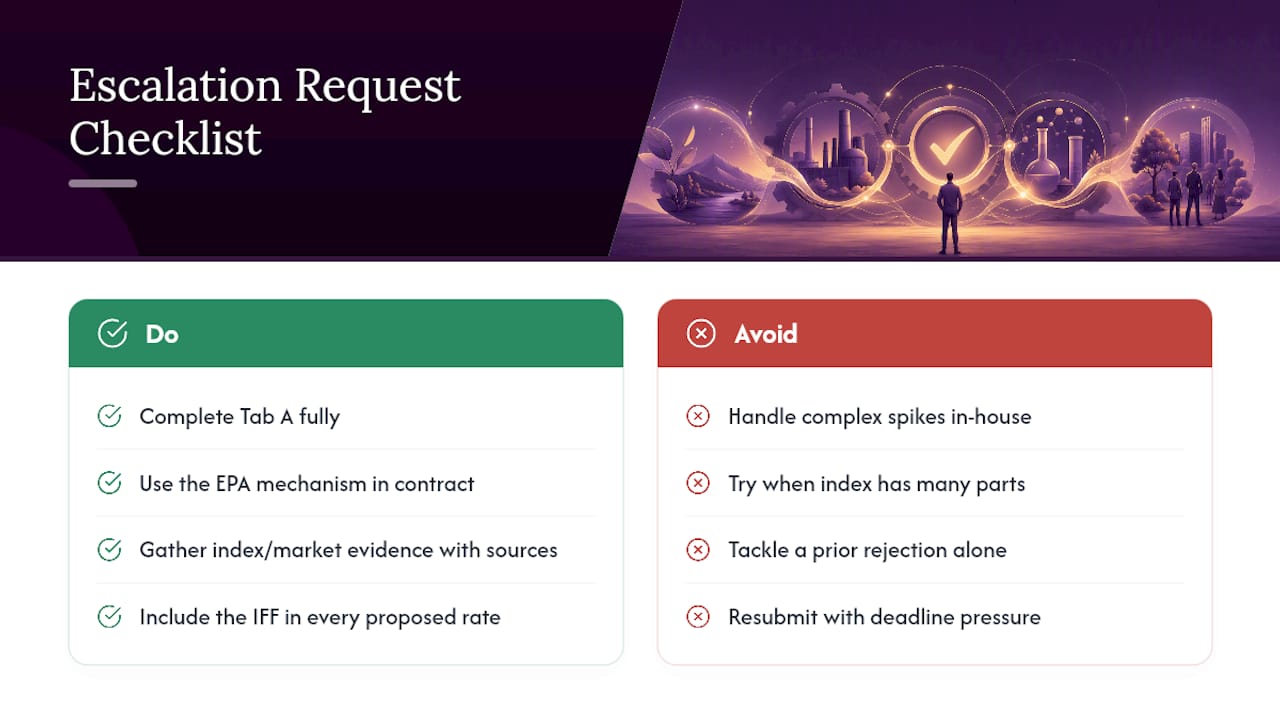
Here’s the short version of what separates a clean EPA approval from a three-month back-and-forth: build a complete Tab A, confirm you’re using the EPA mechanism your contract actually specifies, gather index or market evidence with sources and dates attached, bake the IFF into every rate you propose, and run a line-by-line consistency check against your last approved contract before you hit submit.
Handling that in-house works fine for a straightforward fixed-rate escalation with clean records. It’s a different story when you’re facing an urgent cost spike, an index calculation with multiple moving parts, a prior rejection you need to untangle, or a deadline where a resubmission cycle isn’t an option. Those situations reward experience with how COs actually read a PPT, not just knowledge of what the clause says.
— Josh
Get Help Filing Your Next EPA Modification
Professional consulting services can help you navigate PPT rejections by providing readiness assessments, full PPT preparation including Tab A universe documentation, modification filing, and negotiation support when a Contracting Officer pushes back on your numbers, as detailed by Professional Services – Chief Legal Office. If you’ve been rejected once already, or you’re staring down a cost increase with no clean index math to back it up, that’s exactly where a second set of experienced eyes shortens the timeline instead of extending it. Contractors juggling their own operations rarely have hours to spare reconciling Tab A against a two-year-old contract file, and one missed field can cost another 30-day cycle. Start with a discovery consultation and get a clear read on which EPA mechanism fits your contract and what documentation you’ll need before you file.
Sources
- 552.238-120 Economic Price Adjustment—Federal Supply Schedule Contracts
- Federal Register: Schedule EPA implementation (Aug 5, 2024)
- Multiple Award Schedule (MAS) modification guide (April 2026)
- Implement the new economic price adjustment clause | GSA
FAQ
What Is an Economic Price Adjustment on a GSA Contract?
An EPA is a contract clause, most commonly 552.238-120, that allows a GSA Schedule holder to raise or lower pricing under a pre-agreed method rather than renegotiating the whole contract.
How Do I Know Which EPA Mechanism My Contract Uses?
Check your contract’s terms and conditions; every GSA Schedule contract locks in one of four mechanisms (fixed rate, market index, established commercial pricing, or unforeseeable market change) at the time of award.
How Long Does a GSA Escalation Request Take to Approve?
Administrative modifications often process in 7 to 10 days, while EPA requests and other substantive modifications commonly take 10 to 30 days or more depending on documentation completeness and Contracting Officer workload.
What Is the Most Common Reason an EPA Request Gets Rejected?
An incomplete or inconsistent Tab A submission, meaning your listed universe of offerings doesn’t match your last approved contract, is the leading cause of rejection.
When Does an Approved Escalation Take Effect?
Only orders issued on or after the modification’s effective date get the new pricing; orders placed before that date keep the original contract price.
Should I Hire Help for a GSA Escalation Request?
Handling a straightforward fixed-rate escalation yourself is often manageable, but complex index calculations, urgent cost spikes, or a prior rejection are strong reasons to bring in expert support to prepare the PPT correctly the first time.
Recommended
- Demystifying GSA Pricing
- 5 Useful Roles of a GSA Schedule for Small Business
- An Essential Checklist to Maintain Your GSA Schedule Contract
- Government procurement strategies that help SMBs win GSA bids