

The Basis of Award (BOA) is the commercial customer or customer category that anchors the government’s price relationship on your GSA Schedule contract. If that customer’s pricing shifts in a way that undercuts the government, GSAR clause 552.238-81 (Price Reductions) can force you to pass the same reduction to your federal price list. Check your contract’s clause version and Transactional Data Reporting (TDR) status today, and loop in your Contracting Officer the moment pricing changes.
TL;DR:
- The contractor must continuously monitor their agreed-upon Basis of Award customer or category, as any price reductions outside of exclusions trigger obligations.
- Reporting commercial price reductions within 15 calendar days of implementation is mandatory, with timely notification crucial to avoid compliance issues.
- Transitioning to Transactional Data Reporting replaces BOA tracking with monthly submission of 16 data elements per sale, shifting focus to data accuracy instead of relationship management.
- Accurate record-keeping of price changes, approvals, and notifications is essential to prevent audit findings related to missing documentation or late disclosures.
- Contractors with broad BOA designations, such as all commercial customers, need to track extensive sales data, demanding disciplined internal procedures and dedicated ownership.
Table of Contents
- What Is the Basis of Award in a GSA Contract?
- Basis of Award vs. Most Favored Customer: What’s the Difference?
- How Does the Price Reductions Clause Get Triggered?
- How Does Transactional Data Reporting Change Basis of Award Obligations?
- Your Compliance Checklist for BOA and Price Reductions
- Where to Find the Clause Text and What to Expect in a Modification
- What Do Auditors and Contracting Officers Actually Flag?
- Why Basis of Award Deserves Ongoing Operational Attention
- How GSA Focus Helps You Stay Ahead of Price Reduction Risk
- Sources
- FAQ
What Is the Basis of Award in a GSA Contract?
At the negotiation table, you and your Contracting Officer (CO) settle on two things: a specific commercial customer or customer category, and the discount relationship your GSA pricing must preserve against that customer. That agreement becomes the Basis of Award. It lives in the contract’s pricing pages and gets referenced every time a reduction question comes up later.
The clause enforcing this is 552.238-81 Price Reductions, and it puts two obligations on you as the contractor: maintain the agreed price or discount relationship to your BOA customer, and report to the CO whenever that relationship changes in the government’s favor. This is not a one-time formality. It follows the contract for its entire life, including option periods.
What this means in practice:
- You agree on a BOA customer/category and a discount percentage or price relationship at award.
- You must monitor that relationship continuously, not just when GSA asks.
- Any reduction to your BOA customer that isn’t excluded under the clause has to flow to your GSA pricing too.
- The obligation survives modifications, extensions, and most repricing actions.
Basis of Award vs. Most Favored Customer: What’s the Difference?
Most Favored Customer (MFC) and Basis of Award get used almost interchangeably in casual conversation, but they answer different questions. MFC is the commercial customer who historically gets your best pricing. It’s the benchmark used during the original proposal evaluation to figure out where GSA pricing should land relative to your best commercial deal. BOA is what happens after that negotiation. Once the CO and you agree on a BOA customer, that agreement, not your general MFC status, governs price-reduction obligations going forward.
Here’s where it gets practical:
- If your sales are almost entirely federal at the time of award, a CO will often set the BOA as “All Commercial Customers” rather than a narrow, hard-to-track customer. Guidance from the CGP’s evaluation of FSS Program Pricing explains this protects the government in case your commercial sales grow later.
- A narrow BOA customer (say, a specific distributor) is easier to negotiate but riskier to track if that customer’s discount terms shift quietly.
- Contractors with heavy federal concentration should expect the broader “All Commercial Customers” designation and plan their tracking accordingly, since it means watching your entire commercial book, not one account.
How Does the Price Reductions Clause Get Triggered?
Three situations typically trigger 552.238-81, and each one deserves its own watch list.
- A revised catalog or pricelist. If you publish new commercial pricing that lowers rates to your BOA customer or category, that counts.
- More favorable discounts or terms elsewhere. Extending better payment terms, volume breaks, or net pricing to your BOA customer than what GSA gets.
- Special, off-catalog discounts. A negotiated one-off deal for your BOA customer, even if it never appears in a published pricelist, still counts.
Once one of these happens, the clock starts. The clause requires you to notify the CO “as soon as possible, but not later than 15 calendar days after its effective date.” That’s not 15 business days. Weekends and holidays count.
Pro Tip: Build the 15-day clock into whatever system your sales team uses to approve discounts. If pricing approval and CO notification live in separate departments with no shared trigger, you will miss the window before anyone notices.
After you report, GSA typically implements the reduction through a bilateral contract modification, with an effective date aligned to when the commercial reduction took effect. That alignment matters. A mismatched effective date is one of the more common paperwork headaches contract administrators run into during a modification.
How Does Transactional Data Reporting Change Basis of Award Obligations?
TDR replaces the entire CSP and BOA/PRC tracking exercise for contractors whose TDR modification has taken effect. Instead of monitoring a specific customer’s pricing relationship, TDR vendors report 16 required transactional data elements for every MAS sale, on a monthly cadence.
GSA’s own TDR guidance confirms that TDR contractors are not required to submit a Commercial Sales Practices disclosure or maintain a BOA/PRC relationship the way legacy contractors do. That sounds like less work, and in one sense it is. But the trade is real:
- No more BOA customer identification or discount-relationship tracking for TDR contracts.
- Monthly transactional reporting with 16 data points per sale, submitted through the FAS Sales Reporting Portal (FAS SRP).
- Higher tolerance for data-accuracy scrutiny, since GSA now leans on the transactional data itself rather than a negotiated benchmark relationship.
The practical shift: legacy BOA tracking is a relationship problem. TDR compliance is a data-quality problem. Both demand discipline; they just demand it in different places.
Your Compliance Checklist for BOA and Price Reductions
Work through these in order rather than all at once. Most contractors find the sequencing matters more than the individual tasks.
- Confirm your clause version and TDR status. Pull your current contract and check whether you’re running 552.238-81, the Alternate I version, or a TDR modification that supersedes both.
- Identify your BOA customer or category at the SIN level. Some contracts carry different BOA designations across special item numbers, so a single company-wide answer can be wrong.
- Map that BOA customer to your sales data systems. Finance and sales need to agree on where BOA-relevant transactions actually live.
- Build a discount approval workflow. Route any proposed discount to a BOA customer through one approval point before it goes live, not after.
- Keep a pricelist change log. Every catalog revision should get a dated entry, even minor ones.
- Create a CO notification template. Have language ready so you’re not drafting from scratch inside the 15-day window.
- Set record retention rules. Keep discount approvals, pricelist history, and CO correspondence for at least the length of your contract’s audit lookback.
Pro Tip: Assign one named person, not a department, as the BOA controller. When pricing decisions and PRC risk assessment sit with a single accountable owner, discounts stop slipping through unreviewed.
Sales, finance, and contract administration each play a role here, and a GSA contract pricing after award review can help clarify who owns what before a gap turns into a finding.
Where to Find the Clause Text and What to Expect in a Modification
Don’t rely on secondhand summaries of your obligations. Pull the actual clause language from acquisition.gov’s GSAM text or the govinfo CFR excerpt, and compare it against what’s physically incorporated into your contract.
- The basic 552.238-81 clause requires reporting and automatic price-reduction application when triggers occur.
- Alternate I gives the government more flexibility to request adjustments rather than applying an automatic reduction, and some contracts carry this version instead.
- The Vendor Support Center’s BOA guidance recommends checking which version applies before assuming your obligations, since the two versions handle the mechanics differently.
Once you’ve reported a reduction, expect a bilateral modification within a reasonable window, with an effective date tied back to your commercial reduction’s own effective date. If those dates drift apart, flag it with your CO before signing.
What Do Auditors and Contracting Officers Actually Flag?
GSA’s Office of Inspector General has published multiple pricing and oversight audit reports in recent years, and the recurring findings aren’t exotic. They’re procedural.
- Inconsistent or missing records. No paper trail connecting a discount decision to a rationale.
- Undocumented discount approvals. A price change nobody signed off on, or nobody can explain months later.
- Late CO notification. Missing the 15-day window, sometimes by a wide margin.
The fix isn’t complicated, just consistent: reconcile your pricelist against actual sales monthly, log every discount approval with a reason attached, and keep a short audit packet ready so a CO request doesn’t send you scrambling. A GSA compliance review built around these habits catches most issues before they become findings.
Why Basis of Award Deserves Ongoing Operational Attention
Too many contract holders treat BOA as something settled at the negotiation table and forgotten. That’s backwards. The agreement you make at award is the easy part. The obligation to monitor it for the life of the contract is where compliance actually lives or dies.
The contractors who stay clean are the ones who put a real owner on BOA tracking, not a rotating cast of whoever remembers to check. When discounting gets complex, or when a TDR transition is on the table, that’s exactly when it makes sense to bring in someone who has navigated the clause mechanics before rather than learning them mid-audit.
— Josh
How GSA Focus Helps You Stay Ahead of Price Reduction Risk
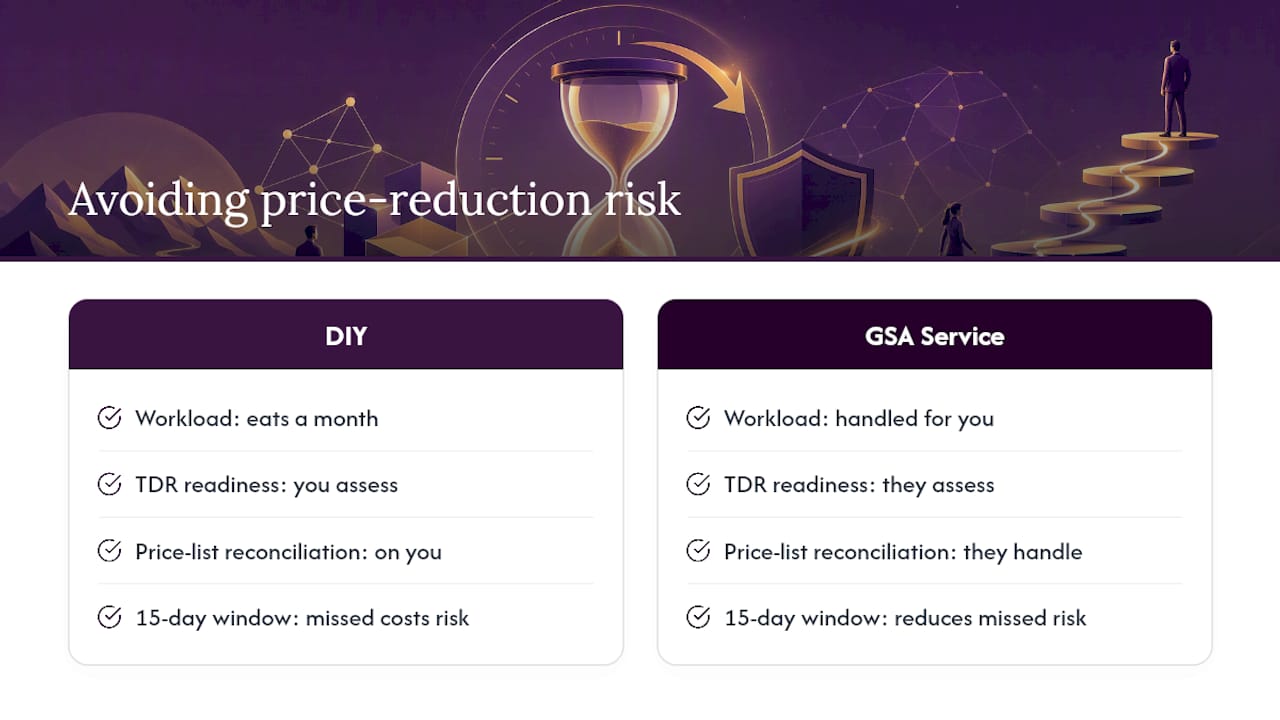
Reconciling a price list against 552.238-81 obligations, or figuring out whether a TDR modification actually removes your BOA tracking burden, is exactly the kind of detail work that eats a contract administrator’s month. Gsascheduleservices handles contract reviews, price-list reconciliation, and TDR readiness assessments for GSA Schedule holders who’d rather not learn the hard way what a missed 15-day window costs. That’s the concrete difference: instead of guessing whether your clause version still applies or building a notification workflow from scratch, you get someone who’s mapped this terrain before doing it with you.
If your BOA situation involves multiple SINs, a recent TDR transition, or a discounting structure nobody’s fully documented, book a discovery call and get a clear read on where your exposure actually sits.
Sources
- Acquisition
- 552.238–81 Price Reductions (PDF) | govinfo
- GSA expands transactional data reporting requirements | Husch Blackwell (HKLaw)
- Transactional Data Reporting requirements | GSA
- Most Favored Customer / Basis of Award | Vendor Support Center (GSA)
FAQ
What Are GSA Guidelines on Basis of Award?
GSA guidelines require the CO and contractor to agree on a BOA customer or category at award, then hold contractors to 552.238-81’s reporting and price-relationship rules for the life of the contract, unless the contract is under TDR.
What Is the GSA Award Schedule?
The GSA Award Schedule, often called the Multiple Award Schedule (MAS), is the long-term government-wide contract vehicle that lets federal buyers purchase commercial products and services from pre-vetted vendors at negotiated pricing.
What Is GSA in the U.S. Government?
GSA, the General Services Administration, is the federal agency that manages procurement infrastructure, including the Multiple Award Schedule program, so other agencies can buy goods and services without running a separate competition each time.
What Is GSA IT Schedule 70?
GSA Schedule programs for information technology were formerly structured separately but have since been consolidated into the single, unified MAS program covering IT alongside other categories.
How Is a GSA Contract Awarded?
A GSA contract is awarded after a Contracting Officer evaluates your proposal, negotiates pricing against your commercial sales practices, and sets your Basis of Award customer or category, at which point the contract, and your 552.238-81 obligations, take effect.
Recommended
- Schedule Contract Guide: How to Get a GSA Schedule Award
- The Basics of GSA Contract Schedule
- An Essential Checklist to Maintain Your GSA Schedule Contract
- A 3 Steps Guide to the GSA Contract Acquisition Process