

CPARS, or the Contractor Performance Assessment Reporting System, is the U.S. federal government’s platform for evaluating contractor performance. It impacts federal contracts by influencing source selection, past performance records, and a contractor’s competitive position for future awards. Ratings range from Exceptional to Unsatisfactory, and evaluations cover areas like technical quality, cost control, schedule management, and small business subcontracting.
Key Points:
- Evaluation Frequency: Annually and at contract completion.
- Rating Scale: Exceptional, Very Good, Satisfactory, Marginal, Unsatisfactory.
- Impact Duration: Ratings stay relevant for 3 years (or 6 years for construction/architect-engineer contracts).
- Contractor Response: 14 days to challenge or comment on evaluations.
Quick Table of Ratings and Their Impact:
| Rating Level | Impact on Future Contracts |
|---|---|
| Exceptional | Highest chance of securing awards |
| Very Good | Strong competitive advantage |
| Satisfactory | Meets minimum expectations |
| Marginal | Risk of losing future contracts |
| Unsatisfactory | Significant risk to future awards |
CPARS evaluations are critical for contractors aiming to secure federal contracts, as they shape how agencies assess reliability and performance. Contractors should prioritize clear communication, robust performance management, and thorough documentation to maintain strong ratings.
Full Walkthrough of CPARS in Realtime
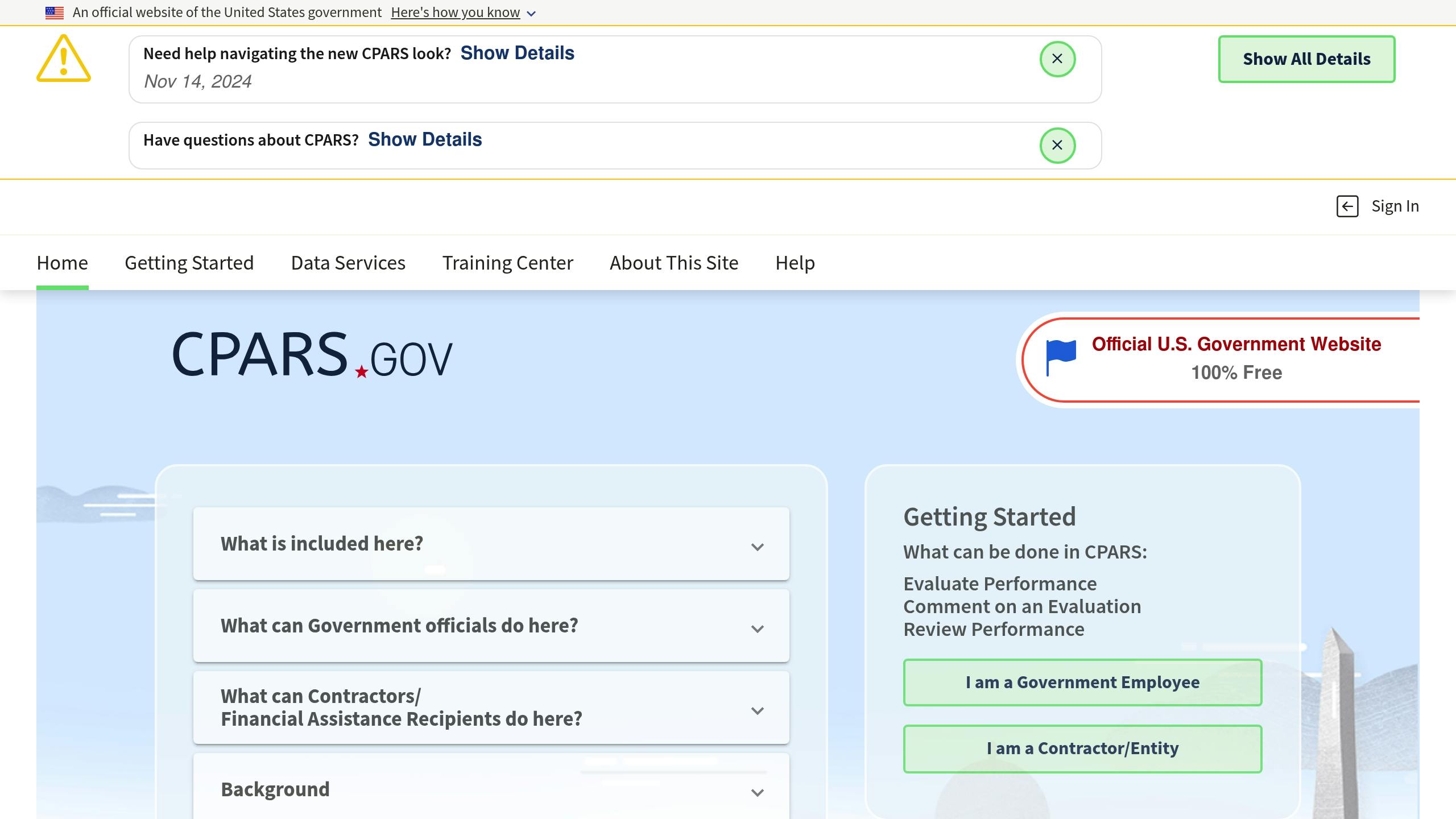
CPARS Evaluation Process
The CPARS evaluation process is carefully designed to record contractor performance throughout the contract lifecycle, providing a clear framework for assessment.
When Evaluations Happen
Evaluations take place annually during active contracts and again at contract completion. Contractors are notified one month before the evaluation period ends, with weekly reminders leading up to the evaluation. Agencies must complete the process within 120 days after the evaluation period concludes, which includes a 60-day window for contractor feedback . Each year, about 120,000 CPARS evaluations are conducted .
What Gets Measured
CPARS evaluations focus on key areas of performance that play a major role in a contractor’s ability to win future contracts. These areas include:
| Performance Area | Key Assessment Criteria |
|---|---|
| Technical Quality | Accuracy, completeness, and quality of work |
| Cost Control | Staying within budget and managing costs effectively |
| Schedule Management | Meeting deadlines and achieving milestones |
| Management | Resource usage and team oversight |
| Small Business | Meeting subcontracting goals |
Rating System Explained
CPARS uses a standardized rating scale to evaluate contractor performance, with each rating influencing potential future contract opportunities. The evaluation process relies on detailed documentation to justify the assigned ratings. Evaluators are required to include:
-
Narrative Assessment
A concise narrative that highlights specific examples of contractor performance. -
Performance Evidence
Concrete performance examples supported by measurable outcomes and compliance data. -
Supporting Documentation
Records such as project files, communication logs, and other relevant data to back up the ratings.
This structured and evidence-based process ensures CPARS ratings accurately reflect a contractor’s performance and reliability for future federal contracts.
Effects on Contract Success
CPARS ratings play a critical role in determining a contractor’s success in federal contracting. These evaluations heavily influence an agency’s decisions during source selection and future contract awards.
How Agencies Use CPARS Scores
Federal agencies use CPARS evaluations to gauge a contractor’s reliability and overall performance. Recent protest statistics highlight a growing emphasis on past performance in decision-making:
| Year | COFC Protest Decisions | GAO Protest Decisions |
|---|---|---|
| 2024 | 10 cases | 38 cases |
| 2023 | 16 cases | 52 cases |
| 2022 | 35 cases | 61 cases |
This data shows why improving performance consistently is crucial. Agencies are required to evaluate past performance for all contracts above the simplified acquisition threshold . These records can influence decisions for up to three years, and for construction contracts, up to six years .
Maintaining Good Ratings
Because CPARS scores are so influential, contractors need to consistently meet or exceed performance expectations. Here are some strategies to help maintain strong ratings:
-
Clear Communication:
- Stay in regular contact with government officials.
- Keep a record of key discussions and agreements.
-
Effective Performance Management:
- Monitor contract requirements closely and aim to exceed them.
- Address any issues quickly.
- Document all achievements thoroughly.
-
Strong Quality Assurance:
- Use strict quality control processes.
- Oversee subcontractors carefully.
- Record instances where performance surpasses expectations.
As outlined in FAR 42.15:
"To justify an Exceptional rating, identify multiple significant events and state how they were of benefit to the Government" .
Contractors have 14 days to respond to unfavorable ratings with comments, rebuttals, or additional details . A solid reputation in the federal contracting space depends on actively addressing any concerns and ensuring CPARS evaluations accurately reflect performance.
sbb-itb-8737801
Handling CPARS Reviews
Federal contractors need to pay close attention to their CPARS evaluations to stay competitive in government contracting. Knowing how the review process works and responding effectively can make a big difference in securing future opportunities.
Contractor Response Period
Contractors have 14 calendar days to review their ratings and comments, gather evidence, craft a concise, fact-based response, and submit it through the CPARS portal . Once the 14 days pass or a response is submitted, the evaluation becomes final. If you encounter challenges during this period, here’s how to handle poor ratings effectively.
Managing Poor Ratings
If you receive an inaccurate or negative rating, take action after the response period. For example, in October 2024, Michael M. Tsontos, S.A. Chania Sucursala Bucuresti challenged an incorrect CPARS evaluation from USACE, resulting in a re-evaluation order .
Start by reviewing the evaluation objectively. Then, gather evidence and submit a clear, well-documented rebuttal.
"Now, when submitting comments or rebutting statements, contractors should avoid the urge of going on the attack! It makes more sense to strike an objective and professional tone. Facts, coupled with persuasive argument, will garner more points with the contracting officer and the reviewing official." – Schoonover & Moriarty, LLC
Rating Disputes
If your initial response doesn’t resolve the issue, there are formal ways to escalate the dispute:
| Dispute Level | Action Required | Timeline |
|---|---|---|
| Initial Review | Submit comments in the CPARS portal | 14 days |
| Higher Authority | Request review above the contracting officer | After the initial response |
| CDA Claim | File a formal Contract Disputes Act claim | After higher review |
| Final Appeal | Appeal to a board of contract appeals or the Court of Federal Claims | After a CDA denial |
Act quickly and carefully during disputes to protect your standing for future contracts. Taking the right steps at the right time can help you navigate the CPARS process and maintain a strong position in government contracting .
Tips for Better CPARS Scores
Improving CPARS ratings involves a structured approach to managing contract performance and documentation. Federal contractors can boost their scores by focusing on tracking performance, maintaining open communication with Contracting Officers, and keeping thorough records.
Tracking Performance
Performance tracking systems can help you spot problems before they impact your CPARS ratings. At the start of a project, set clear success metrics – this is especially important for contracts without specific quality measures . Key performance areas to monitor include:
| Performance Area | Tracking Method | Documentation Required |
|---|---|---|
| Quality Standards | Daily quality checks | Inspection reports and customer feedback |
| Timeline Adherence | Milestone tracking | Schedule updates and delivery receipts |
| Cost Management | Budget variance analysis | Financial reports and cost savings data |
| Customer Satisfaction | Feedback sessions | Meeting minutes and correspondence |
Encourage project managers to log daily achievements, such as customer compliments or examples of exceptional work .
Working with Contracting Officers
After setting up effective performance tracking, focus on building strong relationships with Contracting Officers. Regular communication is key. Schedule performance reviews to discuss progress, address any issues early, and gather informal feedback. Use these meetings to present data that highlights your success and make sure to document all discussions and agreements.
Record Keeping
Good record keeping ties everything together. Pay close attention to these areas:
- Contract Deliverables: Keep detailed records of deliverables, including quality metrics, delivery dates, and customer acceptance.
- Communication History: Save all important correspondence and performance data to support your CPARS evaluation.
- Performance Metrics: Document specific examples where your team exceeded contract expectations. According to FAR 42.15:
"To justify an Exceptional rating, identify multiple significant events and state how they were of benefit to the Government" .
To ensure consistency, implement internal CPARS documentation processes . These practices not only help improve your CPARS ratings but also give you a competitive edge in federal contracting.
GSA Focus Services

GSA Focus Overview
GSA Focus assists small businesses in navigating federal contracting and improving CPARS performance. Their services include preparing necessary documents, monitoring compliance, and providing expert support throughout the entire contract process. With their systems, contractors can organize and maintain the documentation required for strong performance evaluations.
Contract Management Benefits
GSA Focus simplifies contract management with a focus on improving CPARS outcomes:
| Area of Focus | Impact on CPARS | How It Works |
|---|---|---|
| Documentation Systems | Keeps performance records complete | Uses automated tracking and reporting tools |
| Compliance Monitoring | Avoids negative ratings | Conducts real-time checks on requirements |
| Performance Tracking | Boosts ratings | Employs milestone-based assessment tools |
| Issue Prevention | Minimizes disputes over ratings | Implements an early warning system for potential issues |
CPARS Support
In addition to contract management, GSA Focus offers targeted CPARS support to help businesses maintain strong performance ratings. Their strategies focus on managing evaluations and preventing disputes, ensuring contractors can address concerns effectively.
Key elements of their CPARS support include:
- Conducting pre-evaluation assessments to uncover and resolve potential issues
- Utilizing systems that document performance to support positive ratings
- Providing expert advice during the 60-day comment period for rating challenges
"Before the initial performance evaluation is submitted, ask the evaluators about any potential issues or concerns", says Josh Ladick, founder of GSA Focus. He stresses the importance of proactive communication in safeguarding strong CPARS ratings.
Summary
CPARS is the federal government’s main system for evaluating contractor performance, with more than 120,000 evaluations carried out each year .
Here’s a quick recap of the key evaluation areas:
| Performance Area | Role in Rating | How Often Evaluated |
|---|---|---|
| Technical Quality | Assesses deliverables | At least once a year |
| Cost Control | Reviews budget management | Throughout the contract |
| Schedule/Timeliness | Tracks deadlines | Monitored continuously |
| Management | Evaluates team and resource use | Ongoing |
| Small Business Subcontracting | Checks compliance with terms | Per contract requirements |
Since 2015, fewer than 2% of contractors have received Marginal or Unsatisfactory ratings . This underscores the importance of maintaining a strong performance record.
To manage CPARS effectively, contractors should focus on consistent communication with agencies, documenting milestones and performance, and addressing any issues within the 14-day comment period . These steps are key to achieving positive outcomes and staying prepared for additional support when needed.
For contractors seeking extra help with CPARS management, services like GSA Focus can simplify compliance, streamline documentation, and make federal contracting easier. Their support ensures consistent performance ratings throughout the contract lifecycle.
Related Blog Posts
- Ultimate Guide To GSA Contract Performance Metrics
- Ultimate Guide to Marketing with Past Performance
- How to Monitor Performance Risks in GSA Contracts
- Regulatory Requirements for Federal Contracts